Photos from Palma de Mallorca
 +1
+1Castell de Bellverattraction
+1Current conditions and the practical reference material that helps turn the saved places into a trip.
7-day forecast from Open-Meteo. UV badges flag days when sun protection matters (3 and above is moderate; 8 and above is risk territory for unprotected fair skin within 30 minutes).
About 59% of the year's rain falls in these months. Typical highs around 19°C, lows around 17°C.
Typical highs around 25°C, lows around 22°C. About 21mm of rain a month.
Public holidays from Nager.Date.
Public-transit operators within 8 km of the city center. Click through to each operator’s site for routes, fares, and tickets.
Palma, also known as Palma de Mallorca, is the capital and largest city of the autonomous community of the Balearic Islands in Spain. It is situated on the south coast of Mallorca on the Bay of Palma. With a population of 438,234 as of 2024, it is the 8th-largest city in Spain.
The links below support the changing or licensed reference material on this page. Personal notes and ordinary geographic facts are not footnoted individually.
Monthly highs, lows, rainfall — long-term averages, NASA POWER.
Operators and modes are aggregated from individual transit-agency GTFS feeds. Route classifications come from each feed’s route type codes.
Maps, image licenses, and the full dataset registry are listed in site credits.
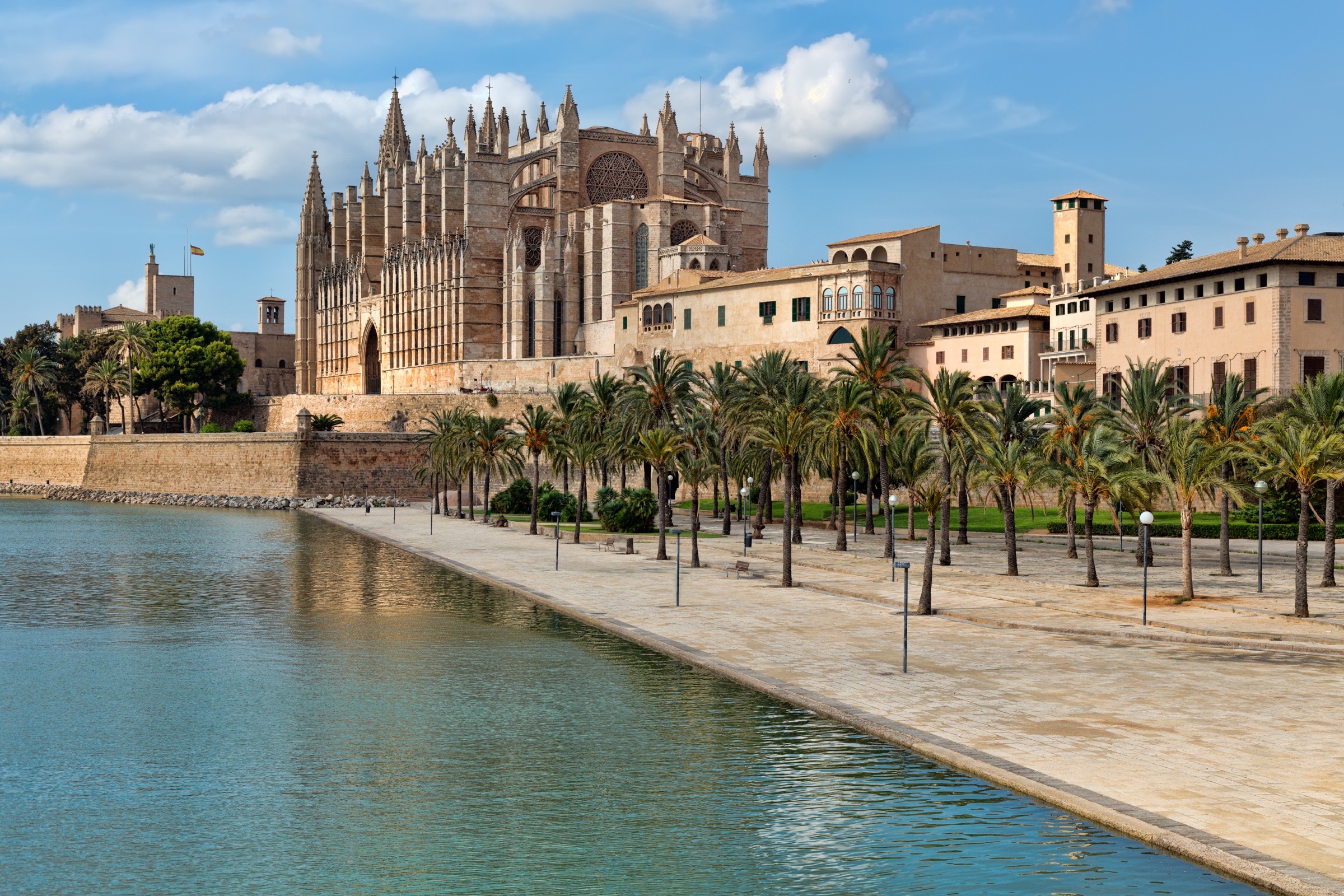
My Palma de Mallorca travel guide. La Seu, the old town, Bellver Castle, the airport bus, where to stay, and where to eat.
Palma
Palma is the capital of Mallorca. It has a huge Gothic cathedral on the waterfront, a walkable old town, and a strong restaurant scene.
Planning brief
Palma is the capital of Mallorca and the Balearic Islands. The city has a huge Gothic cathedral on the waterfront, a dense old town behind it, and a strong restaurant scene.
La Seu, the old town, Bellver Castle, and the waterfront make Palma a city in its own right.
La Seu rises above the old harbor and dominates the waterfront. Start there.
The old quarter behind the cathedral is the best base, walkable and full of restaurants. The seafront and marina are the alternative.
The Serra de Tramuntana, the train to Sóller, and the island's beaches are outside the city. Palma is the transport base for reaching them.
Palma de Mallorca Airport (PMI) sits about 8 kilometers east of the city. The A1 airport bus runs between the airport, the center, and the seafront. Taxis leave from the rank outside arrivals.
The airport is one of the busiest in Spain through the summer, so allow extra time on the way out. Inside Palma the center is walkable, and buses cover the rest.
Stay in the old town, the dense quarter of lanes behind the cathedral. It is the most walkable base, full of restaurants and small squares, and central to everything in this guide.
The seafront and marina area is the alternative, with sea views and easy airport-bus access.
Palma Cathedral, known as La Seu, is the landmark, a vast Gothic cathedral rising above the seafront. Antoni Gaudí worked on its interior in the early 20th century. It is the right place to start.
Beside it stands the Royal Palace of La Almudaina, the old Moorish-built fortress-palace still used for state occasions. The old town behind them is a walkable maze of patio houses, courtyards, and small squares, with the leafy Passeig del Born as its main avenue and the small domed Arab Baths a surviving trace of the Moorish city. Above the city, the round Bellver Castle is an unusual circular Gothic fortress with a wide view over the bay.
Palma is the main transport base for the rest of Mallorca. The Serra de Tramuntana, the UNESCO-listed mountain range along the northwest coast, includes the stone village of Valldemossa and the harbor town of Port de Sóller. The wooden train to Sóller leaves Palma and crosses the mountains to Sóller. Mallorca's beaches and coves are spread around the rest of the coast.
Palma eats on Mallorcan cooking: the spiral ensaïmada pastry, pa amb oli bread with oil and toppings, island seafood and rice dishes, and a growing modern restaurant scene in the old town.
| Spot | What it is |
|---|---|
| Arroceria el Puente | A rice and paella specialist |
| Bar España | A Spanish bar and tapas spot |
| FABRICK food & more | A casual all-day spot |
| KOH | Thai and Asian |
| HEMUDU | Asian |
| Santosha | A casual restaurant |
