Bali, and which base is actually right for your trip
My Bali travel guide. Which base fits which trip, from Seminyak's beach clubs to Canggu's surf to Ubud's inland temples.
- Updated
- May 12, 2026
Current conditions and the practical reference material that helps turn the saved places into a trip.
7-day forecast from Open-Meteo. UV badges flag days when sun protection matters (3 and above is moderate; 8 and above is risk territory for unprotected fair skin within 30 minutes).
About 74% of the year's rain falls in these months. Typical highs around 28°C, lows around 24°C.
About 60mm of rain a month, against 235mm in the wet season.
Public holidays from Nager.Date.
Bali is an Indonesian island and province and the westernmost of the Lesser Sunda Islands. East of Java and west of Lombok, the province includes the island of Bali and a few smaller offshore islands, notably Nusa Penida, Nusa Lembongan, and Nusa Ceningan to the southeast. The provincial capital, Denpasar, is the most populous city in the Lesser Sunda Islands and the second-largest, after Makassar, in Eastern Indonesia. The Denpasar metropolitan area is the extended metropolitan area around Denpasar. The upland town of Ubud in Greater Denpasar is considered as Bali's cultural centre. The province is Indonesia's main tourist destination, with a significant rise in tourism since the 1980s, and has become the country's area of overtourism. Tourism-related business makes up 80% of the Bali eco
The links below support the changing or licensed reference material on this page. Personal notes and ordinary geographic facts are not footnoted individually.
Monthly highs, lows, rainfall — long-term averages, NASA POWER.
Maps, image licenses, and the full dataset registry are listed in site credits.
My Bali travel guide. Which base fits which trip, from Seminyak's beach clubs to Canggu's surf to Ubud's inland temples.
Bali gets mis-planned more than almost anywhere, because the images people come for, the rice terraces, the surf breaks, the cliff pools, live in three different parts of an island that take real time to cross. The one decision that shapes the whole trip is where you base. Here's how I'd pick.
Planning brief
Bali is really three or four trips, depending on which corner of the island you base yourself in. Seminyak is the beach-club-and-pool-deck version with the most polished dining and the most expensive rooms. Canggu twenty minutes north is the surf-and-café version with the digital-nomad crowd and the more relaxed pace. Ubud an hour inland is the temple-and-ridge-walk version with the cooler air and the rice-terrace view. The important planning decision is whether to use one base or move between the coast and Ubud rather than pretending they are the same trip. The map below carries the curated pin set that earlier four sub-region lists were consolidated into in May 2026. This writeup covers the bases and the rhythm.
Most trips work as Ubud-plus-coast rather than one base for everything. The drive between Ubud and Canggu is about an hour with traffic. You can pivot mid-trip rather than commute every day.
Seminyak is the polished resort-and-beach-club version. Canggu is the surf-cafés-and-rice-fields version, more casual, more breakfast bowls, more digital nomads. Same coast, twenty minutes apart, different trips. Both share the same airport (DPS) and the same general weather.
An hour inland from the coast, about 200 meters higher, noticeably greener. Sacred Monkey Forest, the Campuhan Ridge Walk before breakfast, the Saraswati water temple. The rice-terrace and waterfall routes require drives beyond central Ubud, so choose the base with those transfers in mind.
Potato Head, Finns, La Brisa, Café del Mar, COMO, Tropicola, Ku De Ta. Each is a full-day commitment with a pool deck, a DJ, drinks, lunch, sunset. You do not bar-hop them. Pick one or two for the whole trip.
The three bases this list is built around are Seminyak, Canggu, and Ubud, and those are the three the main sections below cover. The broader set of bases that the island actually offers is wider. A second or third Bali trip pulls from the table below.
| Base | What it is good for | The trade-off | Distance from DPS |
|---|---|---|---|
| Ubud | Rice fields, temples, art markets, dance, yoga, slower mornings | Inland. Beach days require a drive | 90 to 120 minutes |
| Canggu | Surf, cafés, longer stays, remote work | Traffic has become part of the experience | 45 to 75 minutes |
| Seminyak | Restaurants, boutiques, beach access | Polished, pricey, heavily touristed | 30 to 45 minutes |
| Sanur | Families, calm water, a walkable beach path | Quieter at night. Under-rated for a first visit | 25 to 35 minutes |
| Nusa Dua | Resort comfort and low-friction beach days | Gated and detached from daily Balinese life | 15 to 25 minutes |
| Uluwatu | Cliffs, surf breaks, temple sunsets | Spread out. You need transport for everything | 45 to 70 minutes |
| Jimbaran | Seafood dinners on the sand, calmer beach, airport convenience | Closest beach base to the airport and useful for early departures | 20 to 30 minutes |
| Amed / Sidemen / Lovina | Slower east and north Bali. Black sand, snorkelling, rice-terrace walks, weaving workshops | Too far for a rushed first visit. Save for a longer second trip | 2.5 to 3.5 hours |
The coast and Ubud work as separate bases. Private-car transfers usually take 60 to 90 minutes in ordinary traffic, so the decision is whether to move once or accept repeated drives.
For a first trip, Sanur is also under-rated as the coast pick if calm water and a flat beach path matter more than the beach-club style. Nusa Dua is sometimes exactly the right answer (low-friction beach reset) and sometimes the wrong version of Bali entirely (gated, separated from the rest of the island). Know which trip you are taking before you book it.
Most travelers arrive at Ngurah Rai International (DPS), south of the Kuta beach area. Pre-booked car or hotel pickup is the cleanest move. The local rideshare apps (Grab, Gojek) work across most of the island but are sometimes blocked from operating at the airport itself. The pickup usually happens at a marked lot a short walk outside arrivals.
Visa on arrival for most nationalities is currently US$35 for 30 days, payable at the immigration desk in cash or card on arrival. The e-VOA option pre-arrival speeds the queue. Customs declarations are now electronic via the QR code at the kiosks before baggage claim.
A note on the airport-to-Ubud transfer: at 90 to 120 minutes (longer in bad traffic), this is the longest of the three transfers and the one most travelers wish they had factored in. Land at DPS in the evening and book the first night somewhere on the coast (Seminyak is the closest 4- or 5-star cluster). Save the Ubud leg for the morning.
A few cultural details that matter on arrival. Small woven offerings of flowers, leaves, and incense (canang sari) sit on sidewalks, thresholds, and in shrines across the island. Step around them rather than over them. Take your shoes off when you enter a home or a temple. Carry a sarong or light scarf for temple visits. Many sites loan one at the entrance but bringing your own is the easier move. The point isn't to perform reverence perfectly, only to avoid treating the island as a backdrop. The other practical note: Indonesian drug laws are severe. Do not pack anything ambiguous, do not accept anything from strangers in the airport queue, and do not be casual about what is in your luggage. The penalties are real and not negotiable.
Pack light. Laundry is cheap and quick everywhere on the island, often same-day or next-day through your hotel or any street-side laundry. A capsule of warm-weather clothes plus a layer for cooler Ubud evenings is more practical than overpacking for an island that does laundry on every block.
The set Mike has used is below. The wider strip beyond these picks includes most of the international 5-star brands in Seminyak (W, Mandarin Oriental, Alila Seminyak, the St Regis at the south end), so this is the curated rather than the comprehensive list.
| Where | Property | Why pick it | Trade-off |
|---|---|---|---|
| Seminyak | Hotel Indigo Bali Seminyak Beach | IHG mid-band on the Seminyak beach side. Pool deck, walk to most of the Seminyak dining list and a couple of the beach clubs | A modern resort property rather than a boutique. The design is the IHG-Indigo standard. Fair value vs the higher-end Seminyak hotels |
| Canggu | Various small properties + villas | Canggu runs on small boutiques, surf-stay villas, and apartment rentals rather than big hotels. The villa market is the better answer here for stays longer than three nights | No single anchor pin yet. Pick by dates. Berawa for the beach-club proximity, Echo Beach for the surf, Pererenan for the slightly less crowded edge |
| Ubud | Various inland boutique hotels and villas | Ubud is the part of Bali where small inland boutiques (Bisma Eight, Mandapa, Como Shambhala for the luxury end) are the natural booking. Tegallalang has rice-terrace-view villa rentals if you want to pay up for the view | Same caveat as Canggu. Pick by dates and budget |
For Seminyak there is one pinned hotel here and it is the IHG. The Canggu and Ubud sets are richer on dining and sights than on lodging at the moment, and the rental-villa market in both areas is the more productive search outside the pinned set.
Seminyak is the polished face of South Bali. The eight blocks between Jalan Petitenget and Jalan Kayu Aya carry most of the big-name beach clubs: Potato Head Beach Club, KU DE TA, SugarSand, and MADE Beach Bar. The dining strip on Jalan Kayu Aya runs through La Favela, The Plantation Grill, Bo & Bun, and Jaansan. The Seminyak Art Market and Seminyak Village cover the shopping side. Kuta Beach is the longer beach immediately to the south for an unbothered swim. The Hard Rock Cafe is on the Kuta side and is the predictable family stop.
Seminyak links hotel breakfasts, reserved beach-club daybeds, sunset on the loungers, and dinner on Jalan Kayu Aya.
Canggu is the more relaxed coast option and the one most digital-nomad pieces are about. The strip runs north from Berawa through Batu Bolong to Echo Beach and Pererenan, with the most concentrated beach-club row in Berawa: Finns Beach Club, La Brisa Bali, Café del Mar Bali, COMO Beach Club, The Lawn. The breakfast set (The Avocado Factory, Funky Pancakes) is the morning surface. Canggu Beach is the surf strip itself, with breaks at Echo Beach and Berawa Beach for intermediate and beginner riders respectively.
Canggu has urbanized rapidly since 2018. The rice fields have shrunk, traffic on the Jalan Pantai Berawa main artery is real, and the digital-nomad density has reshaped the rhythm. It's still the relaxed-coast version of Bali, just no longer the sleepy beach village the older guides describe.
Ubud is the inland Bali. About an hour and a quarter north of Canggu, 200 meters higher in elevation, noticeably cooler and greener. The town center is small and walkable. The main sights cluster within a fifteen-minute radius:
For meals, Restaurant Locavore is the formal-modern-Indonesian booking and the dinner most Ubud planners save a slot for (reserve weeks ahead). Herb Library Bali is the lighter spa-cuisine version.
The rural day-trips out of Ubud are the rest of the Ubud stay: the Tegallalang rice terraces 20 minutes north, the Tegenungan Waterfall 30 minutes south, the Tirta Empul water-purification temple 40 minutes north, the Gunung Kawi rock-cut shrines next door. None of those are pinned in this list yet. Flagged in the authoring notes for a later expansion.
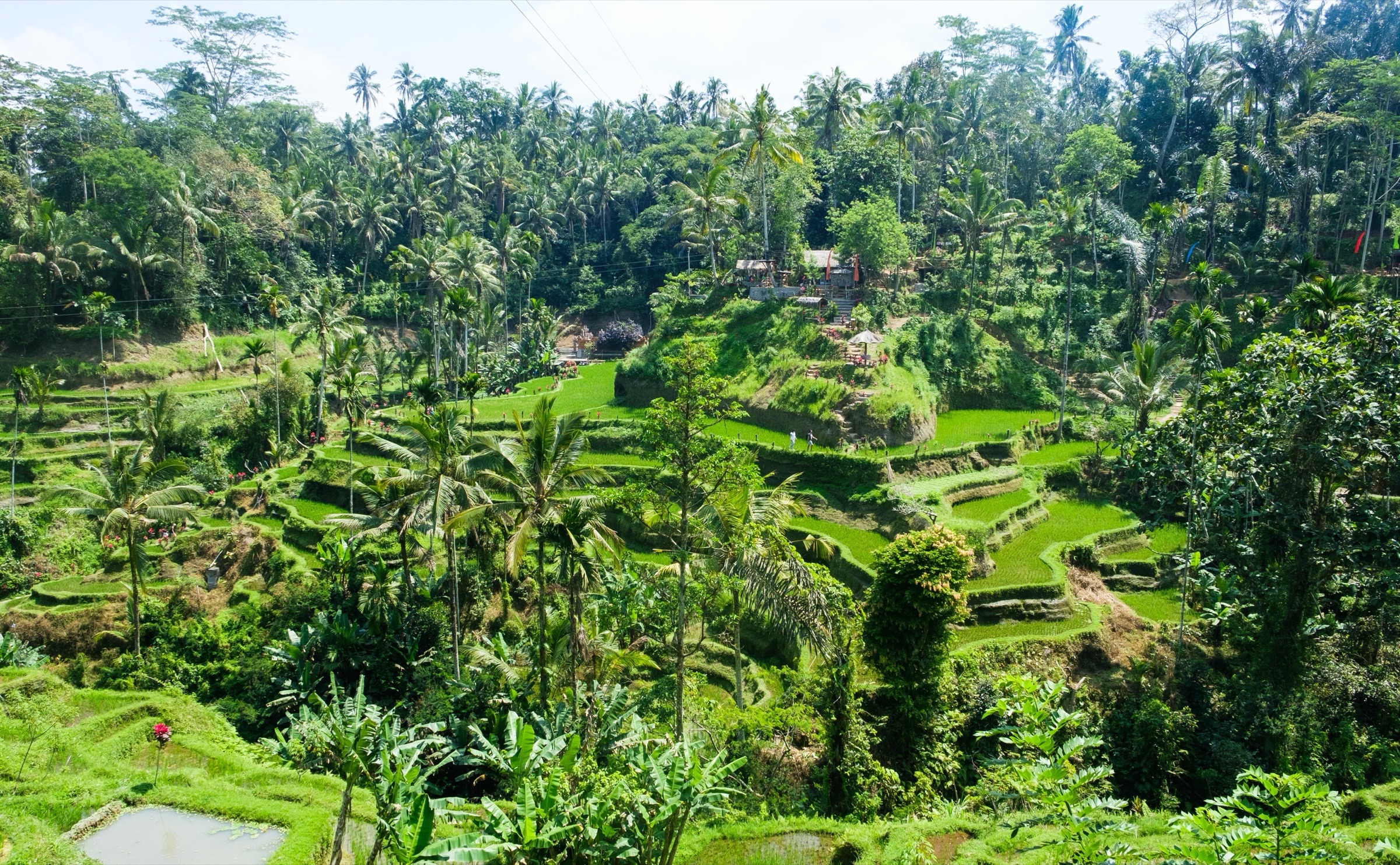
The terraces read better if you think of them as working irrigation landscape rather than only a photograph. Bali's subak system links water, fields, temples, and farmer obligations into a single cooperative structure dating back over a thousand years. UNESCO listed it in 2012. You do not need a technical lecture to see the difference. Once you notice the channels, the small concrete weirs, and the field edges, the terraces stop being only a view. After harvest you may also see ducks moving through the paddies. Farmers use them to eat pests, disturb the soil, and fertilise the fields. A slow morning walking the field paths past those details is a better use of Ubud than chasing three more famous stops.
A note on the cultural performances Ubud is famous for. Most evenings the Ubud Palace courtyard hosts a Legong dance show. Smaller venues across town run Kecak (the seated-chorus dance-drama built around the repeating "cak-cak-cak" vocal pattern) and gamelan ensembles. Gamelan is the Balinese percussion tradition built around metallophones, gongs, drums, and interlocking rhythmic figures. You can listen without knowing the theory and the easiest thing to notice is how fast repeating patterns sit inside slower gong cycles. One show is plenty for most travelers. Two if you want to compare the registers.
The Bali beach club is its own format. A daybed or pool-deck reservation runs a deposit (typically Rp 500,000 to 2,000,000 per person depending on the venue and the day), which becomes a food and drink credit. You arrive late morning or at lunch, eat, swim, drink, lounge through the afternoon, and stay for sunset. The full day is the format. You do not bar-hop them.
A reasonable shortlist by base:
Reservations are essential weekends and in peak (July, August, the December-January period). Midweek in the shoulder months you can walk in but the better daybeds will be gone by lunch.

Two temples make sense at sunset if your trip has time for either. Tanah Lot is the offshore rock temple on the southwest coast about 45 minutes from Canggu, photographed everywhere and crowded by late day. Uluwatu Temple sits on the cliffs of the Bukit peninsula and adds the evening Kecak performance the cultural-performance section above touches on. Pair the two if you base near Uluwatu.
A few things on the island that look like easy add-ons but reward saying no to:
Bali is not Cairo. It's safer, friendlier, less aggressive. But a few patterns recur, and knowing them in advance helps.
None of this should keep anyone from going. Bali stays one of the easier first-international destinations for an American traveler. Knowing the shapes above just means you don't pay the visitor tax on top of the normal one.
The dry season runs May to October. The rainy season runs November to April, with the heaviest rain in January and February. Bali stays warm year-round, so rain is the planning variable, not temperature.
The easiest shoulder windows are April-May and September-October. July-August and late December to early January are the price peaks. November and February-March are the wettest stretches.
Bali runs on the Balinese Hindu calendar plus a few civic dates. The one date you must check before booking is Nyepi, when the whole island stops.
| Event | When | What it changes |
|---|---|---|
| Nyepi (Day of Silence) | A day in March, varies by year | Airport closed, no traffic, no leaving the hotel for 24 hours. Do not schedule arrival or departure on this day |
| Galungan and Kuningan | 10 days, twice per Western year | Streets fill with decorated bamboo penjor. The island looks different without the full shutdown of Nyepi |
| Bali Arts Festival | Mid-June to mid-July | Daily dance, gamelan, and craft programming in Denpasar. Useful if your trip already sits in June or July |
| Ubud Writers and Readers Festival | Late October, five days | Ubud hotels fill for panels, workshops, and literary events |
| Ubud Food Festival | Late May, three days | Smaller sister event to the writers festival, built around food talks, demos, and dinners |
| Village temple anniversaries | Variable | Ask your hotel or driver if an odalan is happening near your base |
If your dates include Nyepi, confirm food, water, and basic hotel service before you arrive. A beach club day is not an option.


