Photos from Cairo
 +3
+3Historic Cairoattraction
+3Current conditions and the practical reference material that helps turn the saved places into a trip.
7-day forecast from Open-Meteo. UV badges flag days when sun protection matters (3 and above is moderate; 8 and above is risk territory for unprotected fair skin within 30 minutes).
Typical highs around 37°C, lows around 21°C. The drier end of the year.
Typical highs around 20°C, lows around 7°C. Most of the year’s greyest, wettest weeks.
Public holidays from Nager.Date.
Public-transit operators within 8 km of the city center. Click through to each operator’s site for routes, fares, and tickets.
Operators and modes are aggregated from individual transit-agency GTFS feeds. Route classifications come from each feed’s route type codes.
Cairo is the capital and largest city of Egypt and the Cairo Governorate. It is home to more than 9.8 million people. It is also part of the largest urban agglomeration in Africa, the Arab world, and the Middle East. The Greater Cairo metropolitan area is one of the largest in the world by population with over 22 million people. Areas of what would become Cairo were inhabited from pre-dynastic and early-dynastic ancient Egypt c. 6000 years ago, as the Giza pyramid complex and the ancient cities of Memphis and Heliopolis are today within the city.
The links below support the changing or licensed reference material on this page. Personal notes and ordinary geographic facts are not footnoted individually.
Monthly highs, lows, rainfall — long-term averages, NASA POWER.
Maps, image licenses, and the full dataset registry are listed in site credits.
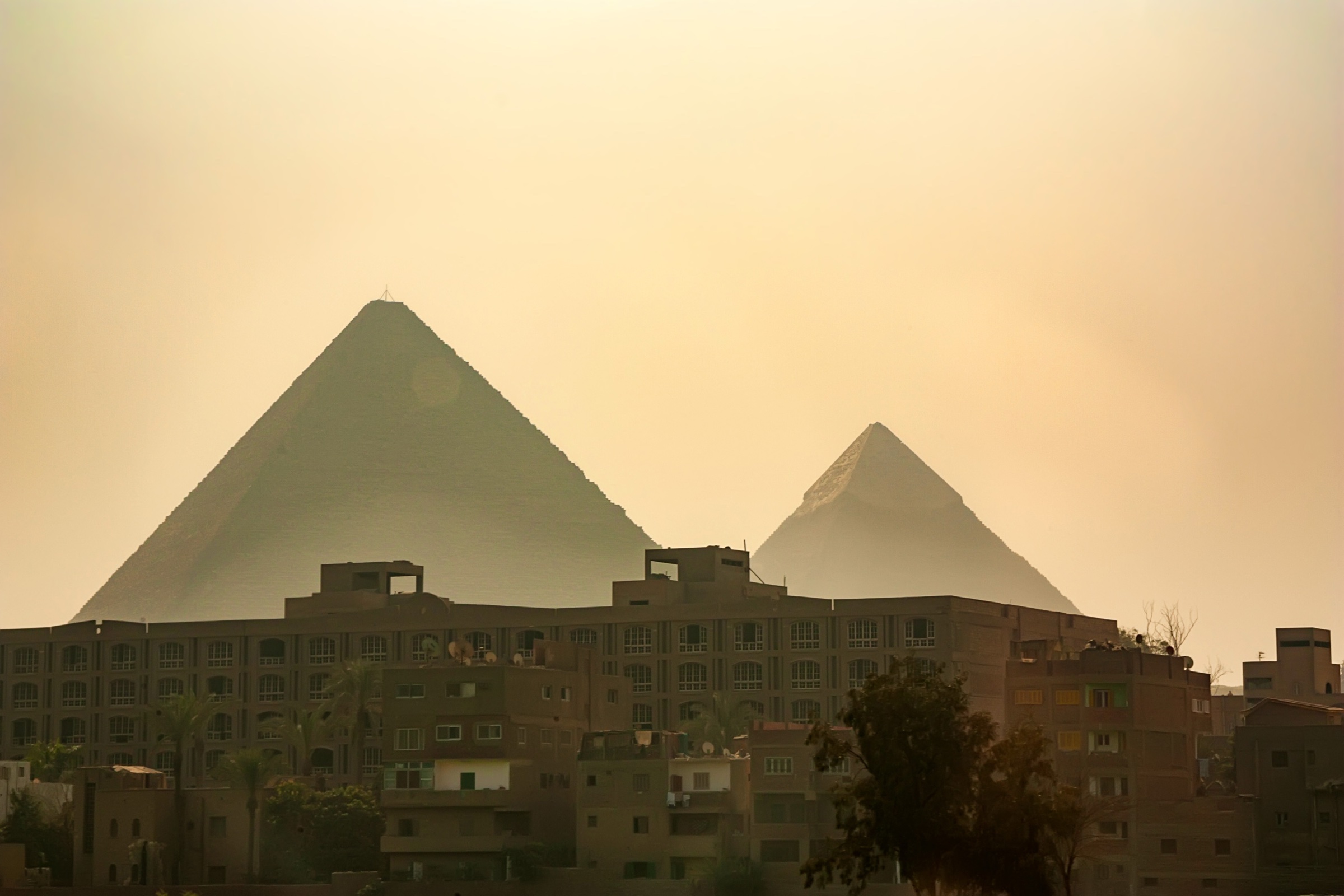
My Cairo travel guide. The airport hotel on points, where to stay in Giza, doing the pyramids DIY, and the scams to know going in.
Cairo asks more of you than most cities: 22 million people, three thousand years of history layered on the streets, and real hustle at the pyramids. I don't book tours, so these are my DIY notes, an airport hotel on points, an Uber to the plateau gate at 7 a.m., the Grand Egyptian Museum after the heat. Go anyway. Few cities give back more.
Planning brief
Cairo is the Egyptian capital and one of the largest cities in the world. 22 million people in the metro area, traffic at all hours, three thousand years of layered history, and a constant low-level hustle on any visitor-facing surface. The pyramids are 30 kilometers from the main airport. The Grand Egyptian Museum opened its full collection in 2024. The food is cheap and good. This guide covers the arrival, where to stay, the pyramids DIY, and the scams you will run into.
Le Méridien Cairo Airport connects to Terminal 3 by a jetbridge. Clear customs, walk five minutes indoors, you are in your room. I paid 17,200 Marriott Bonvoy points per night, which is one of the best points-per-night plays in the program. Pool, bar, and breakfast are decent. Platinum upgrades land cleanly. The right answer for any late or red-eye arrival.
Sphinx Airport (SPX) on the Giza side has far fewer flights than CAI, but Turkish Airlines runs Istanbul, and a handful of European carriers fly in. If your Cairo trip pairs with Istanbul or a European hub with a direct route, SPX puts you on the pyramids side of the city without crossing town in 60-90 minutes of traffic.
The Hyatt Centric West Cairo and the Hyatt Regency across the street are usually the same price or points value. Suites at the Centric have lots of room. The "pyramids view" only works on clear-sky days, and a telephoto lens helps. If you want a real pyramids view, the Marriott Mena House is around the corner and almost always more expensive for that reason.
Drivers accept the trip on the app, then ask for cash and a higher number once you are in the car. Set the Uber payment method to cash before your first ride. Carry the app fare in small EGP notes. Screenshot the in-app price at the start of every trip. None of this is personal. It is how the system runs in Cairo.
From the Hyatt the drive is 20 minutes, plus 10-15 minutes for the Uber to reach you. Call the car around 7 a.m., buy tickets at the kiosk as they open at 8, walk in before the tour groups arrive. By 10 the heat is overbearing in early April. There is no shade on the plateau.
Cairo has two airports visitors should distinguish.
Cairo International (CAI) sits 22 kilometers north-east of central Cairo and 30 kilometers north-east of Giza. This is where most international flights land. The arrivals hall is the densest tout environment in the country. Taxi drivers and tour operators fill the space the moment you clear customs, and Uber drivers will frequently accept the trip on the app and then ask for cash once you are in the car.
Sphinx International (SPX) on the Giza side has far fewer flights, but the location is the trade. Turkish Airlines runs Istanbul, and a small group of European carriers fly in directly. If your Cairo trip pairs with Istanbul or one of the European hubs that flies SPX, you land already on the pyramids side and skip the 60-90 minute cross-town traffic to Giza. Check current routes before you book. The list shifts.
The single best decision for a late or red-eye arrival into CAI is to skip the city transfer entirely.

Le Méridien Cairo Airport connects directly to Terminal 3 by a jetbridge. You walk from immigration to the hotel on the secure side of the airport. No exit doors, no curbside taxi line, no shouted prices. I paid 17,200 Marriott Bonvoy points per night, which is one of the better points-per-night plays in the program for an actual functional 4-star with a jetbridge to the terminal. Pool, bar, and breakfast are all decent. Platinum upgrades land cleanly. Cash rates run in the $150 to $250 USD range, so on points this is a real deal.
| Mode | Time | Cost | When to use |
|---|---|---|---|
| Le Méridien Cairo Airport overnight | 5-minute indoor walk | 17,200 Marriott points or $150-250 USD cash | Late or red-eye arrival into CAI |
| Uber to the city | 45-75 min to central Cairo, 60-90 min to Giza | 200-400 EGP shown in-app. Drivers push for more in cash | Rested daytime arrival. Have small EGP notes ready and set the Uber payment to cash before you leave the hotel |
| Pre-booked hotel transfer | 45-90 min | 600-1,200 EGP | Driver waits at arrivals with a name board. Lowest-friction option for a first trip |
| Airport taxi from the rank | 45-90 min | "Quoted" 500-1,500 EGP after negotiation | Last resort. Agree the price in writing on a phone screen before you load luggage |
| Sphinx Airport (SPX) Uber to Giza | 15-30 min | 80-200 EGP in-app | If your inbound flight is on a carrier that uses SPX (Turkish, certain European routes), this skips the cross-town transfer entirely |
For arrivals at a normal hour into CAI, Uber straight to your city hotel works. Open the app before you walk out, have small Egyptian pounds in hand, treat the cash push as the standard negotiation. It is not a personal slight.
The Cairo Metro is cheap and useful when both ends line up, especially for crossing the core without sitting in traffic. It does not reach the airport or the pyramids, so plan a car for those.
Line 2 gets you toward Giza/Cairo University territory, but the pyramid plateau is still a car ride. Line 3 is the newer piece that finally makes more east-west trips practical after years of construction sites. Use station tickets for one-off rides or the metro cash-wallet card if you expect repeated rides.
Two real bases for most first trips. Giza or the 6th of October corridor if the pyramids are the reason you came. Zamalek or Garden City on the Nile islands if the city itself is the reason. The airport hotel covers the arrival and departure ends of the trip but is not where you base for the days in between.
| Where | Property | Why pick it | Trade-off |
|---|---|---|---|
| Airport (Terminal 3) | Le Méridien Cairo Airport | Jetbridge to Terminal 3. The one-night fix for a hard CAI arrival. 17,200 Bonvoy points a night. Platinum upgrades land reliably | Use it for the arrival or departure ends, not as the city base |
| Giza / 6th of October | Hyatt Centric West Cairo | 15 minutes from the pyramid plateau in the morning, away from central Cairo traffic in the evening. Suites have lots of room | The "pyramids view" works only on clear-sky days, and a telephoto lens is required for the shot. A 30 to 60-minute Uber to anything in the city. The dining radius is the hotel and a couple of nearby places |
| Giza / 6th of October | Hyatt Regency West Cairo | Across the street from the Centric, usually the same price or points value. Pick on availability and which property has the suite upgrade on the day | Same trade-offs as the Centric. The two are interchangeable |
| Giza, plateau-adjacent | Marriott Mena House | The actual pyramids-view property. The garden looks straight at Khufu. If you wanted to splurge on one Cairo hotel, this is the one | Almost always more expensive than the Hyatts, sometimes by a wide margin. The view is the entire premium |
| Heliopolis | Holiday Inn Cairo Citystars | Value pick on the airport side of the city, attached to Citystars Mall. Easy access to both the airport and central Cairo on the Salah Salem highway | A business hotel attached to a mall. Book it for the price and the convenience, not the atmosphere |
| Zamalek / Garden City | Sofitel Nile El Gezirah, Four Seasons Nile Plaza, Kempinski Nile, Grand Hyatt Cairo | The Nile island bases. Walking to the older Egyptian Museum, the cafés of Zamalek, the restaurants of Garden City | More expensive. The traffic and noise are real. The city does not sleep on this side of the river |
The Hyatt Centric and Hyatt Regency are the workhorse Giza bases for a points-driven first trip. Same neighborhood, same value, swap on availability. The Marriott Mena House is the splurge pick if the actual pyramids view from your room is the reason you came. For a longer Cairo stay or a second trip, Zamalek or Garden City puts you next to the rest of the city, at the cost of more traffic and noise.
Uber covers all of Cairo and Giza and is the default for getting around. Two things to know before your first ride.
The first is that Cairo Uber operates in a hybrid card-and-cash market that is unlike how Uber works in the US or Europe. The second is that the cash push is the system, not the individual driver. A few practical rules make every ride cleaner.
Set the Uber payment method to cash before your first Cairo ride. The app shows the fare, you pay the driver in Egyptian pounds at the destination. Card payment "works" on paper, but a meaningful fraction of drivers will tell you the card system is down once you are in the car and ask for cash anyway. Setting cash as the default skips that negotiation entirely.
Carry the right denominations. Have the app-quoted fare in small EGP notes before you get in. 50 and 100 EGP notes are the workable bills. Trying to pay a 200 EGP ride with a 500 EGP note that the driver "cannot break" is the most common renegotiation moment.
Screenshot the in-app fare at the start of every ride. If the driver tries to add a "traffic surcharge" or quotes a higher number at the destination, the screenshot ends the conversation. Pay the app fare, leave a few pounds tip if the driver was helpful, get out.
For longer pyramid or museum days, hire a driver. Most hotels can arrange a private car-and-driver for 8 to 12 hours for $50 to $90 USD. You skip the per-ride negotiation entirely. The driver waits while you tour, then drops you back at the hotel.
The Cairo Metro exists and is cheap (a few EGP per ride), but it is not a visitor's tool. It does not reach Giza, the lines are crowded, and the English signage is patchy. Skip it for the trip.
If you are like me and dislike following a guide and would rather read the Wikipedia article and show yourself around, the Giza plateau works fine as a DIY visit. You are not going to learn less than a tour group does in 90 minutes. The information about every pyramid, queen, and dynasty is online in more depth than any guide will offer, and the site itself is easy to walk.
The Giza Plateau has two entrances. The lower entrance is at the Sphinx end near the Mena House and the old village of Nazlet El-Semman. This is where every tour group starts, and it is the densest sales-pitch zone on the plateau. The upper entrance on Fayoum Road sits at the top of the plateau near the Pyramid of Khufu and is the quieter way in.
The plan: Uber to the upper gate to arrive at 8 a.m. opening, buy your ticket at the kiosk, walk the loop downhill, finish at the Sphinx and the café there.
On the scale. If you have been to the Mexican pyramids or especially somewhere like Angkor Wat, you may be disappointed in how compact the Giza plateau actually is. The main walking route across the plateau is only a couple of kilometers. You can do it in about an hour without rushing. The photos do not capture how close together the three Giza pyramids stand, on a relatively small piece of ground. The scale is in each individual pyramid, not in the spread of the site.
On the heat. Get there early. There are no trees, no shade structures, and the sand reflects the sun. Even in early April the heat was overbearing by 10 a.m. and we left for the Grand Egyptian Museum. In June through September the practical window closes by 9 a.m. Bring water, a hat, sun protection in any month, and a small bag with the essentials.
The pyramid plateau is the densest scam environment I have hit as a traveler. None of these are unique to Cairo, but the volume is. Knowing the patterns going in lets you pleasantly say no without breaking your stride.
None of this is personal, and none of it changes how good the pyramids are once you are inside. Knowing the patterns going in is what keeps the visit pleasant.
Three other half-day stops round out a trip.

The Grand Egyptian Museum (GEM) opened its full collection in 2024. The entire Tutankhamun trove, more than 5,000 artifacts from the 1922 tomb, is now displayed in one place for the first time. The grand staircase, the atrium, and the design of the building put it among the better museums in the world. Allow four to five hours.
Two practical notes. First, book the timed ticket online before your visit. If you arrive without one you will sit on a QR-code queue in the sun outside the visitor office, with only a small patch of shade nearby. Second, the GEM is walkable from the pyramids on the new pedestrian walkway that opened with the museum, or it is a $3 to $4 Uber. If you finish the plateau at 10 or 11 and the heat is too much, take the Uber to the museum. The Bittersweet GEM café inside the museum is a fair lunch stop.
The Saladin Citadel is the 12th-century fortress on Muqattam Hill above central Cairo. The Mosque of Muhammad Ali (the alabaster mosque) sits at its center, with views over the city from the ramparts. Half a day with the National Police Museum, the smaller Sulayman Pasha mosque, and the view. Modest dress for the mosque, shoes off at the entrance.
Coptic Cairo (Old Cairo) is the cluster of early-Christian churches at the southern edge of the medieval city. The Hanging Church, the Saint Sergius and Bacchus Church (where the Holy Family is said to have rested during their flight to Egypt), the Coptic Museum. A quieter, slower visit than the pyramids. Two hours covers the cluster on foot.
If you have an extra day, the Heliopolis neighborhood has colonial-era Belle Époque architecture and the Baron Empain Palace. A smaller-scale aside that most visitors never reach.
Cairo is easiest from November to March, when daytime temperatures sit around 18 to 25°C and the desert visits are comfortable. December and January are busier because they overlap with US and European winter holidays.
April-May and October are warmer shoulder months. Go early for the pyramids and move indoors by late morning. I went in early April and the plateau was already overbearing by 10 a.m.
June through September is hard work. Temperatures regularly clear 35°C and can hit 40°C. If this is your window, book a hotel with a real pool and keep the pyramid day to sunrise through 9 a.m.
Ramadan moves earlier by about 11 days each year. Daytime food service and opening hours shift, then the city gets lively again after iftar.
Egypt's calendar mixes Islamic lunar dates, Coptic Christian dates, and a few civic holidays. Check the exact year before booking around any movable holiday.
| Event | When in 2026 | What it changes |
|---|---|---|
| Ramadan | Roughly February 17 to March 19 in 2026 | Daytime food service and opening hours shrink. After iftar, cafes and streets stay active late |
| Eid al-Fitr | Mid-March 2026, three days | The closure window after Ramadan. Hotels fill, many offices and shops close, major sites usually keep reduced service |
| Eid al-Adha | Around late May 2026, four days | Another family-travel holiday with closures. Cairo is quieter than usual |
| Sham El Nessim | Monday after Coptic Easter | National picnic day. Parks, the Nile corniche, and family gathering spots are busy |
| Coptic Christmas | January 7 | National holiday. Coptic Cairo is the place to be, while major museum and pyramid sites stay open |
| Cairo International Film Festival | Mid-November, around ten days | Zamalek and Opera House traffic matter more than hotel prices |
For a pyramid day during Ramadan, go early and be aware that your driver may also be fasting. Do not build the day around a long mid-afternoon wait on the plateau.


