
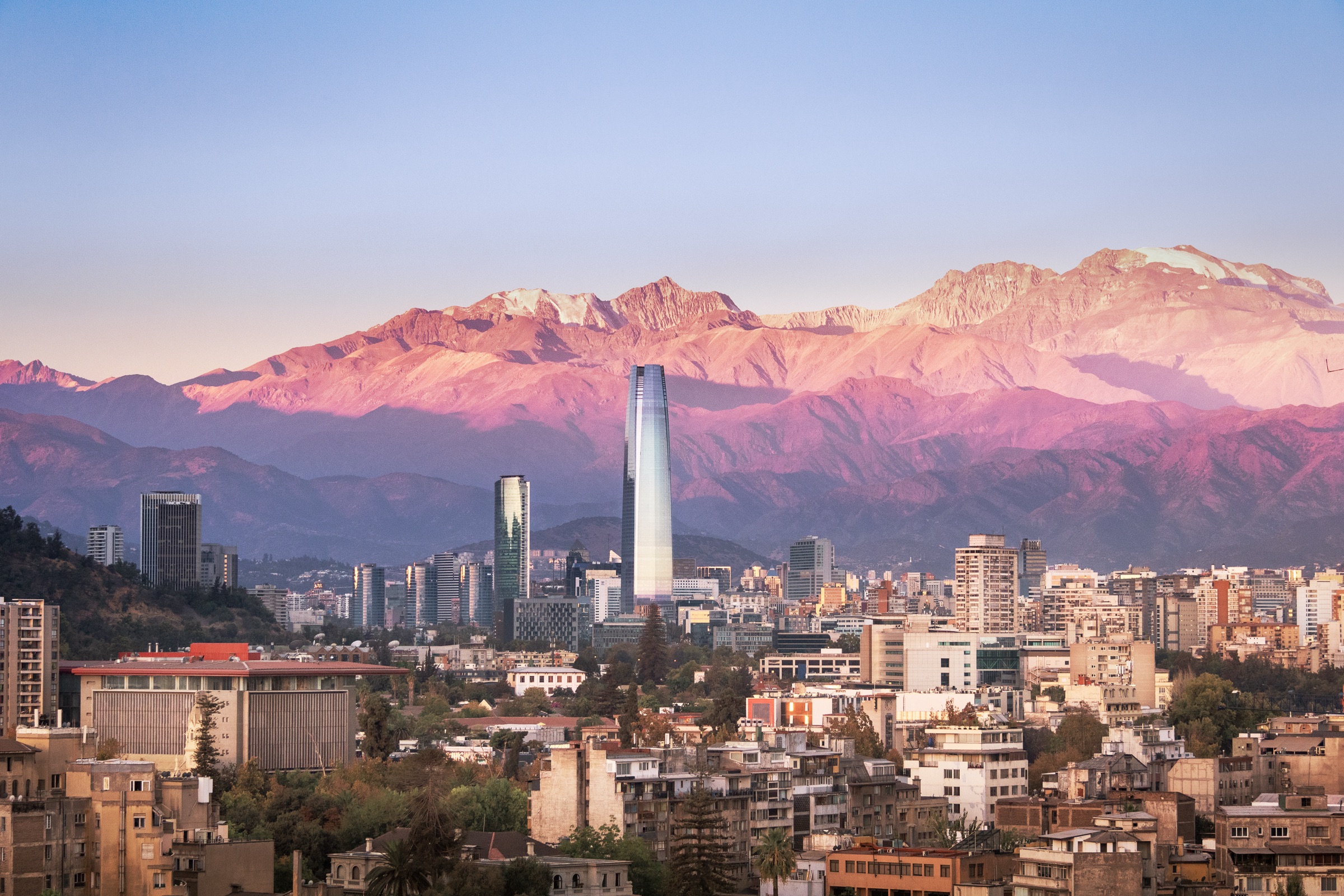
Santiago, a practical capital with wine country beside it
My short Santiago travel guide. Where to stay across Providencia, Bellavista, and Lastarria, Cerro San Cristóbal, the Maipo Valley wineries, and a Valparaíso day trip.
- Updated
- May 15, 2026
Current conditions and the practical reference material that helps turn the saved places into a trip.
7-day forecast from Open-Meteo. UV badges flag days when sun protection matters (3 and above is moderate; 8 and above is risk territory for unprotected fair skin within 30 minutes).
About 71% of the year's rain falls in these months. Typical highs around 16°C, lows around 4°C.
Typical highs around 25°C, lows around 11°C. About 10mm of rain a month.
Public holidays from Nager.Date.
Public-transit operators within 8 km of the city center. Click through to each operator’s site for routes, fares, and tickets.
Operators and modes are aggregated from individual transit-agency GTFS feeds. Route classifications come from each feed’s route type codes.
Santiago, also known as Santiago de Chile, is the capital and largest city of Chile and one of the largest cities in the Americas. Located in the Chilean Central Valley within the Santiago Basin, between the Andes to the east and the Chilean Coastal Range to the west, it anchors the Santiago Metropolitan Region and its conurbation of Greater Santiago, which comprises more than forty communes and concentrates over a third of the national population and around 45% of Chile's GDP. Most of the city lies between 500 and 650 meters above sea level, with recent urban growth extending into the Andean foothills.
The links below support the changing or licensed reference material on this page. Personal notes and ordinary geographic facts are not footnoted individually.
Monthly highs, lows, rainfall — long-term averages, NASA POWER.
Maps, image licenses, and the full dataset registry are listed in site credits.
My short Santiago travel guide. Where to stay across Providencia, Bellavista, and Lastarria, Cerro San Cristóbal, the Maipo Valley wineries, and a Valparaíso day trip.
Santiago de Chile
Santiago is an easy South American capital to plan: a metro that covers what you need, more food depth than its businesslike reputation suggests, wine country within an hour, and the Andes on the skyline. The metro, wine routes, and Andes excursions make it a practical anchor for a wider Chile loop.
Planning brief
Santiago is a practical South American capital to plan. The metro works, the food is strong, the wine country is close, and the Andes are visible from much of the city on clear days. Match the base to the trip, with Providencia for ease, Bellavista for bars, Lastarria for museums, and separate transport for the Maipo Valley wineries.
Santiago's metro is unusually useful by regional standards, clean, fast, and cheap. Cabify (the Spanish-Latin American rideshare app, the regional alternative to Uber) and Uber both work for the gaps. Skip street taxis unless you have a fixed price agreed before you get in.
The Maipo Valley wine region is 40 minutes south by car. Concha y Toro and Santa Rita are the names. Valparaíso is 90 minutes northwest by bus. Book the day, do not rush it.
Modern, walkable, on the metro, full of cafes and casual restaurants. Bellavista is the nightlife base, Las Condes is the upscale-glass-tower base, Lastarria is the museum-and-art base. Providencia is the middle ground.
The Mercado Central is the famous one. The restaurants inside are tourist-priced and average. Go for the atmosphere and the photos. Eat seafood at La Mar in Vitacura instead.
Comodoro Arturo Merino Benítez International Airport (SCL) sits about 15 km northwest of downtown. Three real options:
| Option | Cost | Time | Notes |
|---|---|---|---|
| Official airport taxi | ~$30 to $40 USD | 30 to 45 min | Fixed-fare rank just outside arrivals. The default with luggage |
| Uber / Cabify | ~$20 to $30 USD | 30 to 45 min | Pickup at the parking deck. Same time, cheaper |
| TurBus or Centropuerto bus | ~$3 to $5 USD | 30 to 40 min to Pajaritos metro | Cheapest. Bus to Pajaritos, metro Line 1 to the center |
A note on the Santiago Metro: the Bip! card is the way you ride. Single-use paper tickets are not the standard option. Buy the Bip! at any metro station vending machine, load credit, then tap at the gate. The fare runs CLP 800 to 900 (about $1) per ride depending on time of day. The metro runs roughly 06:00 to 23:00 weekdays, 06:30 to 23:30 Saturdays, 08:00 to 23:00 Sundays.
Santiago's biggest timing issue is Fiestas Patrias in September. Music festivals and New Year are the other hotel checks.
| Event | When | What it changes |
|---|---|---|
| Fiestas Patrias | September 18 to 19 and surrounding week | Fondas, cueca, empanadas, asado, closures, and heavy domestic travel |
| Viña del Mar Song Festival | Late February | Not in Santiago, but spillover can affect hotels. Viña itself gets much tighter |
| Lollapalooza Chile | Mid to late March | Large music weekend at Parque Cerrillos. Central hotels fill |
| New Year's Eve | December 31 | Fireworks around Costanera Center and peak hotel prices |
| Día de la Música | June 21 | Free midwinter concerts across the city |
| Santiago a Mil | Early to mid-January | International theater festival across multiple venues |
| Maratón de Santiago | Early April | Road closures along main city axes |
| Lo Castillo Christmas Market | Late November to late December | Seasonal market in Vitacura |
Four bases that actually work:
| Neighborhood | Why pick it | Trade-off |
|---|---|---|
| Providencia | Modern, walkable, full of cafes and casual restaurants, on the metro. The default for a first trip | Less character than Lastarria or Bellavista |
| Bellavista | Lively nightlife, music venues, the artsy crowd. Close to Cerro San Cristóbal | Loud on weekends. Some blocks feel rough at night |
| Lastarria | Bohemian, dense with galleries, cafes, and museums. Compact and quiet by Santiago standards | Pricier hotels. Smaller selection of mid-tier rooms |
| Las Condes | Upscale, glass-tower district, the financial center. Premium hotels and shopping | Soulless on weekends. Feels like Brickell or La Défense |
For a working stay or a longer apartment booking, Barrio Italia is the bohemian alternative (cafes, design studios, slower pace) and Ñuñoa is the quiet residential pick with parks for families.
The historic center is compact. Anchor on Plaza de Armas, the colonial main square. The Metropolitan Cathedral sits on the west side. The Central Post Office and the National History Museum frame the other edges. Plan one morning for the center: cathedral, museum, a slow walk through the pedestrianised streets toward La Moneda (the presidential palace).
The Mercado Central, just north of Plaza de Armas, is the famous fish market under a cast-iron 1872 roof, prefabricated in Glasgow by R. Laidlaw &. Sons and shipped to Santiago. The market is the photogenic part. The restaurants inside are tourist-priced and average. For better seafood, eat at one of the smaller stalls (Augusto, Galleon) rather than the central seated restaurants, or save the seafood meal for La Mar in Vitacura.
Cerro San Cristóbal is the hill in the middle of the city. The funicular runs from the Bellavista base station to the summit in about 15 minutes. You can also walk or bike up the road. At the top, panoramic views back across the city to the Andes, a sanctuary with a Virgin Mary statue, and a small cafe. Go on a clear morning for the best Andes visibility. Afternoon haze is normal in summer.
The hill sits inside the Santiago Metropolitan Park, which also includes the Chilean National Zoo and a few smaller museums. Pair the funicular with a walk down through the Bellavista neighborhood at the base.
Bellavista itself is the bohemian-and-bar district. La Chascona, Pablo Neruda's Santiago house, sits a few blocks from the funicular base. The museum is small, eccentric (the rooms are shaped like a boat below decks), and one of the most engaging hour-long visits in the city. Tickets around CLP 8,000 ($10). Audio guide included.
Bellavista is also the nightlife base. Two streets in particular (Pío Nono and Constitución) are bar-and-restaurant-dense. The cluster around Patio Bellavista is the tourist-friendly version and works as the easy starting point.
The four museums to prioritize:
All four sit within a 15-minute walk of each other in the Lastarria/Bellas Artes district. Eat lunch on Lastarria street itself. The cafes there are reliable and the prices are reasonable.
40 minutes south of the city by car, Maipo is the most famous of Chile's wine valleys and the closest to Santiago. Two estates anchor any visit:
Other estates (Cousiño-Macul, Undurraga, Aquitania) are reasonable add-ons if a single estate does not fill the day. A driver from Santiago for the day runs around $80 to $120 USD. A group tour with vineyard pickup runs around $60 USD per person.
The Cabernet Sauvignon and the Carmenère are the two grapes Chile is known for. Carmenère is the country's signature: originally a Bordeaux variety, declared extinct after the late-19th-century phylloxera plague in Europe, then rediscovered in Chilean vineyards in the 1990s where it had been misidentified as Merlot for decades. Order both. Drink the Carmenère slightly chilled in summer.
Valparaíso is 90 minutes northwest by bus or car. The historic port city, UNESCO-listed since 2003, is built on 40+ hills connected by funiculars (ascensores) and steep stairways. Walking the upper-town neighborhoods of Cerro Alegre and Cerro Concepción is the trip.
| Anchor | Why |
|---|---|
| Ascensor Concepción | The historic 1883 funicular up to Cerro Concepción |
| La Sebastiana | Neruda's Valparaíso house. Smaller than La Chascona but with the better view |
| Plaza Sotomayor | The civic center, dominated by the Naval Monument |
| The murals | The hillside walls are an open-air street-art gallery. Walk Cerro Alegre with no fixed plan |
A bus from Santiago's Terminal Pajaritos to Valparaíso runs every 20 to 30 minutes during the day. Round trip is about $15 USD. Plan a 12-hour day. The hillside murals, the funiculars, and the seafood at the port are what makes the long day work.
The Cajón del Maipo is the Andean gorge southeast of Santiago. About 90 minutes by car. The road follows the Maipo river up into the foothills. The day is the drive itself, with stops:
Self-drive is the cleanest version of this day. The road is paved most of the way, gravel for the final stretch to El Yeso. A driver from Santiago runs about $100 to $150 USD. Tour-operator day trips are around $70 to $90 USD per person.
Bring water, sunscreen, and a layer. The valley sits high (2,500 m at El Yeso), the sun is direct, and the temperature drops fast in the afternoon.