
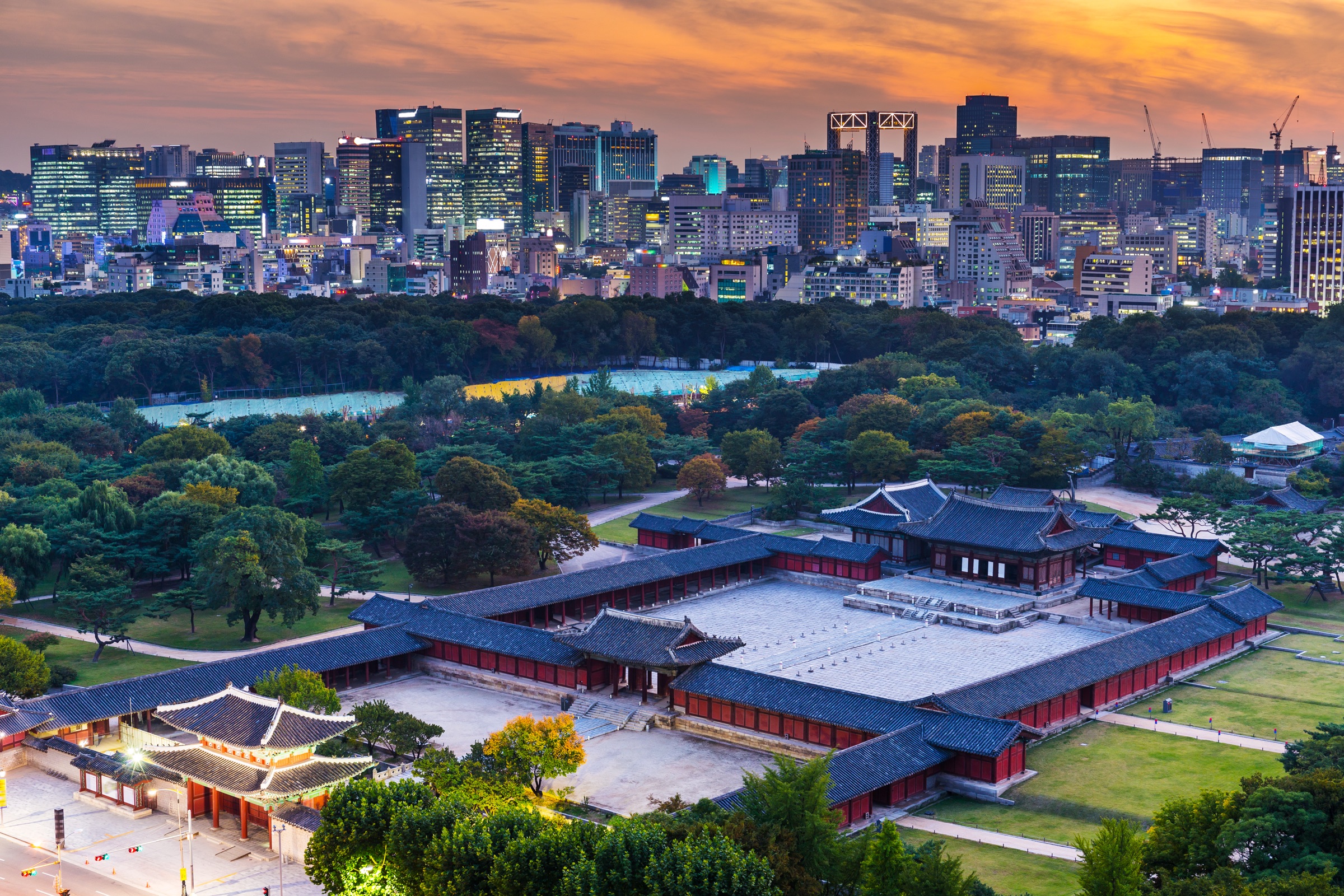
Seoul, a ten-million city that somehow feels easy
My Seoul travel guide. Getting in from Incheon on the AREX, where to stay by neighborhood, the Joseon palaces, Bukchon, and the night markets.
- Updated
- May 18, 2026
Current conditions and the practical reference material that helps turn the saved places into a trip.
7-day forecast from Open-Meteo. UV badges flag days when sun protection matters (3 and above is moderate; 8 and above is risk territory for unprotected fair skin within 30 minutes).
About 71% of the year's rain falls in these months. Typical highs around 26°C, lows around 19°C.
Typical highs around 10°C, lows around 1°C. About 46mm of rain a month.
Public holidays from Nager.Date.
Seoul, officially Seoul Special Metropolitan City, is the capital and largest city of South Korea, and the largest city in the whole of Korea. The broader Seoul Metropolitan Area, encompassing Seoul, Gyeonggi Province and Incheon, emerged as the world's sixth largest metropolitan economy in 2022, behind New York, Tokyo, Los Angeles, Paris, and London, and hosts more than half of South Korea's population. Although Seoul's population peaked at over 10 million, it has gradually decreased since 2014, standing at about 9.6 million residents as of 2024. Seoul is the seat of the South Korean government.
The links below support the changing or licensed reference material on this page. Personal notes and ordinary geographic facts are not footnoted individually.
Monthly highs, lows, rainfall — long-term averages, NASA POWER.
Maps, image licenses, and the full dataset registry are listed in site credits.
My Seoul travel guide. Getting in from Incheon on the AREX, where to stay by neighborhood, the Joseon palaces, Bukchon, and the night markets.
서울
Seoul is a ten-million-person capital that somehow feels easy, five-hundred-year-old palaces a few subway stops from glass towers and all-night markets, all knit together by a metro you can read from the first ride. Plan it by neighborhood rather than trying to cross the whole map.
Planning brief
Seoul is a city of ten million that runs on one of the best subway systems in the world, which makes a sprawling capital feel navigable from day one. The Joseon-era palaces and hanok lanes sit a few metro stops from glass-tower districts and night markets. Plan by neighborhood rather than chasing the whole map.
Buy a T-money card at any convenience store or station machine, load it with cash, and tap onto every subway, bus, and most taxis. The metro is fast, clean, signed in English, and the way you cross the city.
Myeong-dong for central convenience, Hongdae for nightlife and youth culture, the Jongno area for the palaces and hanok quiet, Gangnam or COEX for modern comfort south of the river.
Gyeongbokgung and the Bukchon hanok lanes are the morning. Gwangjang and the street-food markets are the evening. The two halves of Seoul a first visit is built around.
Seoul is ringed by hikeable granite peaks and split by the wide Han River with its parks. Inwangsan for a city-edge climb, Hangang Park for a riverside evening.
Incheon International Airport is the main gateway, about 50 km west of the city. The AREX, the Airport Railroad Express, is the default rail way in. The all-stop train reaches Seoul Station in about an hour and behaves more like the transit network. The non-stop Express service is the cleaner airport product if Seoul Station works for your hotel or onward train. Airport limousine buses run directly to specific hotel districts and can be easier with heavy luggage. Gimpo Airport, the second and closer airport, handles domestic and some regional international flights.
The Seoul Subway is the city. It is one of the most extensive and reliable subway systems in the world, fully signed and announced in English, and it reaches everything in this guide. Buy a T-money card at any convenience store or station machine, load it, and tap onto every subway, bus, and many taxis. Trains stop around midnight, after which taxis are the fallback and are reasonably priced.
Many subway stations are landmarks in their own right because of the exit numbering. Hongik University Station Exit 9 is the example, the standard meeting point and entry into the Hongdae nightlife district.
Pick a base by the kind of trip, and pick something on a metro hub.
| Where | Why pick it | Trade-off |
|---|---|---|
| Myeong-dong | Central, walkable, surrounded by shopping and street food, the best transit access | Touristy and busy. Not the most distinctive version of Seoul |
| Hongdae | Youth culture, live music, nightlife, the indie-and-art district | Loud at night. Better for a younger, later trip |
| Jongno / Insa-dong | Next to the palaces and the hanok quarters, calmer, the traditional-Seoul base | Quieter at night, fewer late-dinner options |
| Gangnam / COEX | Modern, polished, business-district comfort south of the river | Further from the historic core. A longer metro ride to the palaces |
For the Gangnam-side base, InterContinental Seoul COEX sits on the COEX mall-and-convention complex, directly connected to the metro and the aquarium.
The historic core of Seoul sits north of the Cheonggyecheon stream, around the old Joseon palaces.
Gyeongbokgung Palace is the largest and the main one, the seat of the Joseon dynasty, with a changing-of-the-guard ceremony at the gate through the day. Changdeokgung, a short walk east, is the other major palace and a UNESCO site for its Secret Garden. Pair them if palaces are the reason you came. Gwanghwamun Square is the wide ceremonial plaza in front of Gyeongbokgung, anchored by the statues of Admiral Yi Sun-sin and King Sejong.
Bukchon Hanok Village is the hillside quarter of preserved hanok, traditional tiled-roof houses, threaded by lanes between the two main palaces. It is residential, so go early and quiet. Insa-dong is the neighboring street of galleries, tea houses, antiques, and craft shops, the easiest place to slow down. Jogyesa is the central Seoul temple of Korean Buddhism, a working temple in the middle of the city and the heart of the lantern festival each spring.
For something more offbeat, Ihwa Mural Village is the hillside neighborhood turned open-air art project on the slope of Naksan, and Seodaemun Prison History Hall is the preserved colonial-era prison, now a sober museum of the Japanese occupation and the Korean independence movement.
N Seoul Tower on Namsan is the main viewpoint, reached by cable car or a walk up through the park, with the whole city laid out below. For a view earned on foot, Inwangsan is the granite peak on the city's northwest edge, a real but manageable climb past shamanist shrines and a stretch of the old city wall.
At ground level, Cheonggyecheon is the restored stream that runs sunken through downtown, a long linear walk below the traffic. Hangang Park is the riverside parkland along the Han, the city's open-air living room, best in the evening when families and friends spread out with delivery fried chicken. Seoul Forest is the larger green park east of the center, the calm half-day.
For families, Coex Aquarium sits inside the COEX mall in Gangnam. For photographers, Yongma Land is a small abandoned amusement park on the city's edge, a cult photo spot that opens to visitors for a small fee.
Seoul eats late and eats in markets, and the markets are the best food planning you can do.
Gwangjang Market is the main market, one of the oldest markets in the country and a dense hall of food stalls, the place for bindaetteok (mung-bean pancake), mayak gimbap, and raw beef. Noryangjin Fisheries Wholesale Market is the vast seafood market, where you buy from the stalls downstairs and have it cooked at a restaurant upstairs. Myeong-dong runs a famous evening street-food strip alongside its shopping, the easiest introduction to Korean street snacks.
For something newer, Common Ground in Konkuk is a retail-and-food complex built from stacked blue shipping containers, the photogenic modern counterpoint to the old markets.
Seoul's calendar runs on the Korean lunar holidays plus a strong run of spring and autumn festivals. Two of the lunar holidays change the city enough to shape a trip.
| Event | When | What it changes |
|---|---|---|
| Lotus Lantern Festival (Yeondeunghoe) | Around Buddha's Birthday, in May | A UNESCO-listed festival, with thousands of paper lanterns and a vast lantern parade through Jongno. Jogyesa temple is the center of it. One of the best times to be in the city |
| Cherry blossom season | Early April, about 10 days | The blossoms peak along the Yeouido riverfront and the palace grounds. The Yeouido Spring Flower Festival is the focal point. Hotels climb in price for the window |
| Seoul Lantern Festival | November | Illuminated lantern installations strung the length of the Cheonggyecheon stream downtown. The autumn counterpart to the spring lanterns |
| Seoul International Fireworks Festival | Early October | A large fireworks display over the Han River, watched from Yeouido and the Hangang parks. Hundreds of thousands turn out |
| Chuseok (Korean autumn harvest holiday) | September or October, around three days | Korea's major family holiday. Seoul empties as residents travel to hometowns, and many shops and restaurants close. A strange, quiet time to visit, easier if you plan around the closures |
| Seollal (Lunar New Year) | Late January or February, around three days | The other big family holiday, with the same pattern. The city is quiet and many businesses close. The palaces often run special free-admission days |
Lotus Lantern dates and cherry blossoms are the main seasonal draws. Chuseok and Seollal require closure planning because the city's normal rhythm pauses.