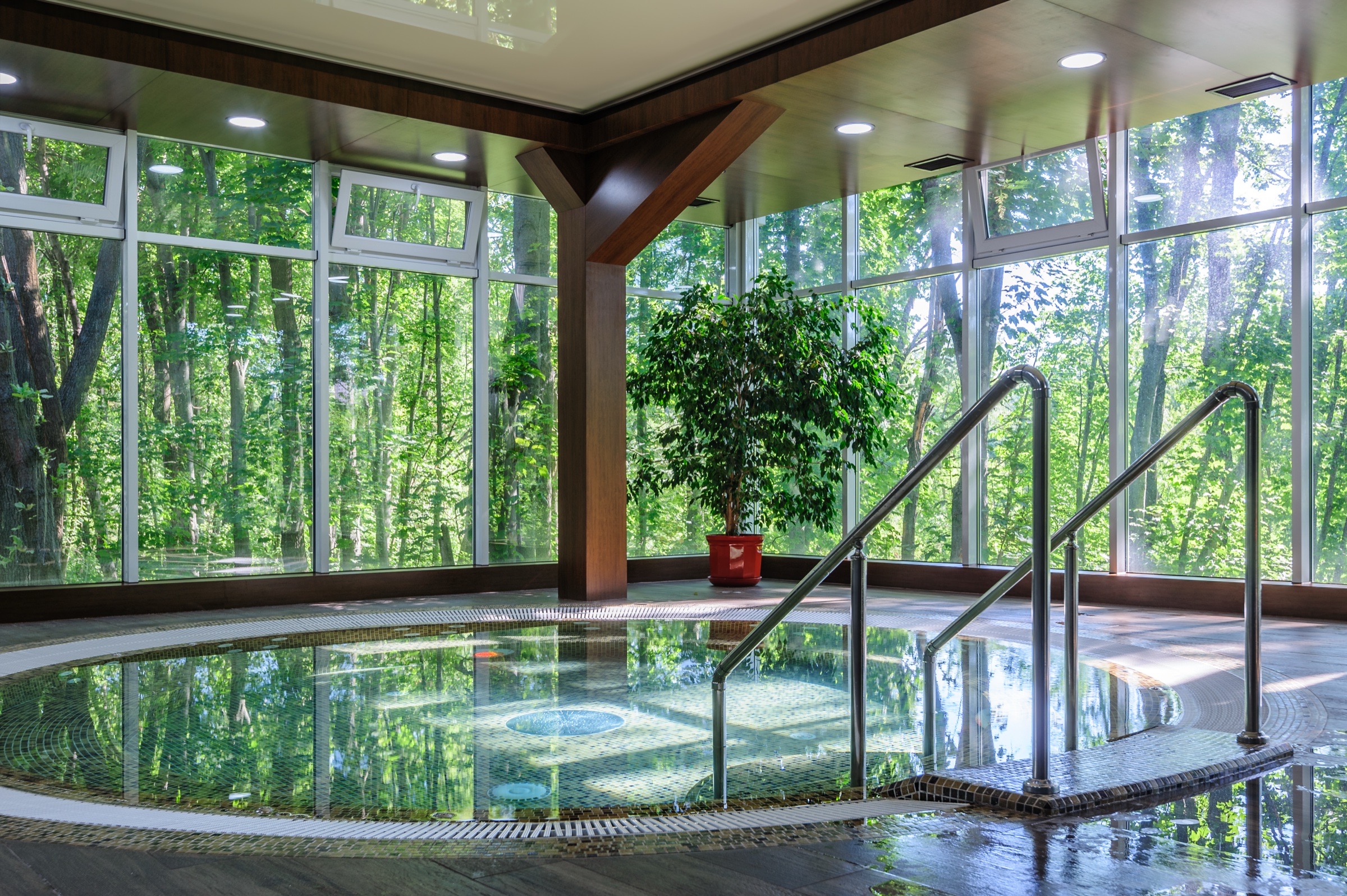
Where to soak after a long-haul flight
A working list of spa towns to fly into when a long coach flight has left your body sore. Therme Erding near Munich, Pamukkale, Budapest, and Thermae Bath.
- Updated
- May 12, 2026
- Saved places
- 52
- Free
- 3
- UNESCO
- 1
On this page
- Munich: Therme Erding, ten minutes from the airport
- Pamukkale: ancient pools and a hotel with its own thermal water
- Budapest: Gellért over Széchenyi, and Rudas for the older one
- Bath: the rooftop pool, and the Roman baths next door
- Vienna: Therme Wien, the other airport hack
- Bucharest: Therme Bucharest, biggest in Europe, right by OTP
- Black Forest spa towns: Badenweiler and Bad Bellingen
- The rest of the pin list
My favorite travel hack after a cheap red-eye flight is to stop somewhere that I can soak in thermal waters. Here's my list of the top spots to layover and treat yourself.
Planning brief
Using a spa day in your itinerary
If you fly long-haul in coach often enough, your back and neck will eventually tell you about it. The travel hack this list is built around is to book the first night in the trip in a city that has a serious thermal spa, and to spend the next morning soaking and getting a massage before any sightseeing starts. The day reads as a recovery day, the rest of the trip starts on better legs, and the spa itself is usually cheaper than the equivalent in a US city. Four destinations earn the first spots. The list is meant to grow.
Book the spa before the city
The arrival day stays a buffer. The morning of day two is when you walk into the thermal water. Book the massage slot ahead online if the spa takes reservations (Thermae Bath, Therme Erding, Gellért all do). The pools themselves rarely need a reservation but the massage slots fill in the first wave of the day.
Pick the airport-adjacent ones for short trips
Therme Erding sits 10 to 15 minutes from Munich Airport, and the Erding Holiday Inn lets you skip the train into Munich entirely. The shape of the trip is fly in, sleep, soak, then carry on to the city or to the next flight. The spa is the destination, not the city.
Pick the destination ones for a longer trip
Pamukkale, Budapest, and Bath are spa destinations in their own right. Their pools sit beside larger cities or archaeological sites, so the spa and surrounding destination need separate planning.
Cheap by Western standards, almost always
Outside of Bath, the thermal spas on this list cost a fraction of a US destination spa for the same hours in the water. A full day plus a massage in Pamukkale, Budapest, or Erding usually runs less than a single hour at a city-center US spa.
Places on this list




Munich: Therme Erding, ten minutes from the airport
Therme Erding is the largest thermal spa complex in Europe, on the north-east side of Munich, and it sits about 10 to 15 minutes by taxi from Munich Airport (MUC). The geometry alone makes it the strongest fly-in-and-soak destination on this list. You land at MUC, take a short taxi out to Erding, sleep, walk into the water in the morning. The city of Munich is on the same S-Bahn line and adds itself to the trip whenever you want it back.
The complex itself is large: a 27-pool main hall, an outdoor thermal area, a separate sauna world, and a tropical lagoon with palm trees and a roof that retracts in summer. The water is mineralised from a 2,000-meter-deep well. A full day plus a massage costs a fraction of the equivalent in a US destination spa, and the crowd is mostly German weekenders rather than tourists.
| What | Why pick it | Where |
|---|---|---|
| Therme Erding | The spa itself. Book the day pass online. Book the massage slot first thing in the morning if you want a 10 a.m. or 11 a.m. table | Thermenallee 1-5, Erding |
| Holiday Inn Express Munich Airport - Erding | Cheap, clean, a normal Holiday Inn Express, and it sits in Erding rather than at the airport itself. Easy taxi to and from the spa | Freisinger Straße 25, Erding |
| Gasthaus & Hotel zum ERDINGER Weißbräu | The Erdinger brewery's own beer hall in the old town. Erding is where Erdinger Weißbier is brewed, and the pint a few streets from the brewery is the freshest one you will get anywhere | Lange Zeile 1+3, Erding |
The spa also has its own hotel attached to the complex if you want to stay on-site and walk into the pools in a bathrobe. The catch is price and the fact that you are inside the spa for the trip rather than seeing any of Erding's small old town. For one night and a soak the Holiday Inn Express is the better-value move. For a weekend that is meant to be a full reset, the spa hotel pays for itself.
Pamukkale: ancient pools and a hotel with its own thermal water
Pamukkale is the white limestone terrace in south-western Turkey, fed by hot calcium-rich springs that have been depositing the terraces for two thousand years. The Romans built a city on top of it. Hierapolis is the UNESCO-listed ruin you walk through to reach the spa pools. The Pamukkale slot on this list is the pure coolness pick: the spa pools are the most spectacular on the list and the per-night cost is the lowest.


The bathing splits into two kinds. The famous one is Cleopatra Antique Pools, a thermal pool inside the Hierapolis ruin with submerged Roman and Hellenistic column drums and marble fragments scattered across the bottom. You swim around two-thousand-year-old architecture. It is shallow, warm, fizzing slightly from the natural carbonation in the spring water, and unlike anything else on this list.
The other side is the hotel thermal pools. Most properties in the Karahayıt cluster a couple of kilometers from the travertines have their own thermal pool fed by the same springs. I stayed at Hierapark Thermal & Spa Hotel Deluxe, which has indoor and outdoor thermal pools, the standard Turkish hotel breakfast, and a fair half-board price that covers dinner.
| What | Why pick it | Where |
|---|---|---|
| Cleopatra Antique Pools | The bath that is the whole reason to make this trip. Submerged Roman columns. Warm calcium-rich water. An hour or two in the pool | Inside Hierapolis archaeological site, Pamukkale |
| Travertines of Pamukkale | The white terraces themselves. Wade barefoot down them in shallow warm water (footwear is not allowed on the calcium) | The terraces below Hierapolis |
| Hierapolis-Pamukkale UNESCO site | The ancient city above the terraces. Theater, necropolis, a small museum. A half-day's wander after the pools | At the top of the travertine terraces |
| Hierapark Thermal & Spa Hotel Deluxe | Indoor and outdoor thermal pools at the hotel itself. Cheap by any Western standard. Book half-board | Karahayıt, two kilometers from the travertines |
Pamukkale combines the thermal pools, travertine terraces, and Hierapolis ruins in one destination. The closest airport is Denizli Çardak (DNZ), which connects to Istanbul on Turkish Airlines and Pegasus several times a day. The ride to Pamukkale is about an hour.
Budapest: Gellért over Széchenyi, and Rudas for the older one
Budapest is the spa-lover's city. Geothermal water reaches the surface in dozens of springs across the city, and the bath culture has been built on top of them in waves: Ottoman, Habsburg, and early-twentieth-century art-deco. Most visitors pick one bath and call it done. The question is which one.

Most travelers default to Széchenyi, the big outdoor neo-Baroque complex in City Park. The photograph of the steaming outdoor pool in winter with snow on the columns is the famous one. Széchenyi is a large, photogenic complex that draws crowds. On a typical Saturday afternoon it is packed.
My favorite is Gellért, in the base of the Gellért Hotel on the Buda side of the river. The interior is art-deco done right: marble, mosaic tilework, stained glass over the indoor pool, the columns and ironwork the Habsburg architects could afford in 1918. The crowds are smaller. The water is the same temperature. If I had one bath day in Budapest, this is the one I would book.
The third one is for the older layer of the city. Rudas was built by the Ottomans in the 1550s and still has the original octagonal central pool under a Turkish dome. It is the closest a contemporary visitor will get to bathing in the bath culture Budapest had before the Habsburgs. The interior is plainer than Gellért's and quieter than Széchenyi's. The rooftop hot tub added in the 2010s overlooks the Danube and is the modern reason most non-Hungarians come.
| Bath | Best for | Where |
|---|---|---|
| Gellért Thermal Bath | The art-deco interior. Marble, mosaic, stained glass, and a calmer crowd than Széchenyi. The one to book if you only do one | Kelenhegyi út 2, base of the Gellért Hotel, Buda side |
| Széchenyi Thermal Bath | The famous outdoor pool in winter steam. Busy on weekends. Go on a weekday morning if you can | Állatkerti körút 9-11, in City Park, Pest side |
| Rudas Thermal Bath | The 1550s Ottoman bath under the Turkish dome. The historical layer. Rooftop hot tub over the Danube is the bonus | Döbrentei tér, Buda side |
A long Budapest weekend fits all three across different sessions: Gellért in the morning of day one, Rudas at night for the rooftop, Széchenyi on day two when the crowds are thinnest. The city's other ten or so thermal baths render below on the map for a longer stay.
Bath: the rooftop pool, and the Roman baths next door
The English city of Bath is the only spot on this list where the museum and the bath are the same story. The Romans built a temple complex called Aquae Sulis here in the first century around the only natural hot spring in the British Isles. The complex was abandoned after the Roman withdrawal, rediscovered in the medieval period, rebuilt in the eighteenth century, and rebuilt again as the modern Thermae Bath Spa complex that opened in 2006. The buildings sit a hundred meters from each other.
Thermae Bath Spa has an indoor pool, several steam rooms (each with a different essential oil), a relaxation lounge, and a rooftop pool above the old-city rooflines. The rooftop is the photograph. It is open in any weather, and rain on warm thermal water is the appeal. I went in October on a gray, wet day and it was the best part of the trip. The English autumn hedges against the high summer crowds.
Next door, the Roman Baths is the museum. The original Roman complex, with the Sacred Spring still bubbling at the center and the Great Bath still full of warm green water you cannot enter. The audio guide is good, the museum is well curated, and walking through it before or after the modern spa is the right order. You understand what you are bathing in.
| What | Best for | Where |
|---|---|---|
| Thermae Bath Spa | The modern bathing complex. Rooftop pool over the city, steam rooms, indoor pool. Book the timed entry slot online. The rooftop sells out first on a weekend | Hot Bath Street, Bath |
| The Roman Baths | The ancient Roman complex preserved as a museum. The Sacred Spring, the Great Bath, the temple foundations | Stall Street, Bath, next door to Thermae Bath Spa |
The two together make the most coherent spa route in Bath: museum first (about 90 minutes), lunch in town, then two or three hours at Thermae Bath. Great Western Railway connects London Paddington with Bath in about 90 minutes, and hotels cluster around the station and center.
Vienna: Therme Wien, the other airport hack
Therme Wien is the second-largest urban thermal complex in Austria and runs the same fly-in-and-soak idea as Erding. It is less airport-tight than Erding, but the U1 metro line stops at the spa door. From central Vienna, the ride to Oberlaa takes about 30 minutes. From Vienna International (VIE), allow about 40 minutes with the CAT or S-Bahn into the center and a transfer.
The complex itself is quieter and more Austrian in feel than Erding's. The water comes from a 1,500-meter well, the indoor and outdoor pool count is high (more than two dozen pools across the main hall, the family world, and the textile-free sauna world), and the day pass is comparable to Erding's. The Vienna add-on is that you are in Vienna. The trip extends naturally into coffee houses, the opera, the Wien Museum, the rest of the city.
| What | Why pick it | Where |
|---|---|---|
| Therme Wien | Indoor + outdoor + textile sauna world all under one roof. U-Bahn to the door from Stephansplatz in about 25 minutes | Kurbadstraße 14, 10th district, Oberlaa |
Use it as the recovery morning when you are arriving into Vienna, or as a half-day reset on a longer Vienna stay. Stay at a normal Vienna hotel rather than by the airport. The U1 is the connection that makes it work.
Bucharest: Therme Bucharest, biggest in Europe, right by OTP
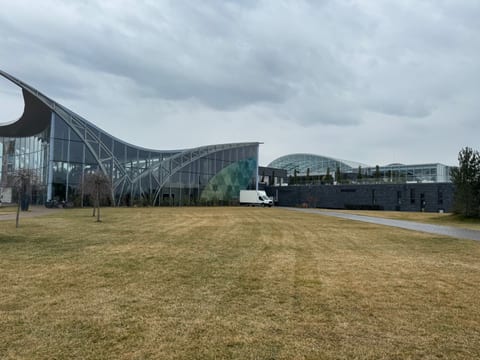
Therme Bucharest is the giant of this list. The complex opened in 2016 outside Bucharest in Balotești, about 10 kilometers from Henri Coandă International Airport (OTP) and 18 kilometers from the city center. It bills itself as the largest urban relaxation center in Europe. The figure that matters more for planning is the seven hectares of indoor pools, palm-tree atriums, sauna world, and a wave pool, all kept at 33°C indoor air year-round. It is the only spa on this list where the building itself is the spectacle.
The hack model works cleanly here. Land at OTP, taxi or rideshare 15 minutes to Therme, soak all day, then either move on to a Bucharest hotel or stay the night at the airport. The complex has its own shuttle from a stop on the OTP side of the airport road. The app is the easier path if you have luggage.
| What | Why pick it | Where |
|---|---|---|
| Therme Bucharest | The scale. Three zones (Galaxy family pools, Elysium pure-relax pools, The Palm tropical atrium). A day pass covers all three | Calea Bucureşti 1K, Balotești. ~10 km from OTP |
Three to four hours covers the soak if you are using it as an airport-day add-on. A full day plus a massage is what to book if Therme is the trip rather than the trip's first stop. Bucharest is a separate visit from there and will need its own scaffold once that writeup lands.
Black Forest spa towns: Badenweiler and Bad Bellingen
The Black Forest in south-west Germany has older thermal towns rather than airport-side mega-spas. Two pins in the saved list cover the practical options.
Cassiopeia Therme Badenweiler sits in the spa town of Badenweiler on the western edge of the Black Forest, about 30 minutes by car from Basel-Mulhouse-Freiburg airport (BSL). The complex is built around a Roman bath ruin that anchors one of the warm-water pools. The rest is the standard German thermal-and-sauna style but in a quieter, smaller, more elegant frame than Erding. The town itself is a 19th-century cure-resort with a small park, a few good hotels, and not much else, which is the right scale for a weekend reset.
Balinea Thermen is in Bad Bellingen further south on the Rhine plain, half an hour from Basel. The bath uses warm mineral water from the same Black Forest seam as Badenweiler. The complex is smaller than Cassiopeia and the town is sleepier.
| What | Best for | Where |
|---|---|---|
| Cassiopeia Therme | The elegant version. Roman ruin in the pool hall, walkable old town, a few real restaurants. Pair with a night at one of the small Black Forest hotels | Ernst-Eisenlohr-Straße 1, Badenweiler |
| Balinea Thermen | The sleepier version. Smaller, cheaper, closer to Basel for the fly-in. Read fewer restaurant reviews and lower the expectations on dinner | Bad Bellingen, Black Forest foothills |
The route starts with either BSL (Basel) or STR (Stuttgart). A rental car connects the spa towns with the Black Forest road south to Lake Constance or north to Freiburg.
The rest of the pin list
The seven cities above are the ones with a writeup so far. The pin map below already carries roughly forty more thermal spas across the atlas that I have either soaked at, want to soak at, or have pinned for a future trip. The list includes Sky Lagoon in Reykjavík, Aqua Dome in the Tirolean Längenfeld, Caldea in Andorra, Caracalla and Friedrichsbad in Baden-Baden, and the free travertine pools at Cascate del Mulino in Saturnia. It also includes Terme di Saturnia itself, Terme Merano and QC Termemilano, Hévíz lake bathing in Hungary, and the Furnas hot springs on São Miguel in the Azores. The broader map adds Karlovy Vary and the Czech beer spa, the Polish thermal complexes at Zakopane and Chochołów, Scandinave Spa in Whistler, Vichy Célestins, and Pozar in Greece. The resort-property set includes Lucknam Park near Bath, Buxton Crescent, Aqualux at Bardolino, and Olympic Palace at Karlovy Vary. The on-page writeup will grow into the cities that earn a section. The map is the full list.
Quick answers
- Why book a spa day on a trip rather than at home?
- The thermal-water spas in this list are large complexes built around a natural hot spring or a serious thermal source, not the candle-and-cucumber-water type, and the water itself is the point. Most US cities do not have a comparable equivalent at any price. Booking one into a trip lines the recovery up with the jet-lag day, which is when your body wants it anyway.
- How long should I plan?
- A morning at the pools, an hour or so for a massage, an unhurried lunch, then back in the water if you want more. Five to six hours covers it. If the spa has a hotel and you can stay on-site (Erding, Hierapark in Pamukkale), the rhythm gets easier. You go back to the room between rounds rather than packing up.
- Will I need a swimsuit?
- Yes for the day complexes (Therme Erding, Thermae Bath Spa, Pamukkale hotels, Széchenyi). Some areas of Therme Erding and most German spas have textile-free zones. Signage marks them. Gellért in Budapest has separate gender-mixed and historically gender-segregated areas with different rules.
- Is the rooftop pool at Thermae Bath a good idea in the rain?
- Yes. The rooftop pool sits above the historic city and is open in any weather. Rain on warm thermal water is part of the appeal, not a problem. The English autumn (October to November) is a fair-weather hedge against summer crowds for exactly that reason.
- Which Budapest bath should I pick first?
- Gellért if you want the art-deco interior (marble, mosaic, stained glass) and a calmer crowd. Széchenyi if the famous outdoor pool view in winter steam is the thing you came for. Rudas if you want the older Ottoman-era bath. The three are close enough that a long stay can do all of them in different sessions.