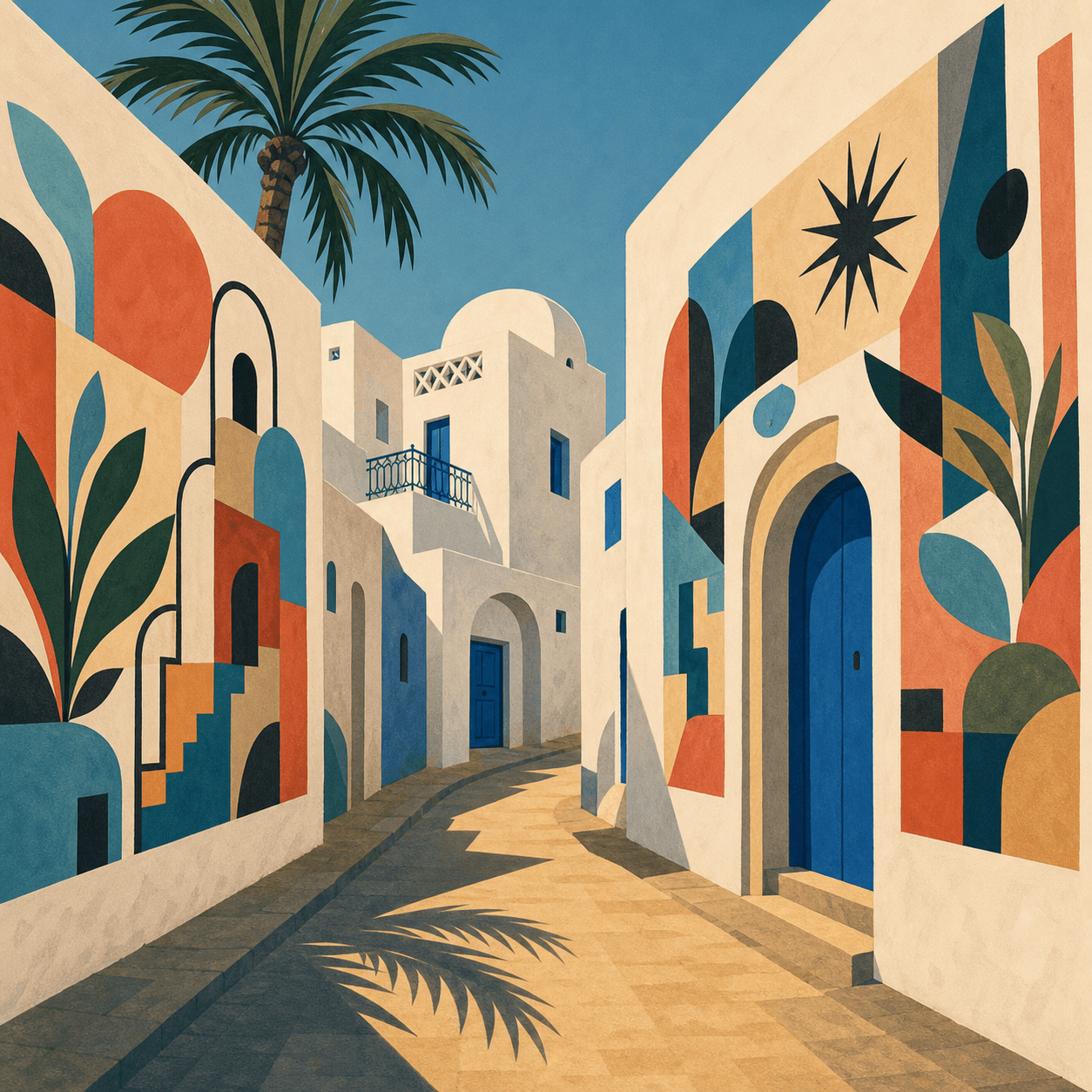
Djerba, the Tunisian island most North Americans have never heard of
My short Djerba travel guide. When to visit Tunisia's Mediterranean island, where to stay, the beaches, El Ghriba synagogue, and the Djerbahood murals.
- Updated
- May 15, 2026
Current conditions and the practical reference material that helps turn the saved places into a trip.
7-day forecast from Open-Meteo. UV badges flag days when sun protection matters (3 and above is moderate; 8 and above is risk territory for unprotected fair skin within 30 minutes).
Typical highs around 30°C, lows around 26°C. The drier end of the year.
Typical highs around 17°C, lows around 12°C. Most of the year’s greyest, wettest weeks.
Public holidays from Nager.Date.
Public-transit operators within 8 km of the city center. Click through to each operator’s site for routes, fares, and tickets.
Operators and modes are aggregated from individual transit-agency GTFS feeds. Route classifications come from each feed’s route type codes.
The links below support the changing or licensed reference material on this page. Personal notes and ordinary geographic facts are not footnoted individually.
Monthly highs, lows, rainfall — long-term averages, NASA POWER.
Maps, image licenses, and the full dataset registry are listed in site credits.
My short Djerba travel guide. When to visit Tunisia's Mediterranean island, where to stay, the beaches, El Ghriba synagogue, and the Djerbahood murals.
Djerba is the Tunisian island most North Americans have never heard of, though European package travelers have known it for thirty years. Cheap Mediterranean sand, plus a 14th-century synagogue, a street-art village, and a desert-edge Berber day trip. The beaches, inland villages, and mainland routes require different transport.
Planning brief
Djerba is the Tunisian Mediterranean island that European package travelers know and most North Americans have never heard of. Beaches, a working medina, an ancient Jewish synagogue, a famous street-art village, and a half-day desert trip to the troglodyte dwellings of Matmata. Dodge the August heat and the airport-taxi shakedown on arrival.
March to June and September to November are the windows. July and August push above 35°C and the resorts fill with European school holidays. December to February are mild and very quiet. Some restaurants close.
Houmt Souk for the medina and walkable culture. Midoun for resort beach access. Aghir for quiet beachside. Erriadh if you want to live inside the street art project. Tezdaine for a calmer apartment between Midoun and the sand.
DJE airport taxis are known to overcharge tourists. The fair price to Houmt Souk is 20 to 25 TND. Expect quotes of 50 to 80 TND from the rank. Negotiate before you load bags, or arrange a hotel pickup ahead of time.
The village of Erriadh hosts the largest open-air street-art project in the world. 250+ murals by 150 artists from 30+ countries. Walkable in 90 minutes. Some pieces have faded since the 2014 origin, but new commissions arrive yearly.
| Window | Months | What to expect |
|---|---|---|
| Best | March to June | Warm, dry, beaches usable, the desert daytrip bearable. The window I would book |
| Peak European holiday | July, August | Pushing 35°C+, busy resorts, prices up. Come only if you want the heat |
| Shoulder | September, October, November | Sea still warm, prices drop, the medina calmer |
| Quiet and mild | December to February | 15 to 20°C, mostly dry, some restaurants closed. Strange-light winter trips work here if you want the island to yourself |
The best window is usually the second half of October, after the European school crowd has gone home.
Djerba's main calendar item is the Lag B'Omer pilgrimage at El Ghriba. Ramadan changes the daily rhythm.
| Event | When | What it changes |
|---|---|---|
| Lag B'Omer at El Ghriba | April or May | Jewish pilgrimage at El Ghriba Synagogue. Security is heavy and Houmt Souk hotels fill |
| Ramadan | Lunar calendar | Reduced daytime food service outside resort hotels, then later nights after iftar |
| Eid al-Fitr | End of Ramadan | Three-day national holiday with shop closures |
| Eid al-Adha | About 70 days after Ramadan | Larger family holiday, with reduced menus in some places |
| Independence Day | March 20 | Civic ceremonies |
| Revolution Day | January 14 | Civic events |
| Republic Day | July 25 | National holiday |
| Festival des Plages | July and August | Resort-coast music, sports, and entertainment |
| Mouled | Lunar calendar | Religious holiday, more visible in inland villages |
Djerba-Zarzis International Airport (DJE) sits about 9 km southwest of Houmt Souk, near Mellita on the west side of the island. The airport is small and clean. Arrivals processing takes 30 to 45 minutes most days.
A practical heads-up: the airport taxi rank is known to overcharge tourists. The fair fare to Houmt Souk is 20 to 25 TND (~6 to 8 EUR). Drivers will routinely quote 50 to 80 TND. Two ways to handle it:
Once on the island, rent a car. The island is roughly 25 km across. The attractions spread from Houmt Souk in the north to the beaches on the east coast to Erriadh in the middle to the south-coast pottery village of Guellala. Without a car, every trip becomes another taxi negotiation. The roads are straightforward. Driving on the right.
Rideshare apps are not reliable on the island. There is no Uber-equivalent.
Five real zones, each with a distinct character:
| Zone | Why pick it | Trade-off |
|---|---|---|
| Houmt Souk | The island's biggest town. Walkable medina, markets, restaurants. Good base for non-beach days | Not on a beach. 15-minute taxi to the sand |
| Midoun | Resort cluster on the eastern beach strip. Hotels at every level | Tourist-dominated. Less local feel |
| Aghir | Quieter beachside, fewer big resorts | Limited food and bar options outside the hotels |
| Erriadh | Live inside the Djerbahood street art project. Boutique stays with local character | No beach access. You commute to the sand |
| Tezdaine | A quieter apartment area between Midoun and the beaches | Less infrastructure than Midoun |
The Iberostar Selection Eolia Djerba is the main international resort if you want a known brand. Below it, a long list of European-branded all-inclusives in Midoun and Aghir. Nothing is meaningfully different at the mid-tier level. For local character, a boutique riad in Houmt Souk or a converted house in Erriadh beats the resort experience.
The eastern coast is where the sand is. Three beaches to head for:
Beach service is minimal compared to a European resort coast: bring water, sunscreen, and patience for the persistent vendors. Topless sunbathing is uncommon. Nude bathing is not done.
Houmt Souk is the working town of the island. The medina is active rather than staged: a fish market that runs early-morning auctions, narrow alleys with local jewelers and spice merchants, and a handful of small restaurants that do real Tunisian food.
Stops in the medina that fill a half-day:
For lunch, brik (the thin pastry with egg and tuna), couscous, and grilled fish are the three plates to order. The corner restaurants on the medina edge serve all three for 15 to 25 TND a head.
The El Ghriba Synagogue, in the inland village of Hara Sghira, is one of the oldest synagogues in the world. The current building is 19th-century, but Jewish settlement on the site goes back centuries earlier. It remains active and is a pilgrimage site each Lag B'Omer (the Jewish festival celebrated 33 days after Passover, in late spring). Security is tight. Bring a passport, expect a short bag check, and dress conservatively.
A 10-minute drive south, the village of Erriadh houses Djerbahood, the largest open-air street-art project in the world. The 2014 initiative invited 150 artists from over 30 countries to paint more than 250 murals across the village walls. Some originals have faded with sun and weather. New commissions arrive most years. Plan 90 minutes to walk the whole village. Bring water and a camera. There is no entry fee. The village just is the gallery.
For a quieter cultural stop, the Guellala Museum on the south side of the island shows traditional pottery, Berber clothing, weaving, and a recreated village setting. About 90 minutes. The hill location gives a wide panorama of the south coast.
Matmata is the troglodyte (cave-dwelling) Berber village on the Tunisian mainland, about a 2-hour drive south of the Djerba ferry. The famous draw is Hotel Sidi Driss, the underground hotel that was used as Luke Skywalker's childhood home in Star Wars (filmed 1976. The original set decorations remain). It still operates as a real hotel. You can spend the night, or stop for a couple of dinars and a tour during the day.
Practical notes for the daytrip:
The Star Wars set is the famous draw, but the surrounding villages and the broader troglodyte landscape are the real reason to make the trip. The dwellings are still lived in. Most remain family homes.