Photos from Krabi
 +3
+3Blue Pool Krabi Thailandpark
 +1
+1Crystal Poolpark
 +1
+1Tub Islandspark
 +1
+1East Railay Bay Beachpark
+3+1+1+1Current conditions and the practical reference material that helps turn the saved places into a trip.
7-day forecast from Open-Meteo. UV badges flag days when sun protection matters (3 and above is moderate; 8 and above is risk territory for unprotected fair skin within 30 minutes).
About 79% of the year's rain falls in these months. Typical highs around 28°C, lows around 26°C.
About 98mm of rain a month, against 270mm in the wet season.
Public-transit operators within 8 km of the city center. Click through to each operator’s site for routes, fares, and tickets.
Krabi is the capital of and main town in Krabi Province, on the west coast of southern Thailand, where the Krabi River flows into Phang Nga Bay. The town lies 650 km (400 mi) south of Bangkok, and as of 2020, has a population of 32,644. As in much of southern Thailand, the local economy centres largely on tourism.
The links below support the changing or licensed reference material on this page. Personal notes and ordinary geographic facts are not footnoted individually.
Monthly highs, lows, rainfall — long-term averages, NASA POWER.
Operators and modes are aggregated from individual transit-agency GTFS feeds. Route classifications come from each feed’s route type codes.
Maps, image licenses, and the full dataset registry are listed in site credits.
My Krabi travel guide. Getting in from KBV, where to stay in Ao Nang, reaching Railay by longtail, and the Andaman-coast restaurants.
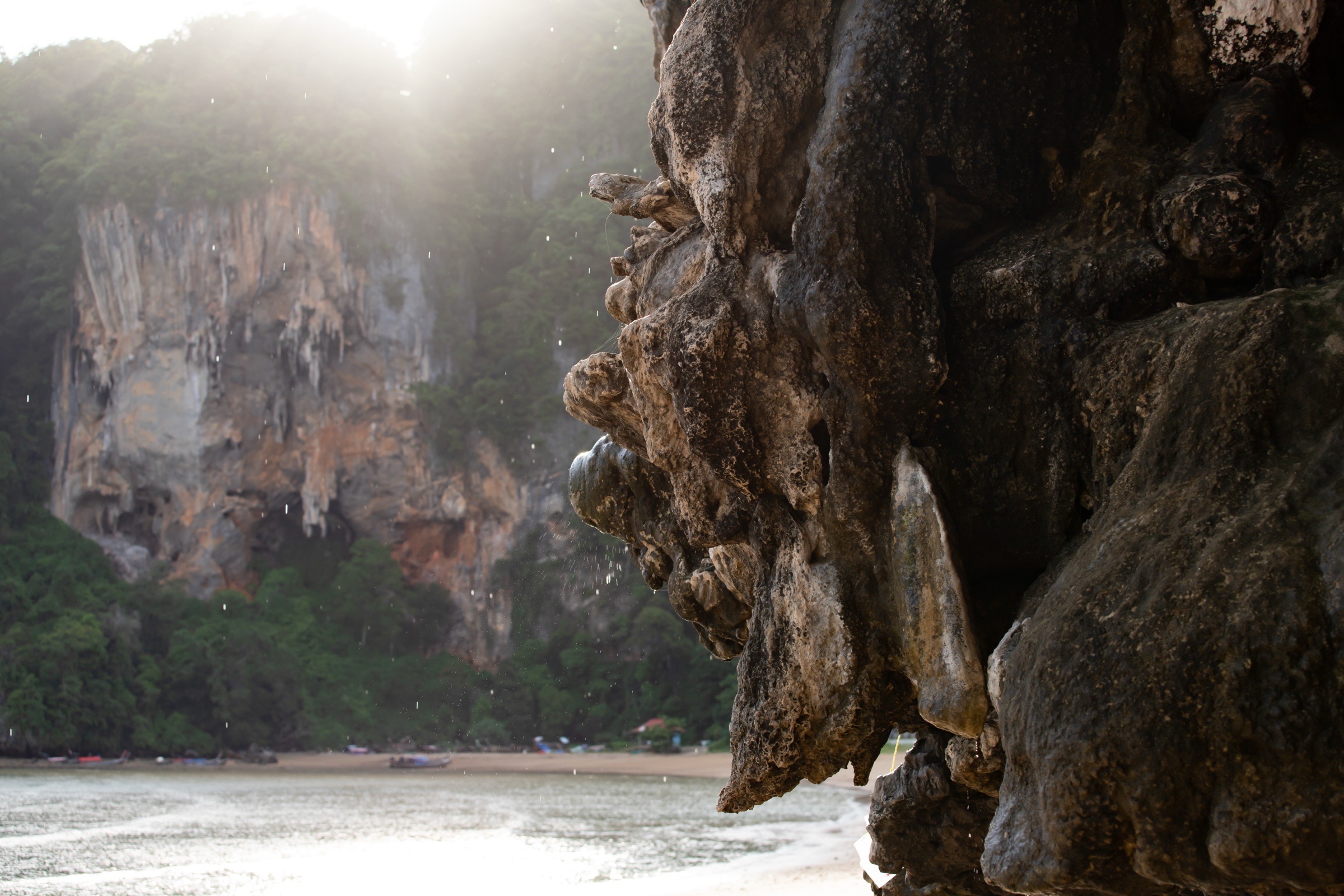
Krabi is the gateway to the Andaman coast's limestone-karst country, Phi Phi, Railay, and a string of cliff-backed beaches. Ao Nang is where most people base. Ao Nang, Railay, and the island ferries require different transport, so choose the base before planning the routes.
Krabi Krabi International (KBV) sits about 18 km north-east of Ao Nang. The airport bus is the cleanest budget path in, with rideshare as the easier-with-luggage alternative.
| Mode | Time | Cost | When to use |
|---|---|---|---|
| Airport bus to Ao Nang | 60 to 70 min | 150 THB single | The default budget option. Direct to Ao Nang every 60 minutes. Comfortable air-conditioned coach |
| Grab | 30 to 45 min | 600 to 900 THB to Ao Nang | Faster and door-to-door. Useful for late arrivals or heavy luggage |
| Pre-booked transfer | 30 to 45 min | 700 to 1,200 THB | Hotel-arranged. Driver waits with a name board |
| Airport taxi from the rank | 30 to 45 min | 700 to 900 THB fixed | Marked taxis at the airport. The fare is set by zone |
Krabi runs on the standard Thai festival calendar plus the boat-life Andaman coast events. The Christmas-NYE window is the priciest hotel time of the year.
| Event | When | What it changes |
|---|---|---|
| Songkran | April 13 to 15 | The Thai new year water-throwing. Ao Nang beach road becomes the local centre. Smaller and more relaxed than the Bangkok or Chiang Mai versions |
| Loy Krathong | Full moon of the 12th lunar month, usually early to mid-November | The floating-lantern festival. Ao Nang beach and Krabi Town's river are the launch points |
| Andaman Rock Climbing Festival | Variable, usually November | Climbing festival on the Railay limestone cliffs |
| Krabi International Music Festival | A weekend in February | Free open-air music festival in Krabi Town. Smaller scale |
| Christmas and New Year peak | December 20 to January 5 | The most expensive hotel window. Ao Nang beach hotels rise sharply, boat tours cost more, and NYE fireworks run on the beach |
| Chinese New Year | Late January or February | Krabi Town has a Chinese-Thai community, with lion dances and fireworks |
| Royal Cliff Beach Festival (Ao Nang) | A weekend in late November | Local fair on Ao Nang beach. Smaller and family-scale |
| Hua Hin Jazz Festival | Not in Krabi | Different coast, useful only if jazz is driving the Thailand route |
For lower hotel prices, avoid December 20 to January 5.
| Property | Why | Notes |
|---|---|---|
| Holiday Inn Resort Krabi Ao Nang Beach | The reliable family resort on Ao Nang | Property is super clean, the breakfast spread is real, and the rate is reasonable for what you get |
| Spot | Why | Notes |
|---|---|---|
| Emerald Pool | The natural-spring swim inside the national park | Go early. It gets crowded as the day builds, and the experience falls off fast once the crowds arrive |
| Ko Poda Beach | A boat-to beach for an afternoon nap | Almost pristine sand and water. Take a longtail from Ao Nang and bring water |
Krabi food runs through casual beach-front Thai (pad thai, green curry, the usual seafood-on-the-beach grill) plus the imported rotation that any popular beach base ends up with (Italian, Israeli, sushi, Irish-pub fish and chips). The picks below cover the spread.
| Spot | Rating |
|---|---|
| Dr. Cat Cafe | Pinned |
| Mountain View Restaurant Ao Nang | Pinned |
| MY PHO - Vietnamese Noodle House & Bar | Pinned |
| SABABA | Pinned |
| Sound of tree Restaurant & bar | Pinned |
| The Irish Embassy Pub Ao Nang | Pinned |


