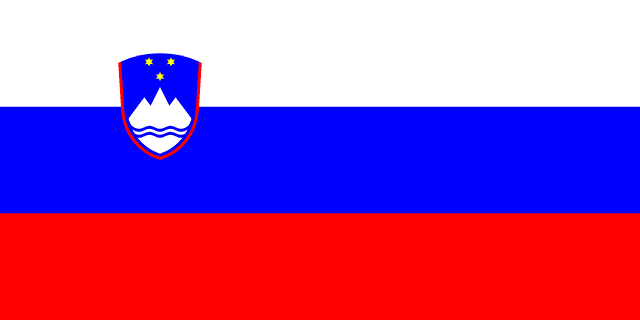
Slovenia
Capital: Ljubljana
About
Slovenia, officially the Republic of Slovenia, is a country in Central Europe. It borders Italy to the west, Austria to the north, Hungary to the northeast, and Croatia to the south and southeast; its southwestern boundary consists of a 46.6-kilometre (29.0 mi) coastline on the Adriatic Sea. Slovenia is mostly mountainous and forested, covers 20,271 square kilometres (7,827 sq mi), and has a population of approximately 2.1 million people. Slovene is the official language. Slovenia has a predominantly temperate continental climate, with the exception of the Slovene Littoral and the Julian Alps. Ljubljana, the capital and largest city of Slovenia, is geographically situated near the centre of the country. Other larger urban centers include Maribor, Ptuj, Kranj, Celje, and Koper.
When things are closed
Upcoming public holidays in Slovenia. On these dates, expect banks, post offices, and government services to close. Many shops and museums close or run shortened hours; transit typically still runs.
dan suverenosti · Sovereignty Day
August 14, 2026
Friday
Marijino vnebovzetje · Assumption Day
August 15, 2026
Saturday
združitev prekmurskih Slovencev z matičnim narodom · Unification of Prekmurje Slovenes with the Mother Nation
August 15, 2026
Saturday
priključitev Primorske k matični domovini · Integration of Primorska into the Homeland
September 15, 2026
Tuesday
dan slovenskega športa · Slovenian Sports Day
September 23, 2026
Wednesday
dan reformacije · Reformation Day
Cities (7)
References4
These references support the changing or licensed material on this page. Personal notes and ordinary geographic facts are not footnoted individually. Entry rules can change, so verify them before booking.
- Travel practicalities. Entry, driving, electricity, water, and official application context. Related: Driving side, World Standards, CDC Yellow Book, WHO drinking-water guidance.
- Country background. Wikipedia summary may be clipped or paraphrased. Numeric baselines are cross-checked with Wikidata. Related: Wikidata, .
