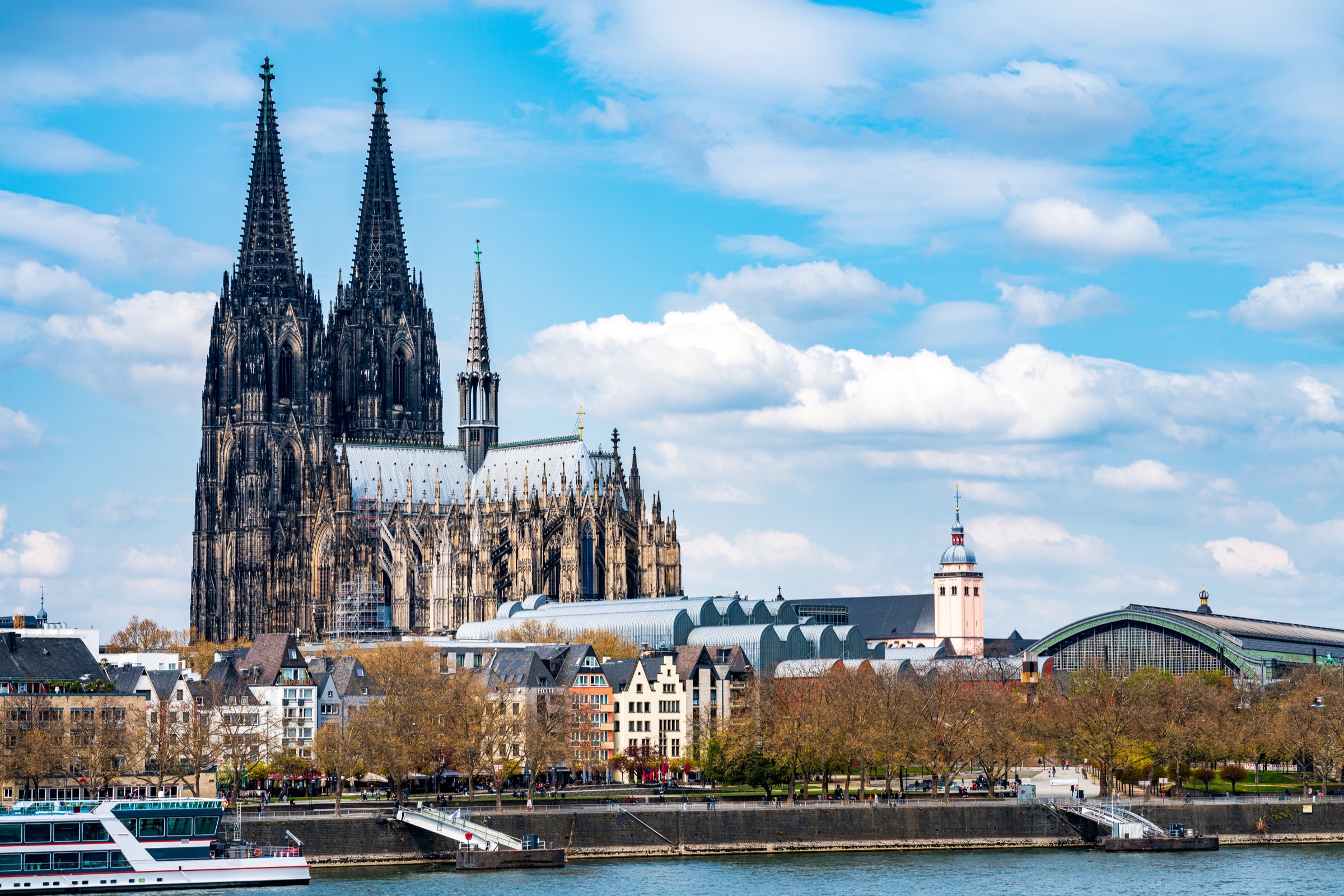
Cologne is a giant cathedral with a city attached
My Cologne travel guide. The cathedral, the Old Town and the Rhine, Kölsch and the brewhouses, where to stay, and where to eat.
- Updated
- May 18, 2026
Current conditions and the practical reference material that helps turn the saved places into a trip.
7-day forecast from Open-Meteo. UV badges flag days when sun protection matters (3 and above is moderate; 8 and above is risk territory for unprotected fair skin within 30 minutes).
Typical highs around 23°C, lows around 12°C.
Typical highs around 7°C, lows around 0°C.
Public holidays from Nager.Date.
Public-transit operators within 8 km of the city center. Click through to each operator’s site for routes, fares, and tickets.
Cologne is the fourth-most populous city of Germany and the largest city of the German state of North Rhine-Westphalia with nearly 1.1 million inhabitants in the city proper and over 3.1 million people in the Cologne Bonn urban region. Cologne is also part of the Rhine-Ruhr metropolitan region, the second biggest metropolitan region by GDP in the European Union. Centered on the left bank of the Rhine, Cologne is located on the River Rhine, about 35 kilometres (22 mi) southeast of the North Rhine-Westphalia state capital Düsseldorf and 22 kilometres (14 mi) northwest of Bonn, the former capital of West Germany.
The links below support the changing or licensed reference material on this page. Personal notes and ordinary geographic facts are not footnoted individually.
Monthly highs, lows, rainfall — long-term averages, NASA POWER.
Operators and modes are aggregated from individual transit-agency GTFS feeds. Route classifications come from each feed’s route type codes.
Maps, image licenses, and the full dataset registry are listed in site credits.
My Cologne travel guide. The cathedral, the Old Town and the Rhine, Kölsch and the brewhouses, where to stay, and where to eat.
Cologne is a giant Gothic cathedral with a city attached, one of Germany's oldest, sat on the Rhine and running on its own pale beer. The cathedral, riverfront, old town, and brewhouses form the central route.
Planning brief
Cologne is a city of about 1.1 million on the Rhine in western Germany, one of the country's oldest, founded by the Romans. It is dominated by its cathedral, a twin-spired Gothic giant beside the main station, and runs on its own beer, Kölsch, and a deep brewhouse culture. The central sights form a compact route, with wider regional connections beyond it.
The cathedral, Old Town, and riverfront cluster beside the main station. The museums and Rhine routes extend beyond that central walk.
Cologne Cathedral stands right beside the main station, so it is the first thing you see. The climb up the south tower is the city's classic view.
Kölsch is Cologne's own pale beer, served in small glasses and topped up until you cover the glass. The old brewhouses are the place for it.
A base around the Altstadt and the cathedral puts the sights, the river, and the brewhouses on foot, with the station right there.
Cologne Bonn Airport sits southeast of the city, connected to the center by S-Bahn in about 15 minutes. Cologne is also a major ICE high-speed rail hub, with fast trains across Germany and to Brussels, Paris, and Amsterdam.
Cologne Hauptbahnhof is right beside the cathedral, in the city center. Once there, the center is walkable and an extensive U-Bahn covers the rest.
The Cologne Bonn Stadtbahn is the tram/U-Bahn hybrid underneath the wider Rhine-Ruhr rail web. For a normal Cologne stop, you mostly walk from the Hauptbahnhof and use local rail only when the hotel, museum, or trade-fair day sits away from the cathedral core.
Stay near the Old Town and the cathedral. A base there puts the sights, the river, the brewhouses, and the main station all within a short walk.
For a hotel by the river, Hyatt Regency Cologne sits on the far bank of the Rhine with a direct view of the cathedral. Spacious rooms, fair price, ten minutes across the river to Hauptbahnhof, and a short S-Bahn from Köln Messe if you're in town for a trade fair. Beyond it the atlas does not yet carry a wide hotel pin set for Cologne, so book on the usual sites and read recent reviews for the property.

Cologne Cathedral, the Kölner Dom, is the city, a vast twin-spired Gothic cathedral that took more than 600 years to finish and is a UNESCO World Heritage Site. It is free to enter, and the climb up the south tower, more than 500 steps, is the city's classic view. It stands directly beside the main station, so it is the first thing most visitors see.
The Old Town spreads between the cathedral and the river, a partly reconstructed quarter of lanes, squares, and brewhouses. Along the Rhine, the Hohenzollern Bridge carries the railway and is famous for the weight of love-locks on its fences. The riverbank holds the Schokoladenmuseum, the chocolate museum, along with the Mustard Museum and shop, and the city's serious museums, the Roman-Germanic Museum and Museum Ludwig, sit by the cathedral.
For a trip out of the city, Wuppertal, about 40 minutes away, is a good day trip for the Schwebebahn, the century-old suspended monorail that runs above the river through the town.
Cologne eats on Rhineland cooking and brewhouse plates, the Halve Hahn and Himmel un Ääd of the local kitchen, all best washed down with Kölsch. The brewhouses are as much the experience as the food.
| Spot | What it is | Notes |
|---|---|---|
| Schokoladenmuseum Köln | The riverside chocolate museum | An extended Lindt advertisement that gives you free chocolate. Still a fun stop. Exhibits cover the history of cocoa, sustainability, and a working production line through glass |
| Peters Brauhaus | A traditional Kölsch brewhouse | Very German, top to bottom. The no-frills authentic experience, the Kölsch arrives until you put your coaster on top of the glass |
| Min Cuisine asiatique & Bar | Asian cooking and a bar | Food is decent, low-key local feel, not many tourists |
| Kaiser Konstantin | A Kölsch brewhouse | Pinned |

