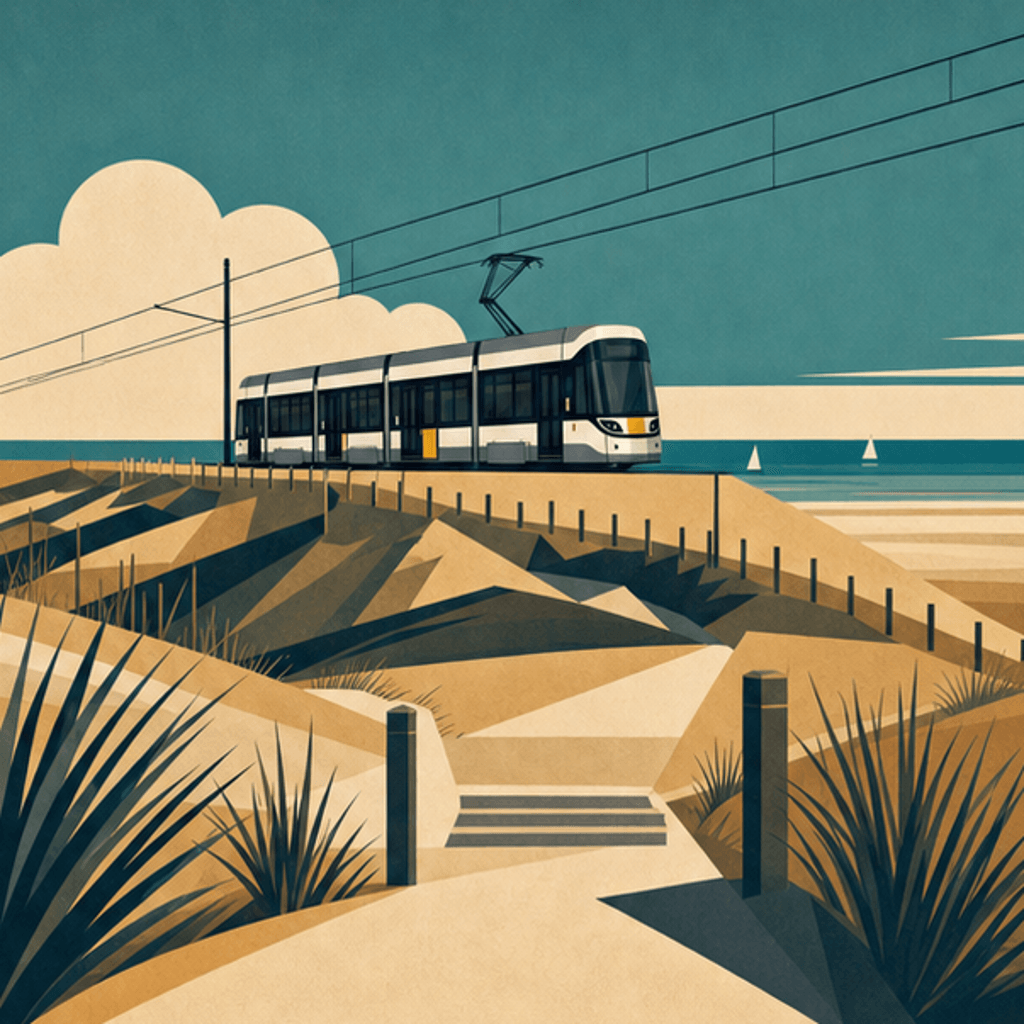
Riding the Kusttram down the whole Belgian coast
My personal guide to the Belgian coast by Kusttram. Where to stop, where to eat in Oostende, the Mercator ship, and the Oostduinkerke shrimp fishermen.
- Updated
- May 14, 2026
- Saved places
- 77
On this page
Belgium's Kusttram is a 67-kilometer tram line running the whole length of the coast, billed as the longest in the world, and it turns the seaside into a low-stakes hop-on, hop-off tour. I wouldn't build a trip around it, but if you are already near the coast it is the easy way to find the beach town that fits. Here's my atlas of the station stops. Check De Lijn for live service.
Planning brief
Riding the Kusttram
This started as a Kusttram station index and has slowly grown into the working Belgian-coast guide it actually wanted to be. The tram is the thread. The list also pins the cafés, parks, ship museum, and beach towns I have actually stopped at along the route. Browse the coast, pick a section, and link through to the places already in the atlas.
Good base
Oostende is the easy starting point because mainline trains meet the coast there and the tram is simple to use in pieces.
Good short ride
Oostende to De Haan is the section I would start with: enough coastline to feel the idea, with a town at the end that makes sense on foot.
Keep going if
The weather is decent, you are enjoying the ride, and you want more of the resort-town sequence toward Blankenberge or Knokke.
Skip it if
You are not already nearby and do not care much about trams, public transport, or ordinary coastal towns.
Places in De Panne
Which section to ride
| Section | Start | Why pick it | Reader note |
|---|---|---|---|
| First sample | Oostende to De Haan | Mainline train access at Oostende, a manageable tram ride, and a town at the end that is pleasant on foot | The section I would choose if you only want the idea, not the whole line |
| Dunes and history | Oostende to Raversijde and Middelkerke | Beach infrastructure plus the Atlantikwall museum in the dunes | Better if you want something more specific than a promenade walk |
| Beach culture | De Panne to Oostduinkerke | Wide sand, family beach rhythm, and the shrimp-fishing tradition nearby | Check tide and local schedules if the horseback fishermen are the reason you are going |
| Resort sequence | Blankenberge to Knokke | Larger resort towns, apartment blocks, shopping streets, and the more polished end of the coast | Useful if you are curious about Belgian seaside development, less necessary for a short day |
How a Belgian beach day actually works
If your only beach experience is California, the Mediterranean, or Australia, the Belgian coast is set up around two things you may not have planned for: real wind almost every afternoon, and a long lunch break in the middle of the day. The North Sea is colder than it looks, the breeze is genuine by 2pm, and Belgians treat a beach trip as a half-day session followed by a full lunch followed by another half-day session. This is a day with structure rather than a hotel-pool day with a snack bar, and once you understand the structure it works very well.
The little wooden houses on the sand
Those rows of small painted wooden cabins lined up on the beach are strandcabines in Dutch, cabines de plage in French. They are not for sale to walk-up visitors and they are not hotels. Most are private day or seasonal rentals, run by the town hall (stadhuis) or a beach concession.
You change in them, store your towels, chairs, and beach toys, and use the small freshwater rinse on the side. Most have a step or a bench out front where families set up for the day. They are not for sleeping in.
How to rent one for a day: ask at the stadhuis or look for the small concession office near the beach access ramp. Day rentals run roughly 25 to 60 EUR depending on town and season, and they book by the morning of, not the night before. Knokke is the most expensive and hardest to get. Oostduinkerke and De Panne are easier.
If you don't rent a cabin, the bigger beaches have strandkorven (wicker basket chairs with a hood) and windschermen (canvas windbreaks staked into the sand) you can rent by the day. Wind is the reason these exist. You will appreciate them by 2pm.
What to bring
- A wind layer. Even on a warm August day the late-afternoon zeebries (sea breeze) can drop the temperature 5 to 10°C in twenty minutes.
- Cash in small notes. Cabin rentals, public-shower meters, parking machines, and many beach paviljoens still take cash without complaint and card sometimes with one.
- Sunscreen, even when overcast. UV is high, and the Belgian summer sun looks gentler than it is.
- A book, snacks for between sessions, and patience. Belgians arrive at 10, leave at 19, and don't need entertainment in between.
You do not need swim shoes. The sand is fine and shells are uncommon outside the low-tide shell strips.
Lunch is the middle of the day, not the end
Belgian beach lunch is a real meal at a real table, not a sand-floor snack run. Paviljoens (wooden beach pavilions every few hundred meters along the dyke) serve from roughly 12 to 14:30, then close their kitchens until the early evening. If you walk up at 14:45 hungry, you will be told to come back at 18:00.
What to order: mosselen-friet (mussels and fries), September through April when mussels are in season. Garnaalkroketten (gray shrimp croquettes) year-round. Order them even if you order nothing else. Tomaat-garnaal (a tomato stuffed with gray shrimp) as a traditional cold starter. The garnalen are small, sweet, and locally caught. They are the reason the Oostduinkerke shrimp fishermen still ride Brabant draft horses through the surf at low tide.
Tipping is rounded up, not American style. Service charge is included.
Showers and changing
- Public outdoor rinse showers are at most beach access ramps. Free or coin-operated (50 cents to 1 EUR), cold water only, no privacy.
- Cabin rinses if you rented one. Small freshwater nozzle on the side of the cabin.
- Paviljoen showers if you ate there. Most will let customers use the bathroom and an indoor rinse on the way out.
- Sea-view hotels typically have outdoor rinse stations on the lower deck. Use them before you walk back through the lobby.
If you are catching the Kusttram back to your base after a swim, the rinse-and-change at a beach access ramp is the workflow. You do not want sand in the tram seat for an hour.
Wind, tide, and the things you won't see elsewhere
The North Sea has a 4 to 5 meter tidal range. The beach you see at high tide is not the beach you see at low tide. Low tide is for shell strips, kite buggies, sand yachts, and the wide flat walk to the water. High tide is for swimming. Tide tables are free at every tourist office. Check them before you drive out.
Two things on the Belgian coast you really cannot see anywhere else:
- Horseback shrimp fishermen at Oostduinkerke. UNESCO listed. They walk Brabant draft horses through the surf at low tide pulling nets for gray shrimp. Catches are weighed in town and cooked at the local paviljoens. Schedule depends on the tide. Check the tourism office.
- Atlantikwall bunkers at Raversijde. A preserved section of WW2 coastal fortifications still standing in the dunes between Oostende and Middelkerke, with a museum walk through the trenches. A strange thing to see in a beach context, and a useful reminder of what this stretch of coast was being used for eighty years ago.
Where to get off along the line
The stops below are the ones I have actually used as destinations rather than just transit. Each is anchored at a town and a Kusttram stop within walking distance, so you can drop them into the section table at the top of this page without rebuilding the day.
| Town | Get off at | What is there |
|---|---|---|
| Oostende | Marie-Joséplein or the main Oostende station | Apero Fish Palace for fresh North Sea fish at lunch, the Mercator (a 1932 three-master in the marina, now a small museum), and Maria Hendrikapark as the green walk between the train station and the dyke |
| De Panne | De Panne Plopsaland | Plopsaland, the Flemish family theme park. Useful only if you have kids in the right band, but it is the reason most Belgian families take the tram this far west |
| Damme (a short ride or bike inland from the Knokke end) | n/a (the tram doesn't reach Damme. The canal-bike or car does) | Hoeke Windmill, a working 18th-century post mill on the canal between Bruges and the coast. Pair with a slow canal ride from Bruges if you have a half-day |
| Knokke | Knokke Station | Grand Casino Knokke, the 1930 modernist casino with the Magritte and Delvaux murals inside. The "Knokke Casino" pin in the atlas is the same building under its more common short name |
Two more 5/5-rated stops to flag without their own row: a quiet Moeder Lambik café halfway up De Panne Kerk for a Trappist between rides, and the broader Raversijde provincial domain around the Atlantikwall already mentioned above.
Otherwise the coast is what it is: wide flat beaches, modernist apartment blocks behind the dyke, scraps of Belle Époque, and the slow rhythm of a country that takes its lunch seriously.
Quick answers
- Should I make a special trip for the Kusttram?
- Not for most travelers. It is more useful as an add-on if you are already near the Belgian coast, Bruges, Ghent, or Brussels and want an easy coastal day.
- What is a good short section of the Kusttram?
- I would start with Oostende to De Haan. It is easy to reach by train, gives you a real sample of the line, and ends somewhere pleasant to walk around.
- Should I use this page as a timetable?
- No. This page is an atlas index of station pins. Use De Lijn for current times, service changes, works, and ticket rules.