Barcelona Metro
Metro · Barcelona · TMB / FGC
14 lines · 161 stations · 30 interchanges
Every line drawn through its stations. Tap a line in the legend to hide or show it.
Lines
- L1Hospital de Bellvitge <-> Fondo30
- L10NLa Sagrera <-> Gorg6
- L10SZAL | Riu Vell <-> Collblanc11
- L11Trinitat Nova <-> Can Cuiàs5
- L12Sarrià <-> Reina Elisenda2
- L2Paral·lel <-> Badalona Pompeu Fabra18
- L3Zona Universitària <-> Trinitat Nova26
- L4La Pau <-> Trinitat Nova22
- L5Cornellà Centre <-> Vall d'Hebron27
- L6Barcelona- Plaça Catalunya <-> Sarrià8
- L7Barcelona- Plaça Catalunya <-> Av. Tibidabo7
- L8Barcelona - Plaça Espanya <-> Molí Nou-Ciutat Cooperativa11
- L9NLa Sagrera <-> Can Zam9
- L9SAeroport T1 <-> Zona Universitària15
Stations from my trips
Photographs from stations connected to this network.
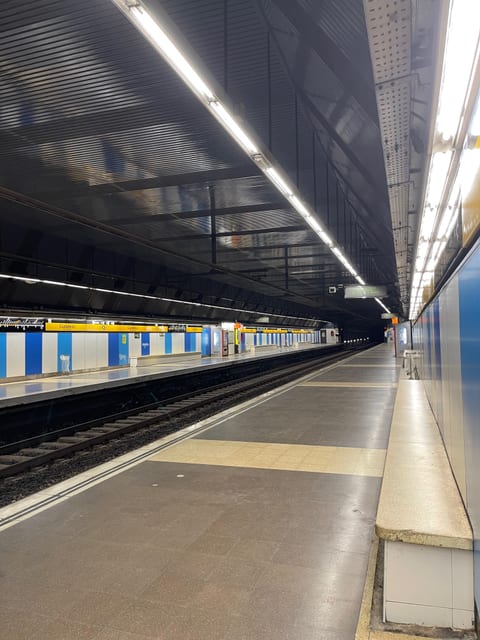 +1
+1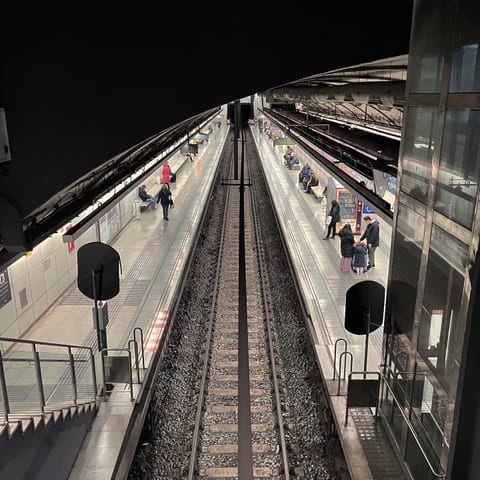
Quick facts
- Operators
- The metro map is really a joined-up system: TMB runs most metro lines, while FGC runs several urban rail lines that behave like metro inside the city.
- As a visitor, you usually do not need to care which operator is under the hood.
- City ticket
- For normal city movement, the T-Casual is still the easy ten-journey choice for one person.
- It is loaded onto T-mobilitat now, and it is not valid at the L9 Sud airport stations.
- T-CasualT-mobilitat
- Transfers
- Integrated tickets cover metro, FGC, tram, and bus inside the zones you bought. Validate when you enter or board, transfers can still count as one journey inside the transfer window.
- Do not treat it like London-style open-loop contactless. It is a local ticketing system.
- Integrated fare
- Airport
- The metro reaches BCN on L9 Sud, but it is rarely the easiest arrival if you are going central with luggage.
- It works better for Fira, Collblanc, Torrassa, or Zona Universitària than for a first central hotel.
- Airport linkL9 Sud
- Regional trips
- Montserrat, Sitges, and other regional trips are not the same thing as your normal Zone 1 city riding.
- Buy the right Rodalies or FGC ticket instead of assuming the city pass covers the day trip.
- Regional rail
- Built form
- The trains can look older, but the loading gauge and station feel are more modern than many older European metros.
- That fits Barcelona: much of the city tourists use is modern or modernized rather than medieval.
- MetroModern tram
Mike’s notes
Barcelona is easy to use once you stop caring which company runs the line. The map presents a single practical network. TMB, FGC, tram, and bus all sit under the same daily decision: what ticket do I have, what zone am I in, and do I need a regional train instead?
For city days, I would usually start with a T-Casual. It is the ten-journey ticket, it works for one person, and it covers the normal metro/tram/bus pattern inside the zone you bought. It is not the airport metro ticket, and it is not a magic day-trip pass.
Network character
Barcelona's metro has old pieces, but it does not feel tiny in the London deep-Tube sense. The trains and platforms are mostly modern-sized enough that the system feels built for a 20th-century city, not squeezed through Victorian tunnels.
The strange part is the geometry. Some parts of the map look as if they want to become rings or clean cross-city connectors, but the system grew through separate operators, inherited railways, and unfinished projects. L9/L10 is the obvious example: a huge automated idea with useful outer sections and a missing middle that keeps the airport branch from feeling as natural as it should.
Airport and day trips
Yes, the metro technically goes to the airport. I rarely use it that way. L9 Sud is fine if you are staying near Fira, Collblanc, Torrassa, or somewhere that lines up with the branch. For most central stays, especially with bags, the taxi or Aerobús is less annoying.
It is also the wrong mental model for Sitges or Montserrat. Sitges is a Rodalies trip. Montserrat is an FGC-plus-mountain-railway sort of day. Buy the right regional ticket and treat those as separate from your normal city metro rides.
Trams and streets
The trams matter because Barcelona's big streets matter. They help explain the newer, more planned parts of the city. You validate when you board, and the same integrated fare world applies, but I would think of the tram as a thoroughfare tool more than a subway substitute.
Short history
1924
Gran Metro opens
Barcelona's first metro opens between Lesseps and Catalunya, the ancestor of today's L3.
1926
The Transversal
The first Transversal Metro section opens between Bordeta and Catalunya, the origin of today's L1.
1961
Network consolidation
The Gran Metro and Transversal systems merge into the Ferrocarril Metropolitano de Barcelona, the predecessor of the TMB metro network.
2004
Modern trams return
The Trambaix and Trambesòs networks make the tram part of the metropolitan street system again, especially along big corridors like Diagonal.
2009-2016
Automated L9/L10
The L9/L10 project adds deep automated sections, eventually including the airport branch, but the network still has missing middle pieces that make the map feel less circular than it wants to be.