Marrakech is overwhelming, and that is the trip
My Marrakech travel guide. Where to stay in a riad, the medina and souks, Jemaa el-Fnaa, the palaces and gardens, and the faux-guide scams.
- Updated
- Jul 6, 2026
Current conditions and the practical reference material that helps turn the saved places into a trip.
7-day forecast from Open-Meteo. UV badges flag days when sun protection matters (3 and above is moderate; 8 and above is risk territory for unprotected fair skin within 30 minutes).
Typical highs around 35°C, lows around 18°C. The drier end of the year.
Typical highs around 19°C, lows around 6°C. Most of the year’s greyest, wettest weeks.
Public holidays from Nager.Date.
Public-transit operators within 8 km of the city center. Click through to each operator’s site for routes, fares, and tickets.
Operators and modes are aggregated from individual transit-agency GTFS feeds. Route classifications come from each feed’s route type codes.
Marrakesh or Marrakech is the fourth-largest city in Morocco. It is one of the four imperial cities of Morocco and is the capital of the Marrakesh-Safi region. The city lies west of the foothills of the Atlas Mountains.
The links below support the changing or licensed reference material on this page. Personal notes and ordinary geographic facts are not footnoted individually.
Monthly highs, lows, rainfall — long-term averages, NASA POWER.
Maps, image licenses, and the full dataset registry are listed in site credits.
My Marrakech travel guide. Where to stay in a riad, the medina and souks, Jemaa el-Fnaa, the palaces and gardens, and the faux-guide scams.
Marrakech is a Moroccan city at the foot of the High Atlas, and the part you came for is all inside the walls of the medieval medina: the souks, Jemaa el-Fnaa, the palaces, the riads down car-free lanes. The medina and the High Atlas require separate planning. This guide also covers the common scams.
Planning brief
Marrakech is a Moroccan city of about a million people at the foot of the High Atlas, and the part most visitors come for is the walled medina, the souks, the squares, the palaces, and the riads. The mountains and Atlantic coast require separate excursions from the city.
The walled old city holds the souks, Jemaa el-Fnaa, the palaces, and the gardens. Trips to the High Atlas or Atlantic coast require separate transport.
A riad is a restored courtyard house in the medina, and staying in one is half the trip. Gueliz, the modern new town, is the easier base for taxis and quiet but it is not the Marrakech you came to see.
The covered market lanes north of Jemaa el-Fnaa are the heart of the old city. Getting lost in them is the point. Save the haggling energy and expect to walk the same lane twice.
The High Atlas starts an hour from the city and Essaouira sits three hours west on the Atlantic. Both require a dedicated road excursion from Marrakech.
Three or four days is the shape of a first trip. That covers Jemaa el-Fnaa by day and by night, a proper wander through the souks, the main palaces and gardens, and enough unhurried time in the medina that you stop counting sights and start reading the place. Two days works if Marrakech is one stop on a wider Morocco route through Fez and the coast.
The medina is dense, and the heat sets the pace from May through September, when afternoons climb past 100°F. Plan the walking for the morning and the early evening, and treat the middle of the day as courtyard-and-mint-tea time. In summer, pay up for a riad with a plunge pool.

Marrakech Menara Airport (RAK) sits about 6 km southwest of the medina, a 15-minute drive in normal traffic.
A petit taxi to Jemaa el-Fnaa should run roughly 70 to 100 dirham. The meters are rarely used for airport runs, so agree the fare before you get in rather than after. Bus 19 runs an airport loop to Jemaa el-Fnaa and on through Gueliz for about 30 dirham, which is the cheap option if you are traveling light.
The easiest arrival is a riad pickup. Cars cannot reach most medina addresses, so the riad sends someone to meet you at a set drop point and walk you in through the lanes. For a first arrival, with luggage, in a maze you do not yet know, the small fee saves you a lost half-hour.
Do not plan much around the airport itself. It works fine as an entry and exit point, but the food options are weak and expensive. La Table du Marché is the kind of place I would only use because I was already airside and needed something before boarding.
Morocco's ONCF trains connect Marrakech to Casablanca, Rabat, Tangier, and the airport-rail network if you are arriving overland. The station, Gare de Marrakech, is in Gueliz, a short taxi from the medina.
For a first trip, I would stay in a riad inside the medina rather than a hotel in the modern districts.
A riad is a traditional Moroccan courtyard house, built inward around a central patio or small garden, with the rooms looking onto the quiet middle rather than the street. Most medina riads are small, often under ten rooms, frequently restored with real care, and the courtyard does the work of shutting out the noise of the lanes. Staying in one is half of what the trip is. You give up something real: you walk in and out through the souks, cars cannot reach the door, and the lanes are hard to learn for the first day.
Gueliz and Hivernage are the modern new-town districts west of the walls, laid out by the French with wide streets, larger hotels, pools, and easy taxis. They are calmer and more convenient, and they put you a ten-minute taxi from the old city. Pick them if a quiet, low-effort base matters more than atmosphere.
Two properties I have actually stayed at:
| Property | Where | Why pick it | Trade-off |
|---|---|---|---|
| Nobu Hotel Marrakech | Hivernage / new town | Tastefully decorated interiors, large modern rooms, 10-minute walk from the medina. The cleanest upscale base if you do not want to commit to a riad | Outside the medina, so you give up the courtyard-cocoon feeling that is half the trip |
| Le Méridien N'Fis | Hivernage | The courtyards, lobby, grounds, and pool are the highlight | The rooms themselves have seen better days. The hard product needs renovation. Book for the grounds and treat the room as a place to sleep |
Otherwise, book a small medina riad on the usual sites, read recent reviews for the specific property, and confirm the riad arranges an airport pickup and a medina escort.

Jemaa el-Fnaa, the great square, is the center of the medina and the place the city turns itself on. By day it is orange-juice carts, snake charmers, and water sellers. After dark it fills with food stalls, musicians, and storytellers, and the smoke and the crowd are the show. It is touristy and it is also the real heart of the city. Go in the evening and eat something.
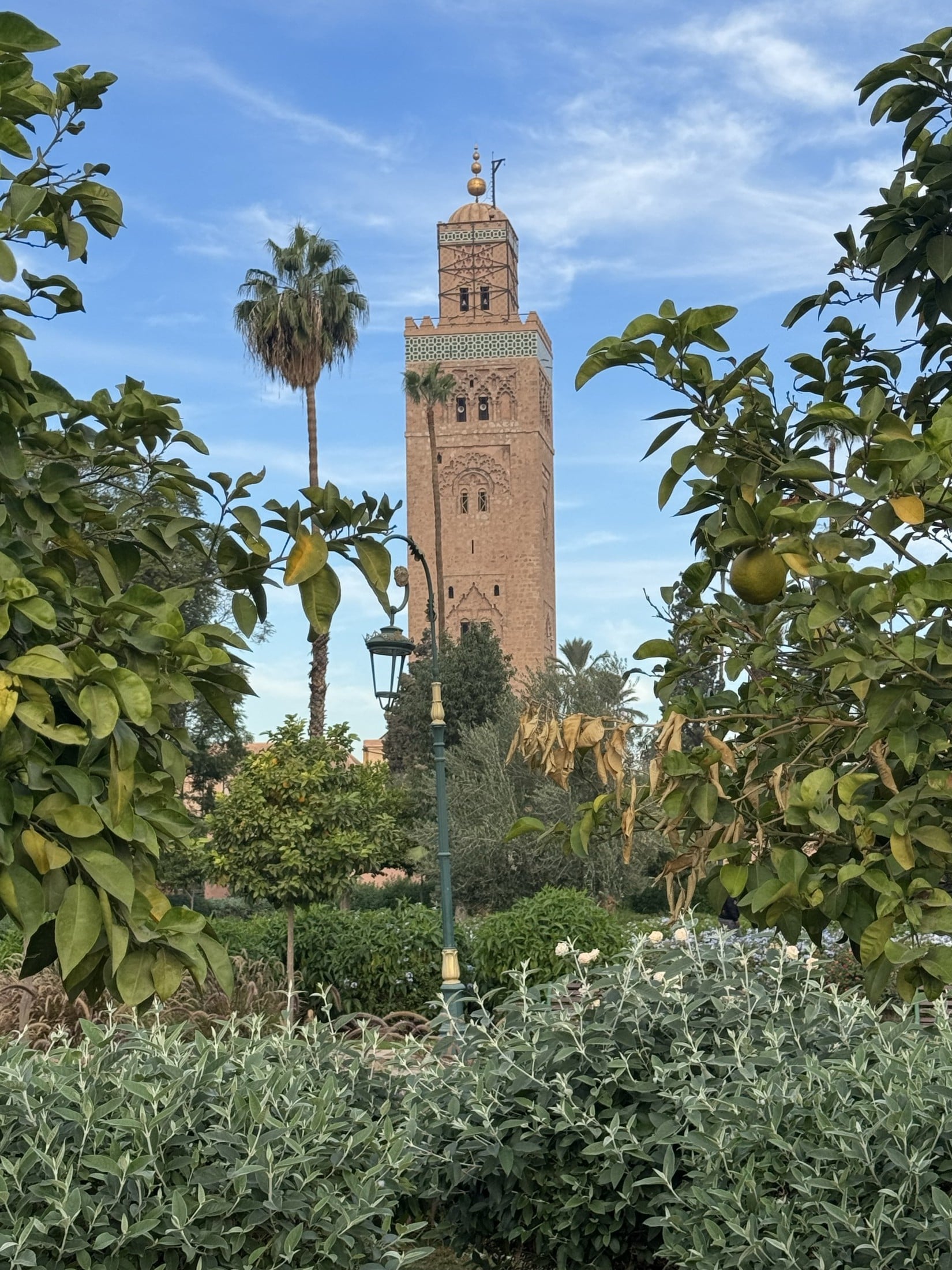
Koutoubia, the Koutoubia Mosque, stands just southwest of the square. Its 12th-century minaret is the tallest building in the medina and the landmark you navigate by when the lanes lose you. The mosque itself is closed to non-Muslims, but the gardens around it are open and the minaret is the orientation point of the whole old city.
The souks run north from Jemaa el-Fnaa, a covered warren of market lanes sorted loosely by trade. Souk Semmarine is the main artery, the wide entrance lane that feeds the smaller souks for leather, metal, lanterns, spices, and dyed wool. Getting lost is unavoidable and is the point. Prices are negotiable, the first number is high, and walking away is the strongest move you have.
Beyond the souks, the Ben Youssef Madrasa is the restored 16th-century Quranic school in the northern medina, one of the most beautiful interiors in the city, and Le Jardin Secret is a restored palace garden mid-medina that makes a good cool break from the lanes.
Bahia Palace is the 19th-century palace in the southern medina, a sprawl of courtyards, painted cedar ceilings, and tiled rooms built for a grand vizier. It is the easiest palace to reach on foot from Jemaa el-Fnaa and the one to see if you only see one. Nearby, the Saadian Tombs are the 16th-century royal necropolis next to the Kasbah Mosque, sealed for centuries and reopened in 1917, small but a short queue.
Outside the walls, the Jardin Majorelle in Gueliz is the cobalt-blue garden created by the painter Jacques Majorelle and later owned by Yves Saint Laurent, now paired with the YSL Museum next door. It is the most-photographed spot in the city and tickets sell out, so book the timed entry online before you go.
| Spot | Why | Notes |
|---|---|---|
| Restaurant Lafarmacie | The dinner pick | The best meal of my week was here |
| Restaurant Le Jardin Ben Youssef | A garden lunch | A peaceful oasis in the middle of the crazy winding lanes. Cool inside the gardens even in mid-afternoon heat |
| LM Bar | An evening drink | Classy, tends to be empty in the evenings. Beers around $6 to $7, cocktails around $10. Live music some nights |
| Chili's | An unexpected backup | Yes, the chain. The staff at this location are kind, polite, and quick, and the outdoor patio is shared with a Papa John's. Sometimes that is the trip you want |
| BlackChich | Casual | Pinned |
| Cafe Chez Zaza | Casual | Pinned |
| Cafe Restaurant Dar L'hssira | Casual | Pinned |
The food itself is Moroccan staples done well: tagine, couscous on Fridays, harira soup, grilled brochettes, and mint tea with everything. The Jemaa el-Fnaa night stalls are an experience to have once, with the caveat that you pick a busy stall and check the bill.
Marrakech is safe. The constant is the hustle, not danger, and a firm no handles nearly all of it.
The faux guide. A friendly local tells you the souk ahead is closed, or that there is a Berber market or a tannery "just today," and offers to walk you there. The destination is a shop that pays commission, and a fee will be expected at the end. Real licensed guides carry a badge. If you did not hire someone, you do not have a guide.
The wrong-way redirect. A version of the same move: someone insists the lane you are walking is closed or dangerous and points you another way, toward a shop or a dead end where a fee is requested for the "help." Trust your map and keep walking.
The henna women. In Jemaa el-Fnaa, women will reach for your hand and start applying henna before you have agreed to anything, then demand payment. Keep your hands to yourself and do not stop.
The square performers. The snake charmers, the monkey handlers, and the water sellers in Jemaa el-Fnaa expect payment for a photo, including a photo taken from a distance. If you do not want to pay, do not photograph them. A few coins settles it if you do.
Taxi fares. Petit taxi meters are often "broken" for tourists. Agree the fare before the ride, or ask the riad what the trip should cost.
None of this is aggressive, and none of it follows you far. The medina is worked by people making a living from visitors, and a steady walk with a clear no is the whole defense.
Marrakech sits at the foot of the High Atlas and three hours from the Atlantic, so a day out of the city changes the landscape completely. The day trips from Marrakech page covers the High Atlas and Imlil, the walled port at Essaouira, the Ourika Valley, and Ouzoud Falls. All are long days, and the practical choice is a hired driver or a tour rather than piecing together public transport.


