
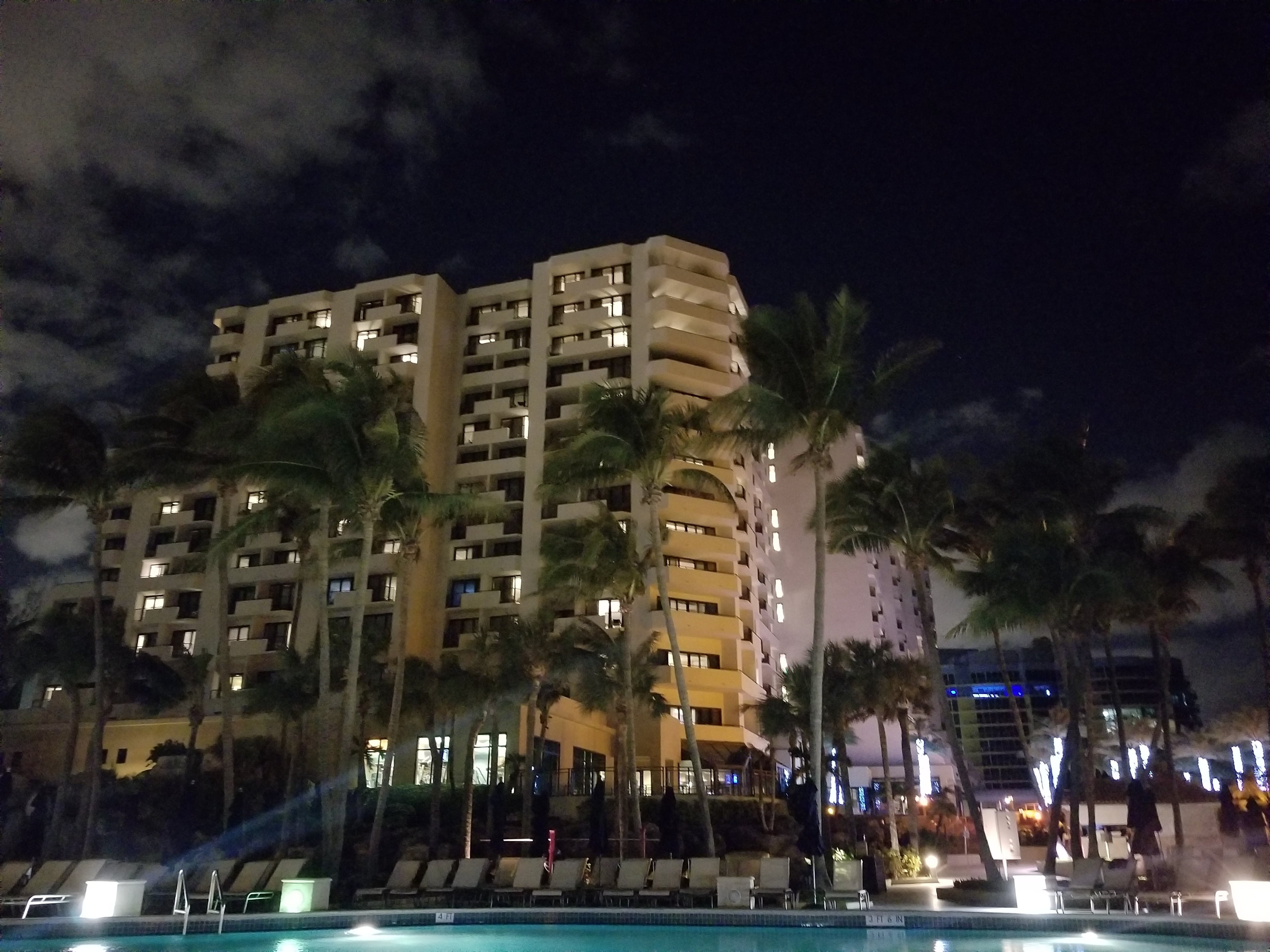
Miami is South Beach, but the city is the rest of it
My Miami travel guide. South Beach and the Art Deco District, Wynwood, Little Havana, where to stay, and where to eat.
- Updated
- Jul 7, 2026
Current conditions and the practical reference material that helps turn the saved places into a trip.
7-day forecast from Open-Meteo. UV badges flag days when sun protection matters (3 and above is moderate; 8 and above is risk territory for unprotected fair skin within 30 minutes).
About 74% of the year's rain falls in these months. Typical highs around 29°C, lows around 27°C.
About 57mm of rain a month, against 165mm in the wet season.
Public holidays from Nager.Date.
Public-transit operators within 8 km of the city center. Click through to each operator’s site for routes, fares, and tickets.
Miami is a coastal city in the U.S. state of Florida. It is the second-most populous city proper in Florida, with a population of 442,241 at the 2020 census. The Miami metropolitan area in South Florida has an estimated 6.39 million residents, ranking as the fifth-largest metropolitan area in the Southeast and eighth-largest metropolitan area in the United States. Miami has the third-largest skyline in the U.S. with over 300 high-rises, 70 of which exceed 491 ft (150 m). It is the county seat of Miami-Dade County.
The links below support the changing or licensed reference material on this page. Personal notes and ordinary geographic facts are not footnoted individually.
Monthly highs, lows, rainfall — long-term averages, NASA POWER.
Operators and modes are aggregated from individual transit-agency GTFS feeds. Route classifications come from each feed’s route type codes.
Maps, image licenses, and the full dataset registry are listed in site credits.
My Miami travel guide. South Beach and the Art Deco District, Wynwood, Little Havana, where to stay, and where to eat.
Miami is a warm, Latin-inflected Florida metropolis of beaches, Art Deco, and deep Cuban and Latin American food. South Beach, Wynwood, Little Havana, and the mainland districts require separate routes.
Planning brief
Miami is a city on the southeast coast of Florida, a warm, Latin-inflected metropolis of beaches, Art Deco, and a deep Cuban and Latin American food culture. Most first trips fix on South Beach, but the city beyond it, Wynwood, Little Havana, Brickell, is the better half. The beach districts and mainland neighborhoods require separate routes.
That covers the beaches, the Art Deco District, Wynwood, and Little Havana, with time to eat across the city's Latin American range.
The Art Deco strip and the beach are the image of Miami, but Wynwood's murals and Little Havana's Calle Ocho are where Miami gets interesting.
South Beach for the beach and nightlife, Brickell for a modern downtown base, Wynwood for the arts scene. A car or rideshare links them.
Winter and spring are warm and dry and busy. Summer is hot, humid, and storm-prone, with hurricane season running into the fall.
Three or four days is the shape of a Miami trip. That covers the beaches and the Art Deco District, the Wynwood murals, and Little Havana, with time to eat across the city's Latin American range.
Miami is also the launch point for the Florida Keys and the Everglades. If either is on the list, add a few days and a rental car.
Miami International Airport (MIA) sits about 8 miles from the beaches. Rideshare and taxis are the usual way in, around 20 to 30 minutes to South Beach depending on traffic. The Metrorail connects the airport to downtown.
Miami is a spread-out, car-oriented city. Fort Lauderdale airport to the north is the other arrival option, often cheaper for flights. Once here, plan on rideshare or a rental car rather than relying on transit.
Miami Metrorail is useful when your trip lines up with the rail spine: MIA, downtown, Brickell, Civic Center, Dadeland, and Tri-Rail. It is not a South Beach train, so do not force it for the beach with luggage.
Metromover is the free elevated downtown circulator. Use it for Brickell, downtown, Bayside Marketplace, Government Center, Kaseya Center, and short hot-weather hops after you are already in the center.
Pick a base by the kind of trip you want.
| Area | Why pick it | Trade-off |
|---|---|---|
| South Beach | On the sand, in the Art Deco and nightlife scene, where many first trips start | Busy, pricey, and loud at night |
| Brickell | The modern downtown high-rise district, walkable, strong for dining | A city base rather than a beach one |
| Wynwood / Design District | The arts-led base, murals, galleries, and bars | Not on the beach, quieter after dark |
| Mid-Beach | Still on the ocean but calmer than South Beach | Further from the nightlife and the Art Deco strip |
The atlas does not yet carry hotel pins for Miami, so book on the usual sites and read recent reviews for the property.
South Beach is the famous one: the wide sandy beach, the lifeguard towers, and the Art Deco District along Ocean Drive and Collins Avenue, a dense run of pastel 1930s buildings best seen on foot in the morning light.
Wynwood is the former warehouse district turned arts quarter, anchored by the Wynwood Walls outdoor murals and now full of breweries, galleries, and restaurants. Little Havana, centered on Calle Ocho (SW 8th Street), is the heart of Cuban Miami, with cigar shops, the domino park, and the cafecito counters. Brickell is the glassy downtown financial district, and downtown holds Bayside Marketplace, the waterfront shopping and dining complex on Biscayne Bay, a departure point for bay cruises.
The beaches run the length of the barrier island, from South Beach north through Mid-Beach and beyond, all wide, warm, and free.
Miami eats on Cuban and Latin American cooking above all, from Cuban sandwiches and cafecito to Argentine grills and Peruvian kitchens, with a high-end scene on top.
Notes are thin, though two pins carry a 5 rating.
| Spot | What it is | Rating |
|---|---|---|
| Baby Jane | A cocktail house and noodle bar | 5/5 |
| Bayside Marketplace | A waterfront shopping and dining complex downtown | 5/5 |
| Baires Grill Brickell | An Argentine steakhouse in Brickell | Pinned |
| Pollos & Jarras | Peruvian | Pinned |
| STK Steakhouse | A steakhouse | Pinned |