Photos from The Hague
 +2
+2SkyView de Pierattraction
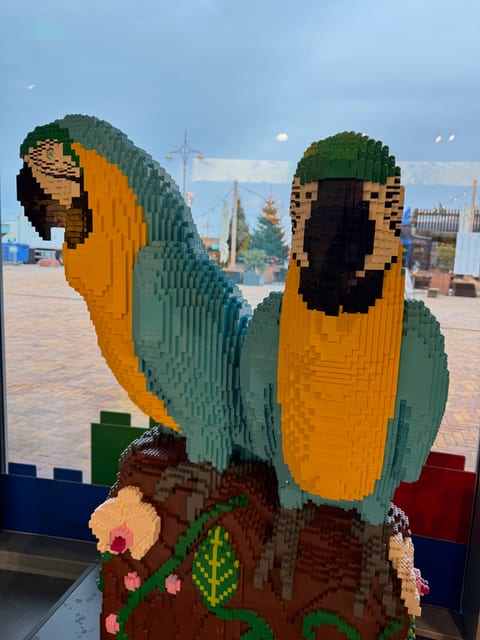
LEGOLAND® Discovery Centre Scheveningenattraction

Mauritshuisattraction
 +2
+2Binnenhof and Hall of Knightsattraction
+2+2Current conditions and the practical reference material that helps turn the saved places into a trip.
7-day forecast from Open-Meteo. UV badges flag days when sun protection matters (3 and above is moderate; 8 and above is risk territory for unprotected fair skin within 30 minutes).
Typical highs around 20°C, lows around 14°C.
Typical highs around 7°C, lows around 3°C.
Public holidays from Nager.Date.
Public-transit operators within 8 km of the city center. Click through to each operator’s site for routes, fares, and tickets.
The Hague is the capital city of the South Holland province of the Netherlands. With a population of over half a million, it is the third-largest city in the Netherlands. Situated on the west coast facing the North Sea, The Hague is the country's administrative centre and its seat of government, and has been described as the country's de facto capital since the time of the Dutch Republic, while Amsterdam is the official capital of the Netherlands.
The links below support the changing or licensed reference material on this page. Personal notes and ordinary geographic facts are not footnoted individually.
Monthly highs, lows, rainfall — long-term averages, NASA POWER.
Operators and modes are aggregated from individual transit-agency GTFS feeds. Route classifications come from each feed’s route type codes.
Maps, image licenses, and the full dataset registry are listed in site credits.
My Hague travel guide. The Mauritshuis Vermeer, Escher in het Paleis, the Peace Palace, Madurodam, Scheveningen, and The Hague as a cheap base for Amsterdam.
The Hague is calmer, cheaper, and more walkable than Amsterdam, with two world-class museums and a real beach 15 minutes away by tram. Rooms run far cheaper than Amsterdam's, 50 minutes up the line, which also makes The Hague a useful Randstad rail base.
Planning brief
The Hague is the easiest "alternative to Amsterdam" the Netherlands has. Cheaper hotel rooms, the best Vermeer in the world, a real beach 15 minutes by tram, and the international-law seat of government on the way. 50 minutes by train from Amsterdam Centraal.
The museums, the Peace Palace, and the coast connect easily from a central base. Amsterdam is 50 minutes by train and Rotterdam is 25.
Mauritshuis sells out by mid-afternoon in season. Escher in het Paleis is fine as a walk-up most weekdays. Madurodam requires online timed entry. Peace Palace tours need advance booking and a passport at the door.
NS trains, HTM trams, regional buses all run on OVpay. Tap a contactless card or phone wallet at the gate or the pole. No upfront top-up, no paper ticket.
Scheveningen is 15 minutes by tram from Den Haag Centraal. Pier rides, beach huts, a wide flat boardwalk. Combine a morning in town with an afternoon by the water.
| Window | Months | What to expect |
|---|---|---|
| Best | May to early September | Long days, warm evenings, the coast usable, café terraces full. Book hotels and the Mauritshuis early |
| Shoulder | April, late September, October | Cooler, fewer crowds at the museums, café energy holds up indoors. The Christmas lights along Lange Voorhout start in late November |
| Quiet and gray | November to March | Short days, frequent rain, but the museums and Sky Bar carry the trip. Hotel rates drop |
Rain is possible in any month, and late June can bring sunset after 22:00.
The Hague has one calendar day that changes the center: Prinsjesdag, the State Opening of Parliament.
| Event | When | What it changes |
|---|---|---|
| Prinsjesdag | Third Tuesday of September | Royal procession, parliamentary ceremony, flags, crowds, and full center hotels |
| North Sea Jazz spillover | Mid-July | The festival is in Rotterdam, but The Hague rooms can fill too |
| Tong Tong Fair | Late May to early June | Indonesian-Dutch food, music, dance, and culture at Malieveld |
| The Hague Jazz | Usually summer | Jazz across central venues |
| Veterans' Day | Last Saturday of June | Civic ceremonies and a military parade through the center |
| Liberation Day | May 5 | National holiday with free concerts and city events |
| King's Day | April 27 | More civic than Amsterdam, with local street parties |
| CPC Loop | Mid-March | Half-marathon road closures through The Hague and Scheveningen |
| Christmas Market | Late November to late December | Compact market around the Plein |
The Hague has two stations. Den Haag Centraal (CS) is the larger and newer, with a glass roof and direct connections to everywhere. Den Haag Hollands Spoor (HS) is older, smaller, and convenient if your hotel sits on the south side near the World Forum.
| Origin | Mode | Time | Notes |
|---|---|---|---|
| Amsterdam Centraal | NS Intercity | ~50 min | Every 10–15 min, ~€14, tap a card at the gate |
| Schiphol Airport | NS Sprinter / Intercity | ~30–40 min | Some Schiphol services stop at Den Haag HS first. Check the platform display |
| Rotterdam Centraal | NS Intercity | ~25 min | Every 10 min, ~€6 |
| Brussels | Eurostar / NS Intercity | ~3 hours | Change at Rotterdam if needed |
| Inside the city | Tram and bus | 5–25 min | HTM operates the tram and bus network. OVpay accepted |
The Hague is small enough that most of the museum-and-palace core is walkable. The exceptions are Madurodam (tram 9) and Scheveningen (tram 1 or 9), which is where the HTM tram/RandstadRail layer matters. For day trips, NS runs every 10 minutes to Delft, Leiden, Rotterdam, and Amsterdam.
A note on cards. All of NS, HTM, and the regional buses accept contactless bank cards or a phone wallet directly under OVpay. Tap in, tap out, charged per kilometer. There is no need to buy a paper ticket or carry an OV-chipkaart. You must have a valid fare to ride. The spot fine for getting caught without one is €50 in cash. Visa, Maestro, and Mastercard all work for the tap. Discover and AMEX are less reliably accepted.
The Hague city center is compact. Anywhere within a 10-minute walk of the Binnenhof puts the museums on foot and the trams at hand. Hotels are about a third cheaper than equivalent Amsterdam properties.
| Hotel | Where | Why pick it | Trade-off |
|---|---|---|---|
| voco The Hague | City center, blocks from the Binnenhof | Sets the bar for new IHG properties. Set in a restored former bank building. Light, airy rooms, great showers, breakfast small but high quality. Rates often around €125/night | Books out on weekends |
| Hotel Indigo The Hague Palace Noordeinde | City center, opposite the royal palace | Set in another former bank building. Each room is individually decorated and the dinner-in-the-bank-vault is the kind of trip story that pays for itself | Boutique-property pricing |
| Staybridge Suites The Hague Parliament | Lange Houtstraat, two blocks from the Binnenhof | My favorite hotel in The Hague. Right across from parliament, spacious rooms, in-building laundry, happy hour on Wednesdays and Thursdays. Best for longer stays. Rates €100–€200 depending on dates | Has crept up in price. Flexible dates required for the lower end |
| Hotel Des Indes | Lange Voorhout | The historic grand hotel. Anna Pavlova lived (and died) here in 1931, Churchill stayed, Empress Sisi and Mata Hari are on the documented guest list | Top of the budget for the city |
If you are basing outside Amsterdam to save money, this is the cleanest version of that play. From The Hague you reach Amsterdam in 50 minutes, Rotterdam in 25, and Schiphol in 30, so museums across all three cities remain accessible by direct rail.
The Mauritshuis is the highlight of the city for almost every first-time visitor. It is the royal collection housed in a 17th-century palace on the corner of the Binnenhof. Inside are Vermeer's Girl with a Pearl Earring, Rembrandt's Anatomy Lesson of Dr Nicolaes Tulp, Carel Fabritius's Goldfinch, and a deep bench of other Dutch Golden Age work.
| Field | Detail |
|---|---|
| Admission | €21 adult. €4 after 4pm daily (introduced 2026) |
| Hours | Tue–Sun 10:00–18:00, Mon 13:00–18:00, Thu late opening to 20:00 |
| Booking | Online timed entry strongly recommended. Sells out by mid-afternoon in season |
| Time on site | 1.5–2 hours |
| Closest station | Den Haag CS, 8-minute walk |
The €4 after-4pm ticket is the play if your day is already packed. The collection is small enough to do in 90 minutes if you focus on the famous rooms. The new wing across the Hofvijver doubles the space and pairs with the older palace via an underground passage.
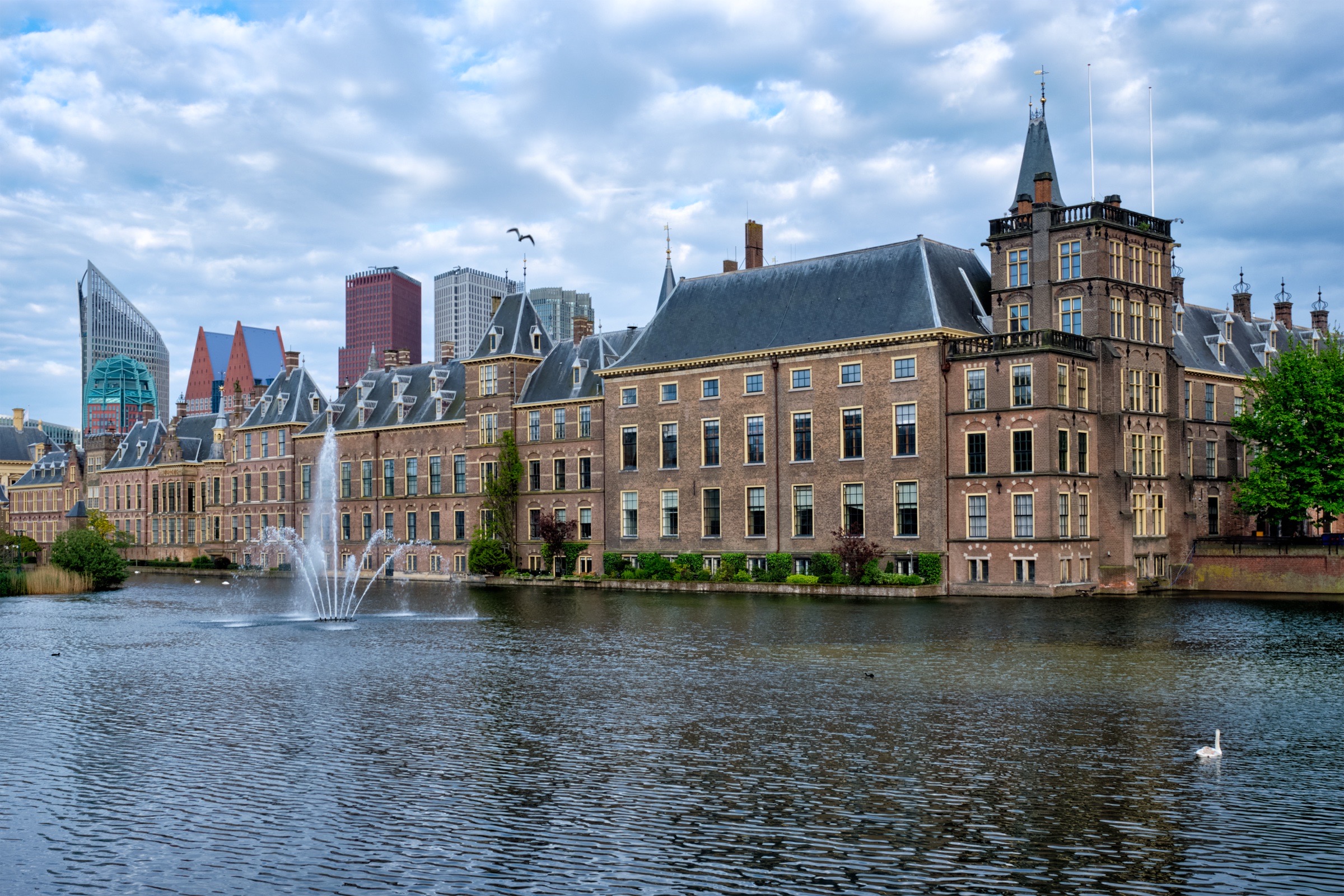
The Binnenhof is one of the oldest parliament buildings still in active use anywhere. The complex dates from the 13th century and the central courtyard, the Hofvijver, is the most-photographed corner of the city. The 13th-century Ridderzaal (Knights' Hall) holds the throne where King Willem-Alexander opens parliament every September.
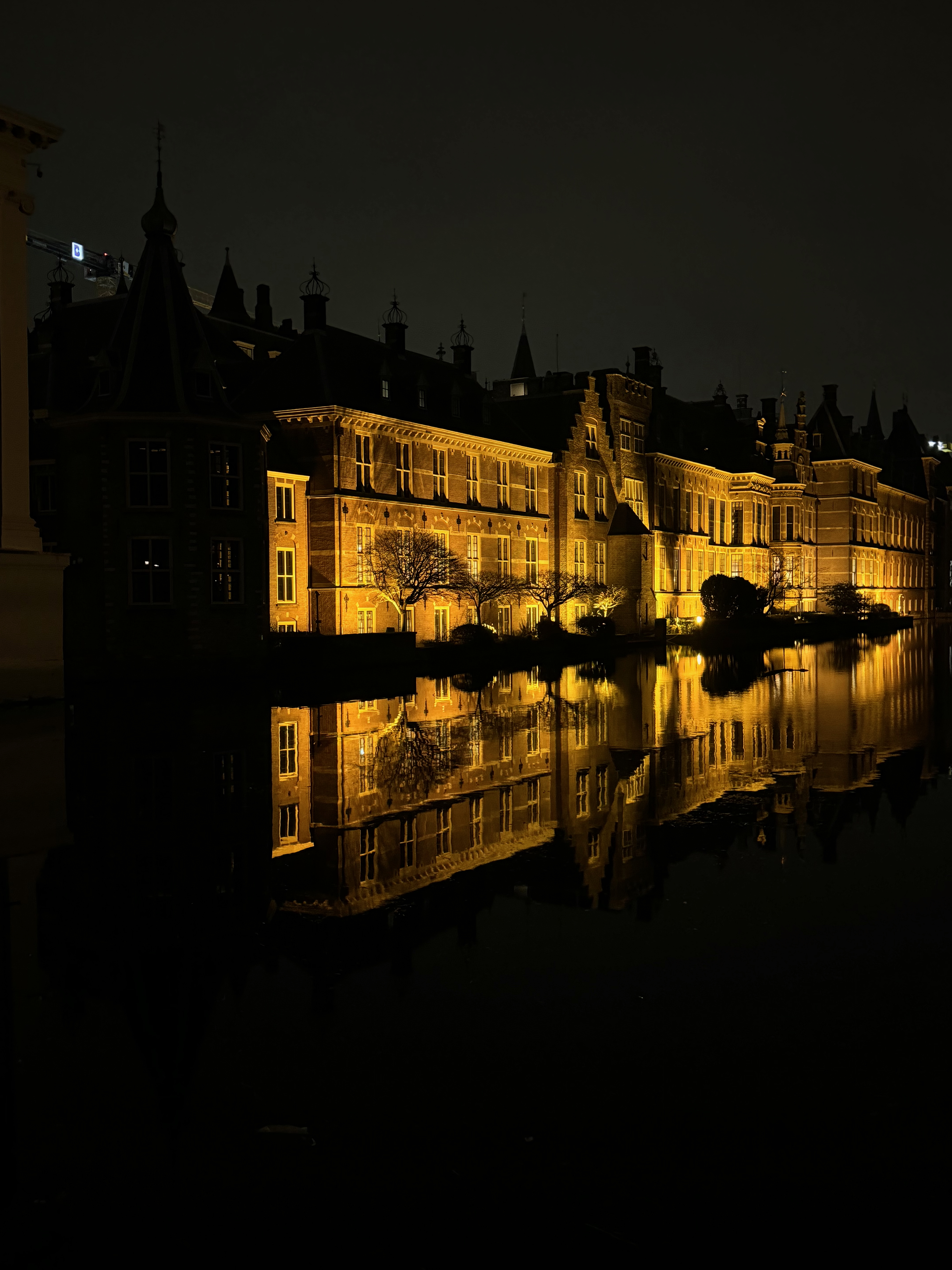
The buildings are best admired from outside. Guided tours of the interior are organized by ProDemos and need advance booking. When the chambers are in session the tours are suspended.
A 5-minute walk from the Binnenhof takes you through the city center proper, including the 19th-century covered shopping arcade De Passage (UNESCO-listed since 2009 as part of the broader heritage inscription). The arcade still holds the original tile floor, decorated cast-iron columns, and a handful of independent shops, including the Hop & Stork chocolate counter where they hand-make the chocolates on site.
A short walk north of the Binnenhof, the Paleis Noordeinde is the working palace of King Willem-Alexander. It is not open to the public, but the exterior and the gardens are visible from the street and take about 10 minutes to walk.
The Escher in het Paleis museum is the second of the city's two top-tier museums. It sits inside the former winter palace of Queen Emma, the great-great-grandmother of the current king, on the elegant tree-lined Lange Voorhout.
| Field | Detail |
|---|---|
| Admission | ~€15 adult |
| Hours | Tue–Sun 11:00–17:00, closed Mon |
| Booking | Walk-up usually works on weekdays. Book online for weekends |
| Time on site | 1 hour |
The collection is the complete Escher: the impossible staircases, the metamorphoses, the tessellations, the printmaking that influenced two generations of graphic designers. The top floor is the trick of the place: interactive exhibits that let you experience the perspective tricks Escher drew on paper. The Hans Van Bentem chandeliers throughout the palace are a draw in their own right.
The combination of the Mauritshuis and Escher in het Paleis is the natural museum half-day. They sit 5 minutes apart on foot.
The Peace Palace is one of the distinctive things about The Hague: the building of the International Court of Justice, the principal judicial organ of the United Nations, and the Permanent Court of Arbitration. It is the only court of the UN system located outside New York.
| Field | Detail |
|---|---|
| Visitor Center | Free, open Tue–Sun 11:00–17:00 |
| Interior guided tour | ~€11, ~1 hour, advance booking required |
| Tours suspended | When the Court is in session |
| Bring | Passport or EU ID at the entry |
| Closest stop | Tram 1 to Vredespaleis |
The Visitor Center stands on its own as a short stop, with exhibits on the history of the building, the international peace movement, and the cases that have shaped the modern court. The interior tour, when it runs, takes you through the great hall, the courtroom, and the library, with stained-glass windows, marble floors, and gifts from member states (a vase from Russia, a jade altar from China, a fence from Germany).
If the Court is sitting the tour is off, and there is no way to know weeks in advance. Booking is online and refundable. Treat it as a "see if it works" rather than a fixed plan.
Madurodam is the trip's other most-quoted attraction: the entire country reproduced at 1:25 scale, with miniature canal houses, working Schiphol, tulip fields in season, a tiny Peace Palace, and live train movements at the model Centraal Station.
| Field | Detail |
|---|---|
| Admission | €22.50 online, €24.50 at the gate |
| Hours | 09:00–20:00 (reduced Sep–Mar) |
| Booking | Online timed entry required. Gate tickets only when capacity allows |
| Time on site | 2 hours minimum, longer with kids |
| Closest stop | Tram 9 from Centraal |
The park is best from late April through September when the model canals are filled with water and the tulip fields are real. Some exhibits go offline for renovation in winter. The website lists which.
Madurodam is the easy half-day with kids, and is a surprisingly engaging stop without them. It is also the only place in the Netherlands where you can see all of the Netherlands without renting a car.
Scheveningen is the Hague's seaside neighborhood, 15 minutes by tram from the city center. The boardwalk runs about 4km along a wide sandy beach, and the Scheveningen Pier carries a small amusement complex over the water at the central point.
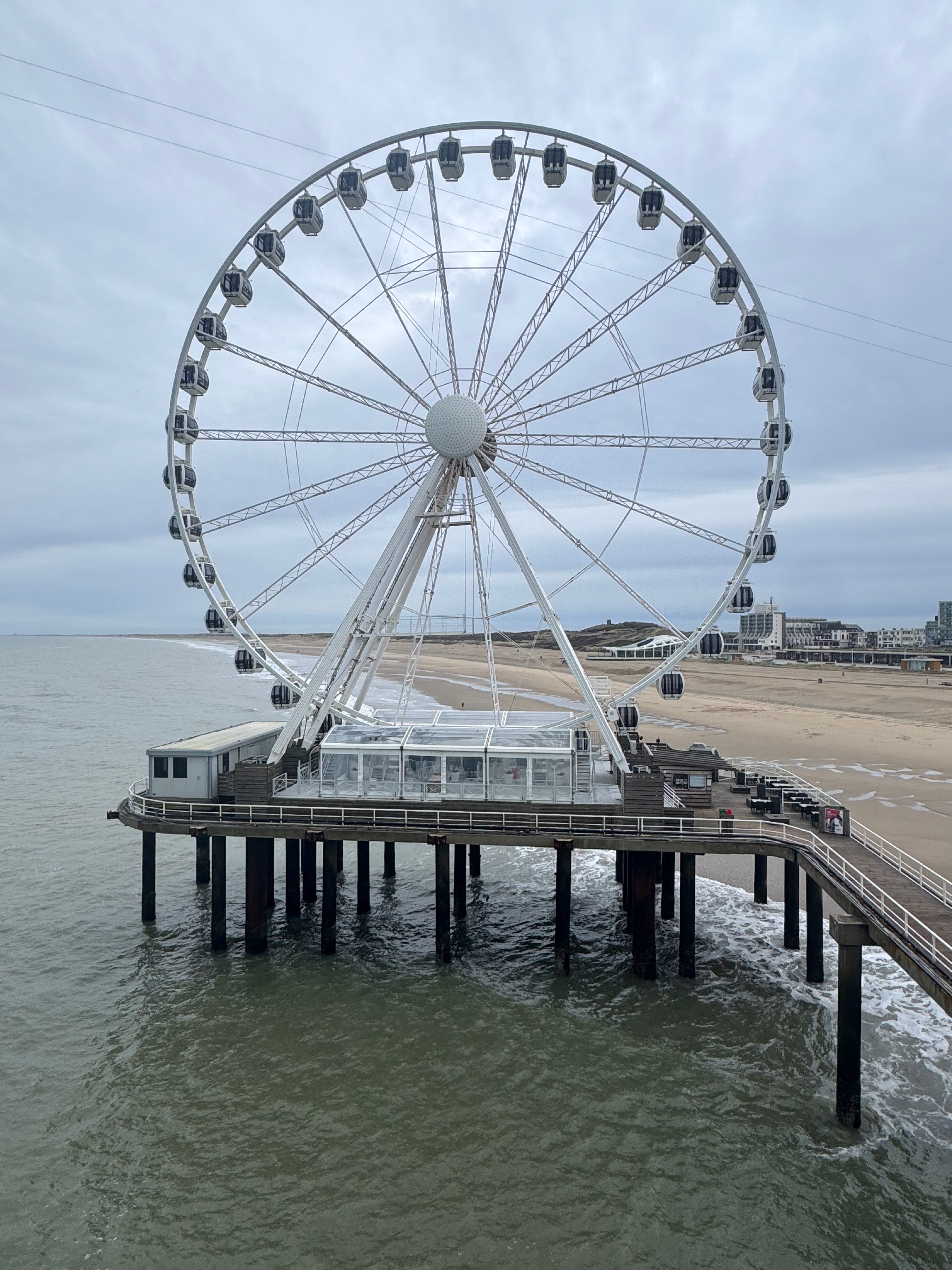
The pier has a Ferris wheel (~€11 per person, 36-car loop, ~20 minutes), a bungee tower (60m drop, €70), and a zip line that runs 350m over the sea (€35. The longest zip line in the Netherlands). The amusements all run year-round in some form. Check before driving up in winter.
The Strandhuisjes at Kijkduin are the most photogenic stop on the coast: bright white wooden beach houses set up every spring and removed for winter at the south end of the boardwalk. They are rentable as accommodation (~€300+ a night), but walk past them either way. The seasonal install means the photo dates the trip.
For lunch on the coast, Habana Beach in Kijkduin is a relaxed bar/restaurant on the sand with a generous breakfast platter and a strong hot chocolate. The Buddha-head terrace decor is its own thing.
A note on Panorama Mesdag. A 10-minute walk from the Peace Palace, this small museum holds the largest cylindrical painting in the world: a 360-degree, 14-meter-tall view of the Scheveningen beach as it looked in 1881. It is a 30-minute stop that surprises almost everyone who walks in.
Delft is the easiest day trip from The Hague. 20 minutes by tram 1 or a 12-minute train from Den Haag CS. The town is a smaller, quieter Amsterdam: canals, cycling, cobbled streets, and a Saturday market.
Three things to see:
| Stop | Why | Notes |
|---|---|---|
| Royal Delft (Koninklijke Porceleyne Fles) | The factory still producing Delft Blue pottery since 1653 | Tours include the painting studio. Pottery for sale on site |
| Nieuwe Kerk and Markt | The 14th-century church on the main square with the royal crypts | Climb the tower for the city panorama |
| Vermeer Center | A small museum dedicated to the Delft master | The actual paintings are at the Mauritshuis. The center gives the context |
A half-day in Delft works as a morning out of The Hague before an afternoon at the Mauritshuis, or as a full day if you slow it down with lunch on the canal.
The Hague has a deeper international food scene than its size suggests, anchored by a large embassy population and a strong Indonesian heritage that dates to the colonial period.
| Spot | Best for | Notes |
|---|---|---|
| De Basiliek | The nicer dinner | Michelin Guide-listed. Lunch is the price-down play: a Michelin-quality plate can run around €30 |
| Little V | Vietnamese | Authentic, fresh, and one of the best meals in the city. Order the tropical drinks |
| Baladi Manouche | Lebanese street food | Cheap, fast, central. Good lunch on a museum day |
| Bouzy | Wine bar | By-the-glass wines and champagnes with bitterballen and bar snacks |
| Boterwaag | Traditional Dutch | 17th-century weighhouse building on Markt. Touristy but the room carries it |
| Lola Bikes & Coffee | Coffee | Vintage bikes on the wall, very good coffee, bike-themed bookshop in the back |
| Steam Scheveningen | Craft beer on the beach side | Big tap selection, live music on Sunday afternoons, the food backs up the drinks |
The rijsttafel ("rice table") is the regional thing to eat in The Hague: a Dutch-Indonesian set of small dishes shared at the table, descended from the colonial era and still better here than anywhere else in the country. Make a reservation. The better rijsttafel restaurants book out on weekends.
Three things in The Hague cost nothing once you have a tram ticket.


