Riding the Bernina Express through the Alps
My notes on riding the Bernina Express through the Alps. The regional connection from Milan to Tirano, the panoramic train, the booking traps, and Chur at the end.
- Updated
- Jul 4, 2026
- Saved places
- 6
- Free
- 1
- UNESCO
- 1
On this page
The Bernina Express is the scenic train that climbs through the Alps from Tirano in Italy to Chur in Switzerland, and it is easier to slot into a Milan trip than the map suggests. I booked mine less than a week out. Here are my notes on doing the same: the regional connection from Milan, the booking traps, and whether the panoramic windows change the ride.
Planning brief
Riding the Bernina Express
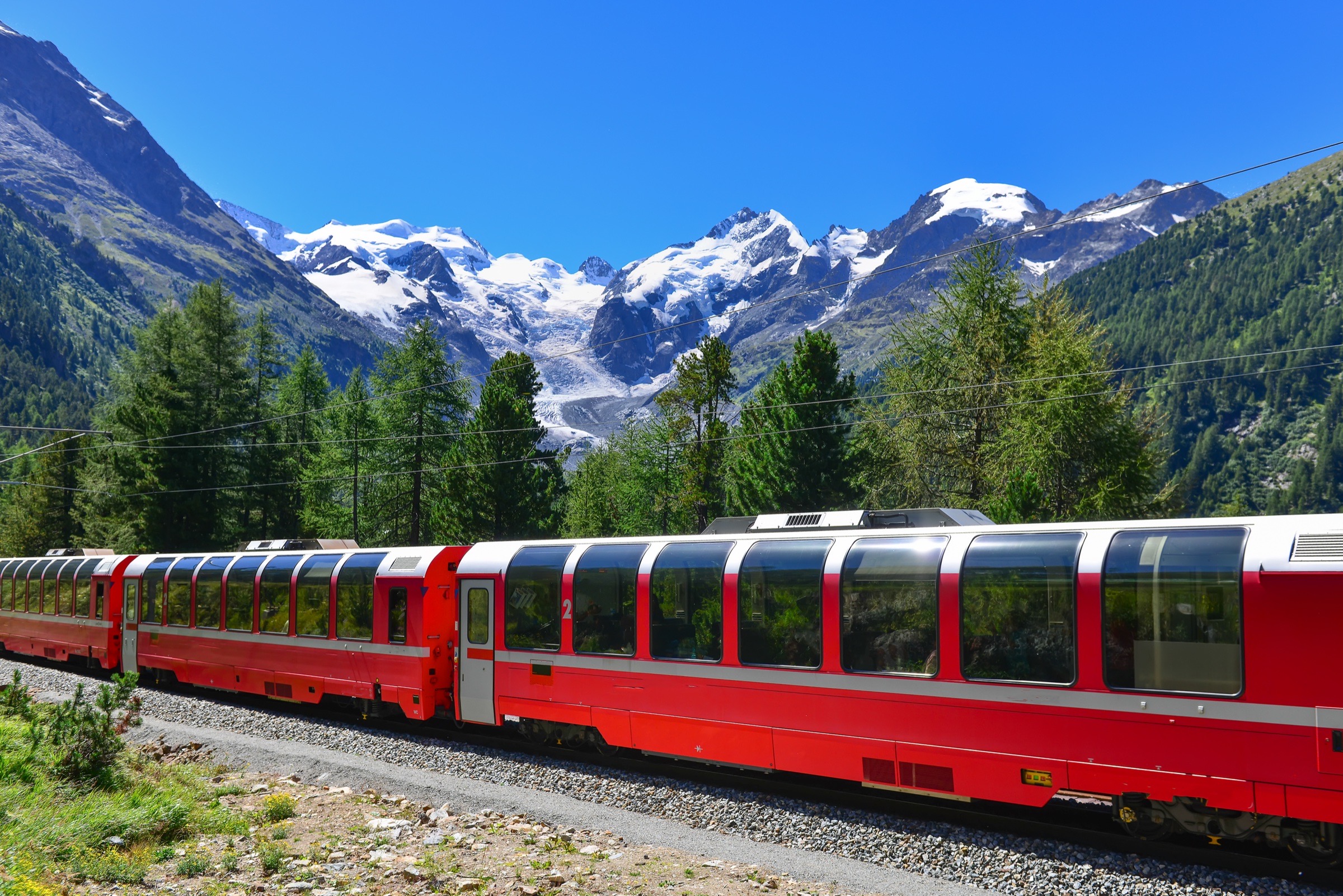
The Bernina Express is the panoramic scenic train operated by Rhaetian Railways that climbs from Tirano in Italian Lombardy across the Alps to Chur in Graubünden, Switzerland. It is easier to add to a northern Italy trip than the route map makes it look. You take a regional train from Milan to Tirano in about two and a half hours, board the panoramic train there, and ride four hours through the Alps to Chur. The train is not high-speed. The line itself is the point. Mostly what you want to know before you book is which class to pick, where to actually buy the ticket, and that the regional non-panoramic trains on the same tracks are a cheaper backup if the Express is sold out.
It is a full day, not a quick excursion
Milan to Tirano regional train is about 2.5 hours each way. Bernina Express Tirano to Chur is about 4 hours. A round-trip in a day is theoretically possible but feels like a punishment. Chur has hotels beside its walkable old town if the rail schedule requires a stop between directions.
Book direct with Rhaetian Railways
rhb.ch is the cleanest path. Seat reservations are mandatory on the Bernina Express even if you hold a Swiss Travel Pass or Eurail. The pass covers the underlying transport but you still pay the seat reservation supplement. Tickets sell out in summer. Book a couple of weeks ahead if you can.
First class is nice, not necessary
The 1+2 seating in first class is quieter and slightly roomier than the 2+2 of second class. The mountain, the viaducts, and the climb to Ospizio Bernina are the same in either car. Pay up if a quieter cabin matters to you. Do not assume first is required to enjoy the ride.
If the Express is sold out, the regional train is fine
The same RhB tracks carry regional trains between Tirano and St. Moritz that run more frequently and cost less. They do not have panoramic windows but the regular windows are large enough that the line still reads as the same trip. A reasonable backup when the named Bernina Express service is full.
Places in Milan


The trip at a glance
If you are already in Milan, the Bernina Express is a realistic full-day rail trip. Take a regional train from Milano Centrale to Tirano, board the Bernina Express there, and ride north through the Alps to Chur. From Chur you can continue deeper into Switzerland on the standard SBB network or stay the night and treat it as a small Alpine city stop.
The cleanest path is to book the Bernina Express directly with Rhaetian Railways at rhb.ch. If you have lead time, comparing cheaper booking paths through Deutsche Bahn (the definitive write-up is on Mark Smith's Man in Seat 61 site) can save real money. First class is comfortable, but the core experience is the line itself. The viaducts, the climb to Ospizio Bernina, the lakes, and the shift from Italian Lombardy into Graubünden. Same train, same view, two cabin classes.
Getting to Tirano from Milan
The Bernina Express does not start in a major city. Most travelers arriving from Italy reach the southern endpoint at Tirano on the regional train from Milano Centrale. The journey takes about two and a half hours, dynamic pricing does not apply, and you can buy the ticket from a kiosk at the station the day of travel.
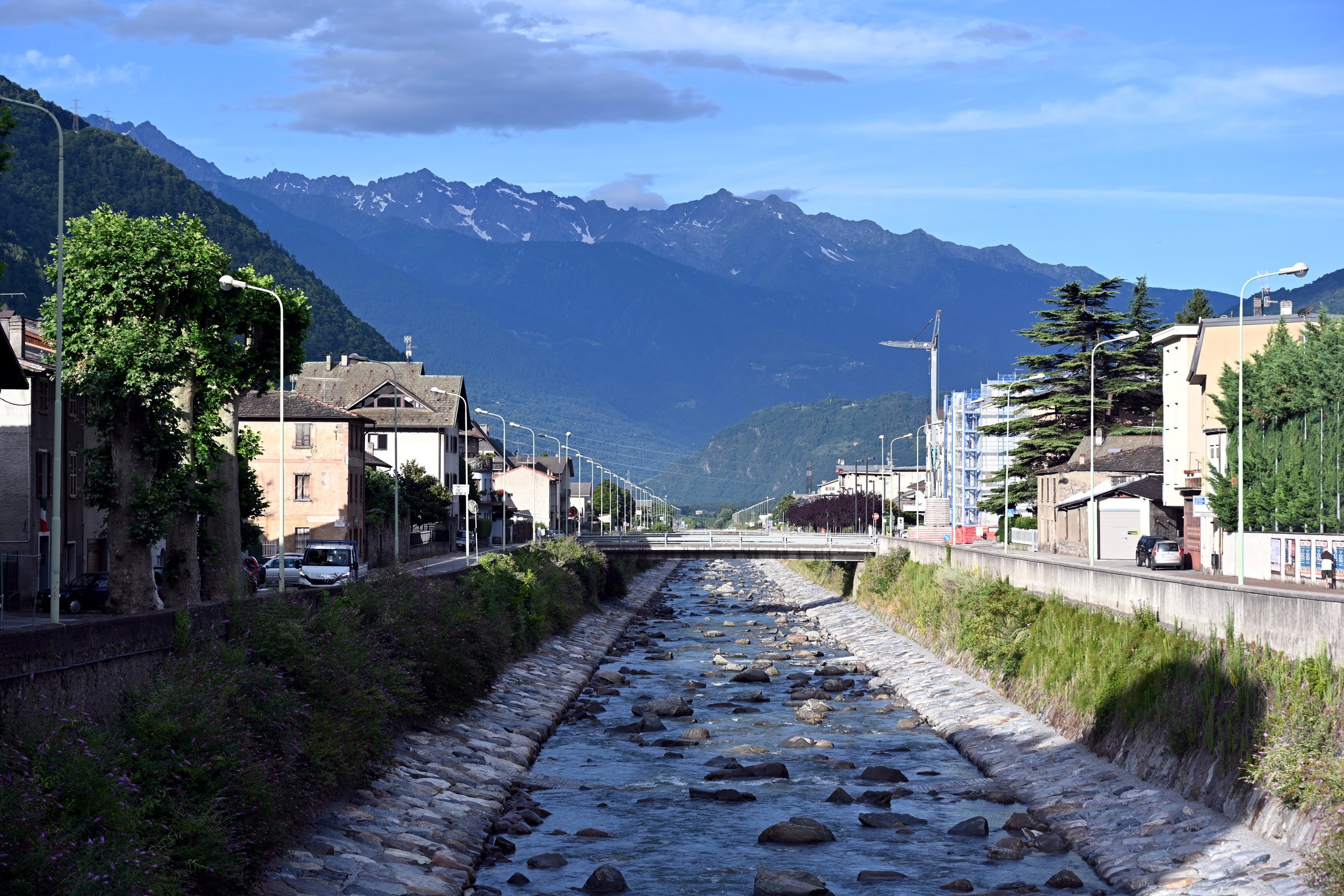
Validate your ticket before boarding. Italian regional tickets are open-dated until you stamp them, and you stamp them at the small green machines on the platform. If you forget, the conductor can treat the unvalidated ticket as fare evasion. How strictly depends on the conductor. The system runs on the assumption that you stamp. Do not skip the green-box step.
Trenord and Trenitalia run the Milano-Tirano line roughly hourly through the day. The mid-morning departures from Milan get you into Tirano in time for a Bernina Express departure at lunchtime, which is the most common shape of the day. Pack a snack and water for the platform-to-platform transfer. Tirano is a small station and the food options are limited. If your connection gives you extra time, use it for a short river or station-area walk rather than stressing over a complicated transfer.
What the Bernina Express actually is
The Bernina Express is the named scenic service operated by Rhaetian Railways (RhB) between Tirano in Italian Lombardy and Chur in the Swiss canton of Graubünden. The route is not high-speed. The train runs slowly through the Alps in panoramic-windowed cars built for sightseeing rather than fast transit. The full journey takes about four hours.
The route crosses the Bernina Pass at Ospizio Bernina, which sits at 2,253 meters. That makes the Bernina Express the highest adhesion (no rack-and-pinion) railway crossing in the Alps. Higher rack railways exist in Switzerland (the Jungfrau Railway reaches 3,454 meters at the Jungfraujoch, for example), but those are a different mechanical category. Most travel writeups conflate the two.
The line was inscribed on the UNESCO World Heritage list in 2008 as the Rhaetian Railway in the Albula and Bernina Cultural Landscape. The engineering, including 55 tunnels and 196 bridges across the Albula and Bernina sections, is the reason for the inscription rather than the scenery alone.
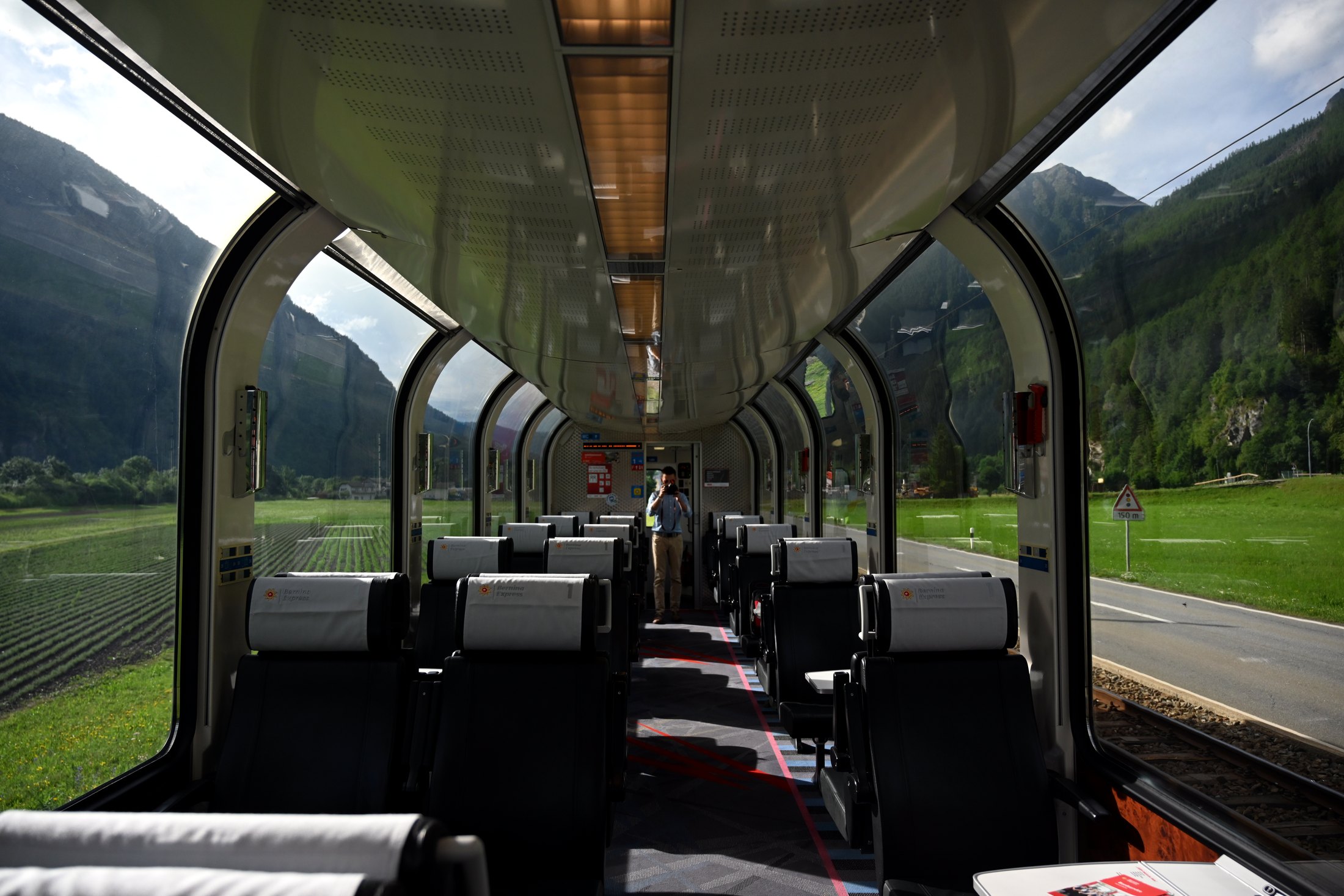
The trains themselves are panoramic-window railcars in two classes. First class has 1+2 seating, second class is 2+2. Both have reclining seats and air conditioning. Wifi has been added on some services but is not consistent, so do not plan to work the whole way.
Booking without overthinking it
Tickets sell out, especially in summer. Book directly from Rhaetian Railways at rhb.ch if you want the cleanest path. If you have lead time and want the cheapest fare, the Man in Seat 61 booking method through Deutsche Bahn saves real money. The catch is that the booking flow is less straightforward.
A seat reservation is mandatory on the Bernina Express even if you hold a Swiss Travel Pass or a Eurail/Interrail pass. The pass covers the underlying transport. You still pay the seat reservation supplement (currently around CHF 32 per leg in summer, CHF 28 in winter).
The first-class decision is less important than the booking timing. The 1+2 layout in first is nicer than the 2+2 of second. The cabin is quieter and the windows are the same panoramic glass. It does not change the mountain or the viaducts. Pick whichever class fits your trip. Do not over-rotate on the class question.
What you see on the route
The standard Bernina Express stops, in order from Tirano to Chur:
- Tirano, Italy. The southern terminus.
- Poschiavo. Small Swiss alpine town in the Italian-speaking Val Poschiavo.
- Alp Grüm. High-altitude station with the Palü Glacier view.
- Ospizio Bernina. The high point at 2,253 m, on the lake.
- Pontresina. Small Engadin valley town.
- Samedan. Junction station above St. Moritz.
- St. Moritz. The famous resort. The line splits here.
- Filisur. Small station, beautiful approach.
- Thusis. Bigger valley town. The line drops into the Rhine valley after.
- Chur. Northern terminus.
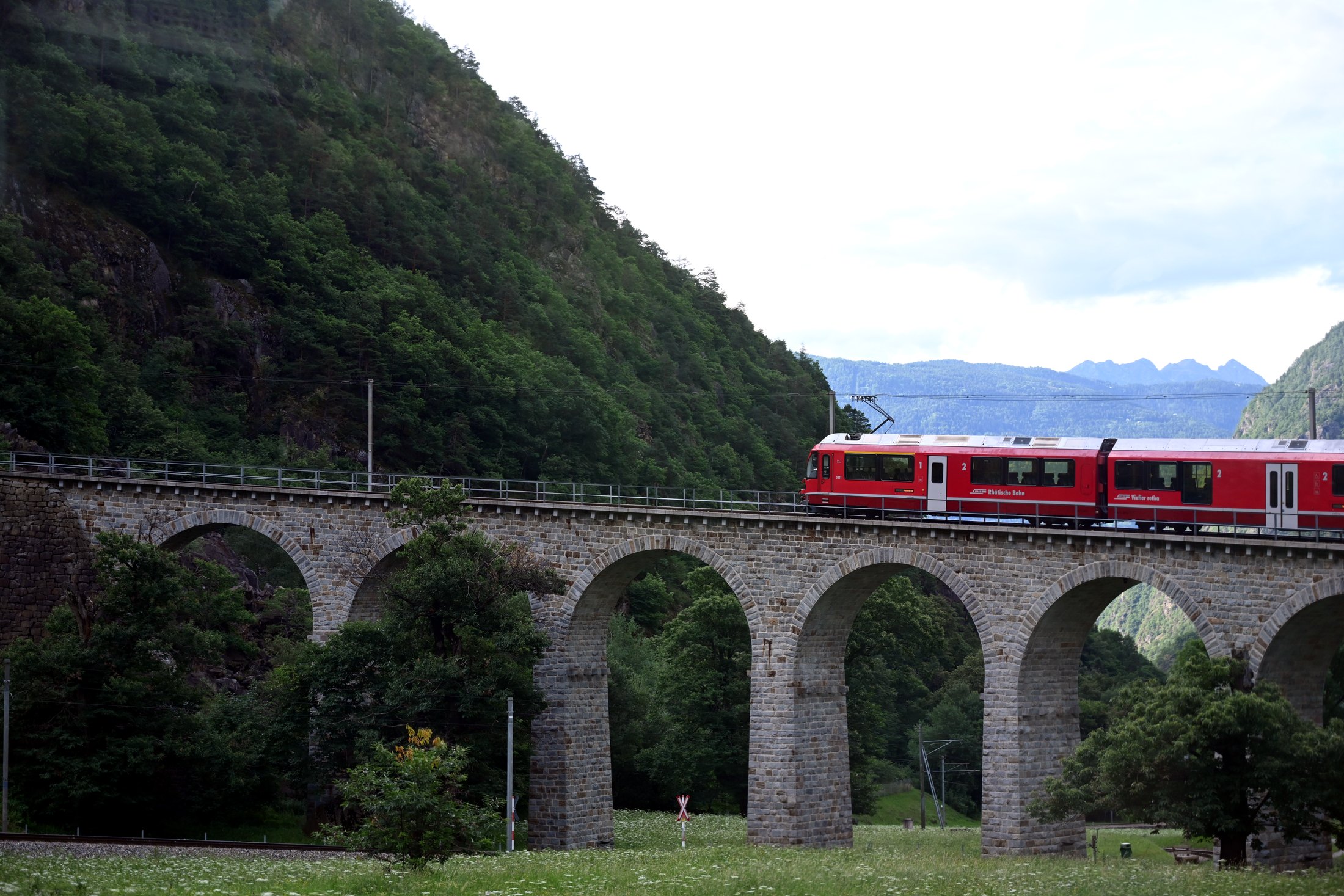
Two stretches are the photographs everyone takes. Between Brusio and Poschiavo the line spirals through the Brusio circular viaduct, a single-track 360-degree loop on a stone bridge that the train wraps around itself like a screw thread. Between Filisur and Thusis the train crosses the Landwasser Viaduct, where the line emerges from a tunnel directly onto a curving stone arch over the river.
If your itinerary lets you choose, southbound (Chur to Tirano) is the slightly more dramatic direction because the climb to the Bernina Pass reads as a clearer ascent than the descent. Most travelers ride northbound from Tirano because Milan is the natural southern anchor and the day shape works out cleaner. The view is real in either direction.
Chur old town
Chur is often described as Switzerland's oldest city. The claim is based on archaeological dating that puts settlement on the site at roughly 5,000 to 11,000 years (depending on which dig you cite). The precise "oldest continuously inhabited" framing is contested by other Swiss towns. The old town is compact and the train station sits right at its edge.
Chur has small hotels around its walkable old town, with the cathedral and Reichsgasse close to the station. Regional trains continue from there into Graubünden.
If the Bernina Express is sold out
The Bernina Express run is not the only way to ride this line. The same tracks are used by RhB regional trains between Tirano and St. Moritz, which run more frequently and cost less. They do not have the panoramic cars, but the windows in the regular carriages are large enough that you still see the landscape people ride the route for. If the named Bernina Express service is sold out for your dates, the regional service is a reasonable backup. You change at St. Moritz to continue toward Chur if that is the route you want.
Quick answers
- How do I get to Tirano from Milan?
- Take the regional train from Milano Centrale to Tirano. Trenord and Trenitalia run roughly every hour through the day. The journey is about two and a half hours, dynamic pricing does not apply, and you can buy the ticket from a kiosk or at the station the day of travel. Validate the ticket at the small green machines on the platform before boarding. Italian regional tickets are open-dated until you stamp them, and unvalidated tickets can be treated as fare evasion at the conductor's discretion.
- What does the Bernina Express actually do?
- It is the named scenic service Rhaetian Railways runs between Tirano and Chur. The full ride is four hours through the Alps in panoramic-window railcars. The train crosses the Bernina Pass at Ospizio Bernina (2,253 meters), the highest adhesion (non-rack-and-pinion) railway crossing in the Alps. The line was inscribed on UNESCO's World Heritage list in 2008 as the Rhaetian Railway in the Albula and Bernina Cultural Landscape. 55 tunnels and 196 bridges across the route are the reason. The photographic stretches are the Brusio circular viaduct between Brusio and Poschiavo (a single-track 360-degree loop on a stone bridge) and the Landwasser Viaduct between Filisur and Thusis (the line emerges from a tunnel directly onto a curving stone arch over the river).
- Should I ride northbound or southbound?
- Either direction works. The line is scenic both ways. If you can choose, southbound (Chur to Tirano) is slightly more dramatic because the climb to the Bernina Pass reads as a clearer ascent than coming down from it. The other consideration is logistics. If you are coming from Italy, northbound from Tirano is the natural shape, and the descent into Chur is its own reward.
- Should I stop in Chur or just transit through?
- Chur is described as one of the oldest continuously inhabited cities in Switzerland, though the dating is contested. Its small Alpine old town is walkable from the train station, with hotels nearby and onward SBB connections deeper into Switzerland.
- Do I need to speak any of the languages?
- Useful but not necessary. The Italian side runs in Italian. The Swiss side runs primarily in German with Romansh and some Italian audible in Poschiavo. Train staff and most service workers along the route speak enough English that ticketing and food are straightforward. Signage on the trains is multi-language.