Photos from Dusseldorf
 +1
+1Holiday Inn - the niu, Tab Dusseldorf Main Station, an IHG Hotelhotel

Rheinturmattraction
+1Current conditions and the practical reference material that helps turn the saved places into a trip.
7-day forecast from Open-Meteo. UV badges flag days when sun protection matters (3 and above is moderate; 8 and above is risk territory for unprotected fair skin within 30 minutes).
Typical highs around 23°C, lows around 12°C.
Typical highs around 7°C, lows around 0°C.
Public holidays from Nager.Date.
Public-transit operators within 8 km of the city center. Click through to each operator’s site for routes, fares, and tickets.
Düsseldorf is the capital city of North Rhine-Westphalia, the most populous state of Germany. It is the second-largest city in the state after Cologne and the sixth-largest city in Germany, with a 2024 population of 618,685. Most of Düsseldorf lies on the right bank of the Rhine, and the city has grown together with Neuss, Krefeld, Hilden, Langenfeld, Ratingen, Meerbusch, Dormagen, Erkrath, Solingen and Monheim. Düsseldorf is the central city of Rhine-Ruhr, the second biggest metropolitan region by GDP in the European Union, that stretches from Bonn via Cologne and Düsseldorf to the Ruhr.
The links below support the changing or licensed reference material on this page. Personal notes and ordinary geographic facts are not footnoted individually.
Monthly highs, lows, rainfall — long-term averages, NASA POWER.
Operators and modes are aggregated from individual transit-agency GTFS feeds. Route classifications come from each feed’s route type codes.
Maps, image licenses, and the full dataset registry are listed in site credits.
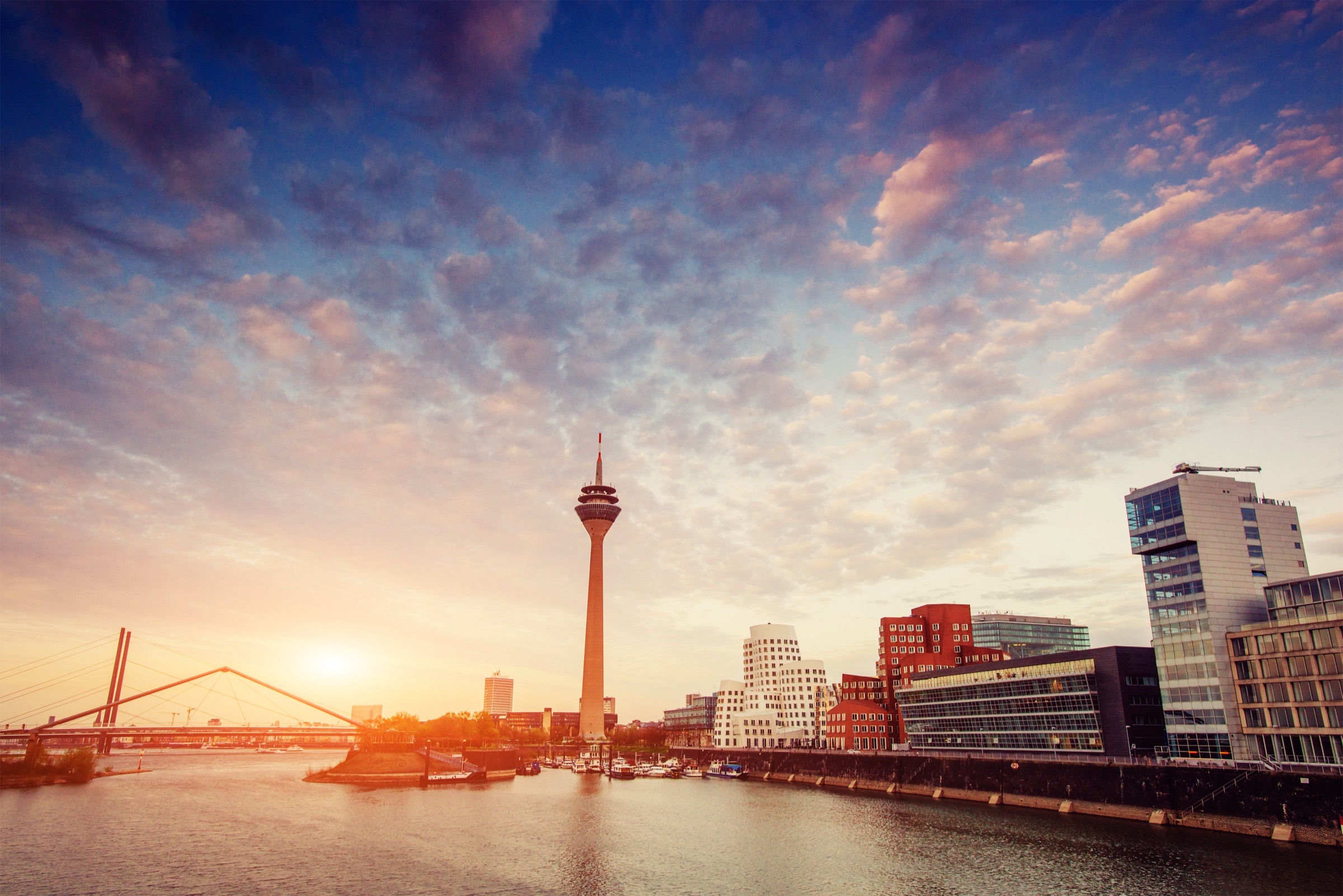
My Dusseldorf travel guide. The Altstadt and its Altbier brewhouses, the Rhine promenade, the MedienHafen, where to stay, and where to eat.
Düsseldorf is a compact old town so packed with bars it is nicknamed the longest bar in the world, where you drink the dark local Altbier, plus a sharp modern side in fashion and design. The central sights form a compact route, with wider regional connections beyond it.
Planning brief
Düsseldorf is a city of about 650,000 on the Rhine in western Germany, the capital of North Rhine-Westphalia. It is known for its compact old town, the Altstadt, where the density of bars has earned it the nickname "the longest bar in the world," for its own dark Altbier, and for a sharp modern side in fashion and architecture. The central sights form a compact route, with wider regional connections beyond it.
The Altstadt, the Rhine promenade, and the modern harbor form a compact route through the center, with fast rail connections across western Germany.
Düsseldorf has its own beer, a dark, malty Altbier, served in small glasses and poured until you cap your coaster. The old brewhouses are the place to try it.
A base by the old town puts the bars, the Rhine, and the Königsallee shopping street on foot. The main station is a short tram or walk away.
Beyond the old town are the Königsallee luxury strip, the Gehry-designed MedienHafen, and one of Europe's largest Japanese communities around Immermannstrasse.
Düsseldorf Airport is one of Germany's larger airports, a few minutes from the city by S-Bahn. Düsseldorf is also a major rail hub on the ICE high-speed network, with frequent trains across Germany and into neighboring countries, and Cologne is under 30 minutes away.
The Hauptbahnhof is a short tram ride or walk from the old town. Inside the city, an extensive U-Bahn and tram network covers the longer distances, and the center is walkable.
The Düsseldorf Stadtbahn and tram network is the city layer after the S-Bahn gets you in from the airport or Cologne. It is most useful for Hauptbahnhof to Altstadt, MedienHafen, trade-fair days, and Rhine-Ruhr hops where walking stops being the clean answer.
Stay near the Altstadt, the old town. From there the bars, the Rhine promenade, and the Königsallee shopping street are all on foot, and the main station is a short tram ride away.
I have the Holiday Inn - the niu, Tab Dusseldorf Main Station pinned now, rated 3. It is a practical station-side option, not the atmospheric Düsseldorf stay. Use it when the price or points math is doing the work. If you want the city to feel like Düsseldorf immediately, stay closer to the Altstadt.
The Altstadt is the heart of the visit, a small grid of streets packed with bars and brewhouses, which is where the "longest bar in the world" tag comes from. It is also the place to drink Altbier, the city's own dark, malty beer, served in small glasses by waiters called Köbes who keep refilling until you cap your coaster.
Along the river, the Rheinuferpromenade is the wide riverside walk, busy on warm evenings, with the Rheinturm, the Rhine Tower, rising at its southern end. Beyond the old town, the Königsallee, known as the Kö, is the canal-lined luxury shopping boulevard, and the MedienHafen is the old harbor redeveloped with striking modern buildings, including a trio by Frank Gehry. Düsseldorf also has one of the largest Japanese communities in Europe, centered on Immermannstrasse near the station, with its own concentration of Japanese restaurants and shops.
Düsseldorf eats on Rhineland cooking and brewhouse plates, with a strong Japanese scene near the station and a broad international range across the old town.
| Spot | What it is |
|---|---|
| Uerige | A historic Altstadt house brewery pouring its own Altbier |
| Zum Schlüssel | A traditional Altbier brewhouse |
| Brewery Schumacher | Another of the city's Altbier brewers |
| HeimWerk Altstadt | German home cooking in the old town |
| Münstermann Kontor | A delicatessen and restaurant |
| Steakschmiede by Don Carne | A steakhouse |
| Tachibana | Japanese, near the city's Japanese quarter |
| Xiao Long Kan | Sichuan hot pot |
| To1980 Vegan | Vegan Vietnamese street food |
| Hexe Bolker4 | An Altstadt bar and restaurant |
