Spanish castle lists get messy quickly because the word "castle" is doing too much work. The Alhambra, Bellver, Coca, Loarre, and Olite do not belong to one simple category, and they do not fit the same kind of trip.
Some are Moorish fortresses or palace complexes. Some are Christian medieval castles from the 11th to 15th centuries. Some are aristocratic statements that borrow defensive language while functioning as power display. A useful itinerary should treat those differences as the point, not as a technicality.
These are the six I would plan around first, with the claims I could verify and a few common travel-blog errors corrected along the way.
Quick Reference
| Site | Best used as | What to notice | UNESCO status |
|---|---|---|---|
| Bellver Castle | Palma half-day | Circular Gothic plan | No |
| Alhambra | Granada anchor visit | Nasrid palaces, water, geometry | Yes, since 1984 |
| Alcázar de Segovia | Madrid day trip | Promontory setting, tower view | Part of Segovia inscription |
| Castillo de Coca | Segovia province detour | Brick Mudéjar construction | No |
| Castillo de Loarre | Aragon road-trip stop | Romanesque military architecture | Tentative list only |
| Royal Palace of Olite | Navarra wine-country pairing | Late-Gothic palace reconstruction | No |
How I Would Use Them in a Trip
The Alhambra is the only one here that can justify anchoring an entire city stop on its own. Segovia works as a strong day trip from Madrid because the castle, aqueduct, and old town sit together. Bellver belongs naturally inside a Palma stay. Olite makes more sense with Navarra wine country than as a long standalone detour.
Coca and Loarre require more intention. Coca is useful if you care about Mudéjar architecture or are already moving through Castile. Loarre is a better fit for an Aragon or Pyrenees route than for a first Spain itinerary built around Madrid, Barcelona, and Andalusia.
Bellver Castle, Palma de Mallorca
Bellver is useful because its oddity is visible before anyone explains it. It is circular, which is rare in European castle architecture. Work began around 1300 under King James II of Mallorca, not James II of Aragon, a mistake that shows up often because the names invite it. The Kingdom of Mallorca was a separate political entity at the time.
The keep, the Torre de l'Homenatge, stands apart from the main circle and is connected by a bridge. The building has served as royal residence, military prison, and now the History Museum of the City of Palma.
A half-day is enough. The roof terrace gives the reason for the climb: Palma, the bay, and the wooded hill below. Bring water if you walk up from the city. The hill is steeper than it looks on a casual map check.
Alhambra, Granada
The Alhambra is not a single building but a fortress, palace, and citadel complex built largely under the Nasrid dynasty in the 13th and 14th centuries on the site of an earlier 9th-century fortress. That matters because the visit changes character as you move through it.
The Alcazaba is the military portion. The Nasrid Palaces are the delicate, controlled heart of the site, where water, stucco, tile, carved text, and geometry do the work of courtly display. The Generalife is the garden and retreat above the palace complex. If you only read the Alhambra as a castle, you miss the way it uses enclosure, shade, water, and pattern to organize attention.
The practical advice is simple: book ahead, especially for the Nasrid Palaces. Entry is timed, demand is high, and official tickets are the safest route. Resellers create needless risk and markup. This is not the place to improvise at the gate.
Alcázar de Segovia
The Alcázar de Segovia sits on a rocky promontory above the meeting of two rivers, which is why so many photographs make it look like a stone ship. It has been royal residence, state prison, artillery academy, and museum. A major fire in 1862 damaged much of the interior, so the current appearance reflects later restoration as well as medieval fabric.
The Disney claim is the one to treat carefully. It is often said that the Alcázar inspired Cinderella Castle, but that claim is not firmly documented. Neuschwanstein is the more consistently cited reference. I would not visit Segovia for the Disney story. I would visit for the tower view, the location, and the way the castle sits with the aqueduct and old town.
Castillo de Coca
Coca is the one I would use to explain Mudéjar architecture to someone who has never heard the word. Mudéjar work emerges from Christian commissions using Muslim craftsmen, techniques, and decorative languages. At Coca, that means brick rather than stone, geometric surface treatment, and a late-medieval Castilian building that does not look like a northern European fortress.
It was built between roughly 1453 and 1496 by the Fonseca family. The common claim that it was built to defend against the Moors is wrong. By then Coca faced no frontier with al-Andalus, and it reads better as an aristocratic statement by a powerful Castilian family.
The building now houses a forestry training school, with parts open to visitors.
Castillo de Loarre
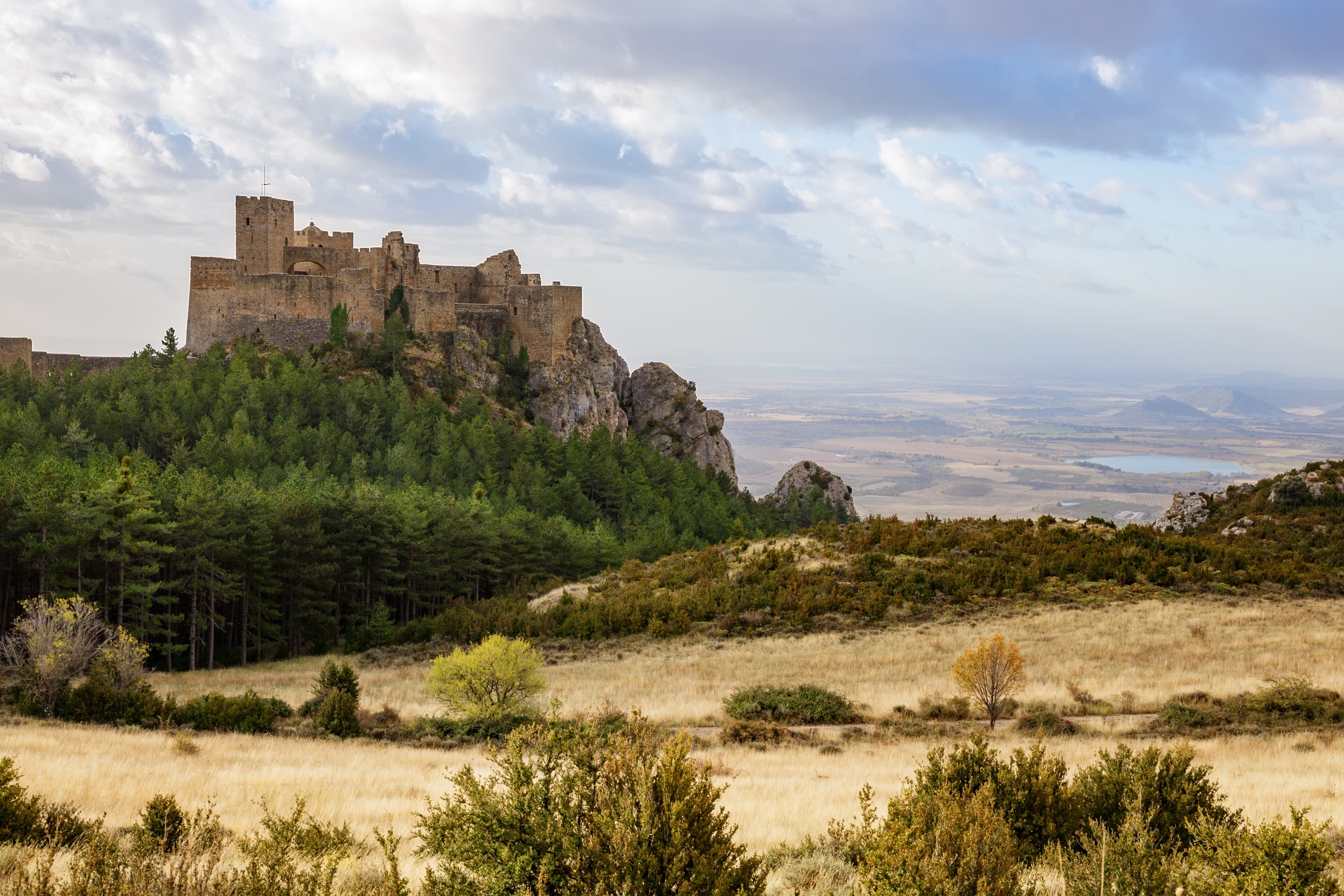
Loarre is an 11th-century Romanesque castle in the foothills of the Pyrenees. The landscape carries much of the visit: dry stone, open slope, long views, and a chapel within the walls that still makes the climb feel purposeful.
The UNESCO claim needs correcting. Loarre is often described online as a World Heritage Site. That is wrong. It sits on Spain's tentative list, meaning it has been proposed for possible future consideration, not inscribed.
Film viewers may recognize it from Ridley Scott's Kingdom of Heaven. That reference is useful visually, but the better reason to go is the survival of the Romanesque chapel and the clarity of the military site.
Royal Palace of Olite
Olite is a palace first and a castle only in the loose travel sense. Built mostly under Charles III of Navarre between roughly 1399 and 1424, it has two main parts: the Old Palace, now operating as a Parador hotel, and the New Palace, the portion most visitors come to see.
The building was heavily damaged by fire in 1813 during the Peninsular War and restored extensively in the 20th century. That does not make it fake, but it does mean the visit is partly an encounter with reconstruction. The towers, courtyards, and late-Gothic atmosphere are still the point.
I would pair Olite with the surrounding Navarran wine region rather than make it a standalone detour from far away.
What I Left Off
Several recurring castle-list claims are not useful. There is no famous Castillo de San Felipe in Madrid. The well-known Castillo de San Felipe is in Ferrol, in Galicia. Barcelona's Castell de Montjuïc is a 17th and 18th century military fortification rather than a medieval castle, so it belongs to a different kind of itinerary. The Alcazaba of Almería would be a fair addition to a serious Moorish-fortress route, but I have not visited it personally and did not want to fake the note.