Current conditions and the practical reference material that helps turn the saved places into a trip.
The next week in Mostar
7-day forecast from Open-Meteo. UV badges flag days when sun protection matters (3 and above is moderate; 8 and above is risk territory for unprotected fair skin within 30 minutes).
Today
Overcast
38° / 24°
UV High
Wed
Overcast
38° / 25°
UV High
Thu
Clear
40° / 25°
UV High
Fri
Overcast
40° / 26°
UV High
Sat
Overcast
36° / 27°
UV High
Sun
Partly cloudy
37° / 27°
UV High
Mon
Overcast
37° / 27°
0.6 mm
UV High
Climate
Cool and wet season (Sep-Mar)
About 74% of the year's rain falls in these months. Typical highs around 10°C, lows around 1°C.
Warmer dry season (Apr-Aug)
Typical highs around 22°C, lows around 11°C. About 52mm of rain a month.
In August 4
Drag to scrub across the year.
JFMAMJJASOND
Weather
29° / 15°
Typical high / low
1 mm rainfall this month
Daylight
14.0h
05:53 – 19:54local
Holidays coming up
Public holidays from Nager.Date.
Airports
closest OMO · 7 km
Getting around Mostar
Public-transit operators within 8 km of the city center. Click through to each operator’s site for routes, fares, and tickets.
Operators and modes are aggregated from individual transit-agency GTFS feeds. Route classifications come from each feed’s route type codes.
About Mostar
Mostar is a city and the administrative centre of Herzegovina-Neretva Canton of the Federation of Bosnia and Herzegovina, an entity of Bosnia and Herzegovina, and the historical capital of Herzegovina.
The links below support the changing or licensed reference material on this page. Personal notes and ordinary geographic facts are not footnoted individually.
My Mostar travel guide. The Stari Most Old Bridge, the bazaar, Blagaj and the Buna source, Kravica Falls, when to skip the afternoon heat, and where to eat ćevapi.
Mostar sits on the Neretva in southern Bosnia and Herzegovina. Its old core is built around the Stari Most, the Ottoman bridge destroyed in 1993 and rebuilt in 2004. I went in July 2025 and regularly saw 40°C afternoons. I stayed inside through the hottest part of the day, then went back out for dinner and a walk after the tour buses had left.
Planning brief
Planning Mostar
Mostar is a city of about 100,000 in Herzegovina, built along the Neretva River. Its center is the Stari Most, the Ottoman bridge destroyed in 1993 and rebuilt in 2004. A day covers the old core. Staying overnight gives you time there before and after the coastal tour buses.
Plan around the tour buses
The Old Bridge and bazaar are quietest before and after the day-trip buses, when the summer temperature also drops.
Avoid summer afternoons
Mostar sits in a valley that traps heat. July and August afternoons can break 40°C. Retreat indoors midday and come out for the evening walk.
Train or bus in, or hire a driver
The Sarajevo to Mostar train takes about two hours through the Neretva canyon. Buses connect Mostar with Dubrovnik and Split, where there is no direct passenger train. A car is most useful if you also plan to visit Blagaj, Kravice, and Počitelj.
Save a day for the day trips
Blagaj's dervish house at the Buna source, Kravice Falls, and the fortified village of Počitelj are 30 to 45 minutes from Mostar. I visited them as a single hired-driver loop.
The comfortable months are April through June and September through October. Highs in the low to mid 20s°C, the river cold but not freezing, and the old core walkable through the afternoon.
The hardest months are July and August. Mostar sits in a narrow valley that traps heat off the surrounding karst, and the average July high is around 27°C with regular spikes well above. The Mostar weather station's all-time record is 43.1°C, set in August 2007. I went in July 2025 and 40°C afternoons were normal. Locals retreat indoors from noon until six, then come out for the evening walk. Restaurants and the bazaar fill up between 18:00 and 23:00 because that is when the town is actually pleasant.
The shoulder months are March and November. They are mild but rainy. From December through February, many bazaar shops close and fewer day trips operate.
How long do I need?
One day covers the old core, the Stari Most, the bazaar, and a mosque or two. But the buses pour in from the coast through the middle of the day, and the old town gets shoulder-to-shoulder.
I would stay overnight. The bridge and bazaar are much quieter in the early morning and after the day-trippers return to Dubrovnik or Split. A second day is enough for Blagaj, Počitelj, and Kravice Falls. A third gives you more time at those stops or a slower day in Mostar.
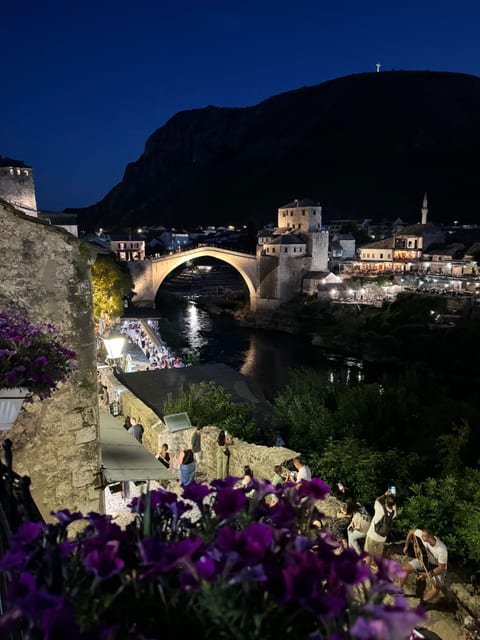
The Stari Most at night, after most of the coastal day trips have left Mostar.
How do I get to Mostar?
The best route depends on where you are arriving from.
Buses connect Mostar with Sarajevo, Dubrovnik, and Split. The fleet is older and the journey is bumpier than the train, but departures are more frequent and the buses run on routes the train does not (Dubrovnik, Split, Kotor). Many day-trippers come up from the coast on one of these.
Driving makes sense when Mostar is part of a longer road trip or you want to visit Blagaj, Kravice, and Počitelj without a tour. Some two-lane mountain roads are narrow, passing can be aggressive, and fuel stations are less frequent outside the cities. Road signs may use Latin or Cyrillic depending on the part of the country. Download an offline map before leaving.
In the city itself, the old core is walkable. There is no point in a rental car unless your trip is built around the day-trip loop.
Where should I stay?
Stay in or near the Old Town, the cluster of cobbled lanes around the bridge. From there the Stari Most, the mosques, and the restaurants are all on foot, and you wake up to the town before the day-trippers arrive.
I rated Apartments Solis 5/5. It is close enough to walk to the old core while avoiding the busiest lanes immediately beside the bridge. Mostar also has many small, owner-run guesthouses, often at much lower prices than comparable rooms on the Croatian coast.
The Old Bridge and the Old Town
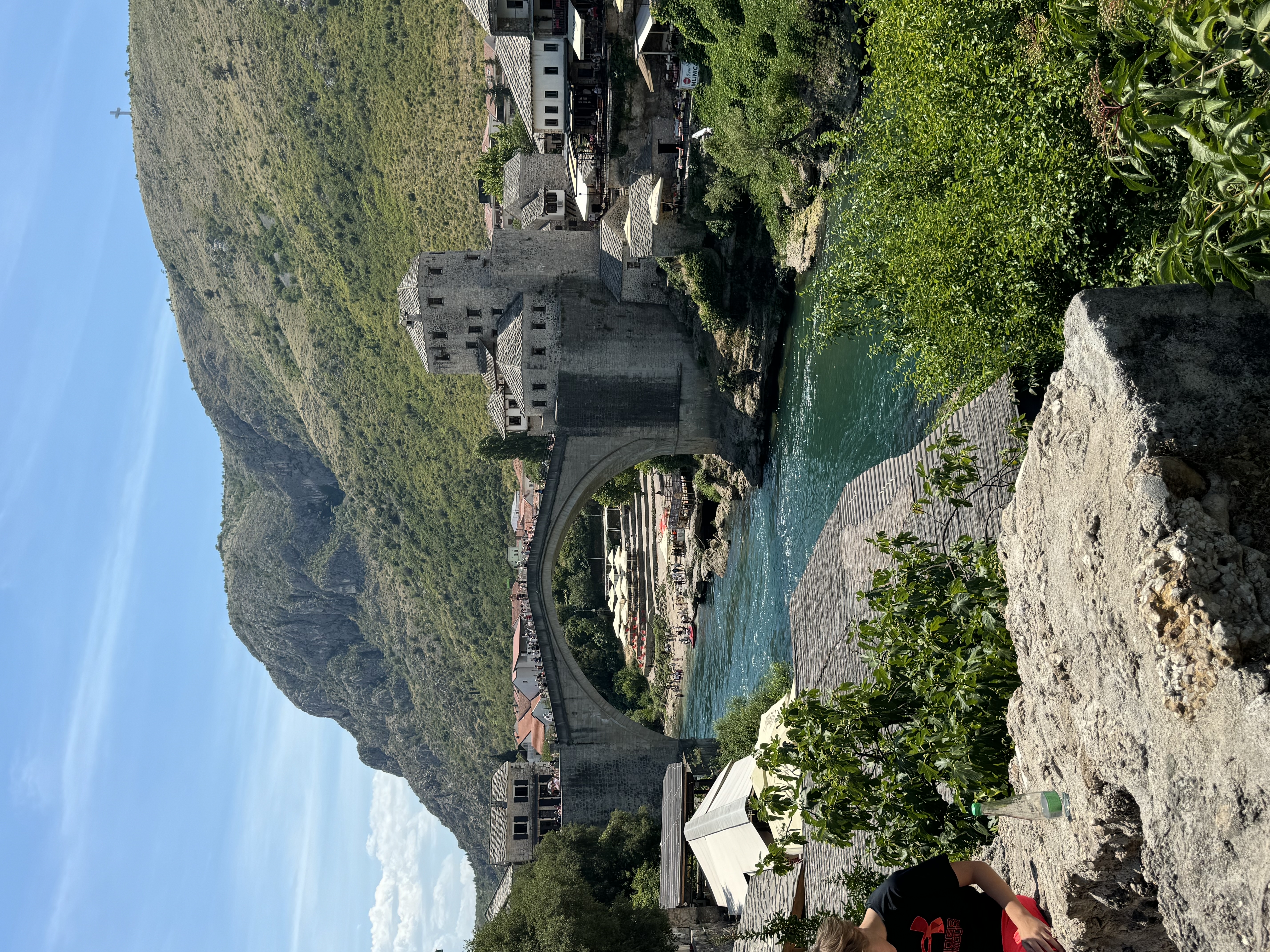
The Stari Most is the main reason most people visit Mostar. It is a single 27-meter stone arch across the Neretva, built in 1566 by Mimar Hayrudin under Sultan Suleiman the Magnificent. The original bridge stood for 427 years.
It was destroyed on November 9, 1993, by Bosnian Croat artillery during the Bosnian War. The shelling lasted hours. The bridge collapsed into the Neretva in pieces. Reconstruction under UNESCO oversight ran from 2001 to 2004, using the same Tenelija limestone, Ottoman techniques, and some original stone recovered from the riverbed. The Old Bridge Area of the Old City of Mostar was inscribed on the UNESCO World Heritage List in 2005. The Old Bridge photo point has an unobstructed view of the arch over the river.
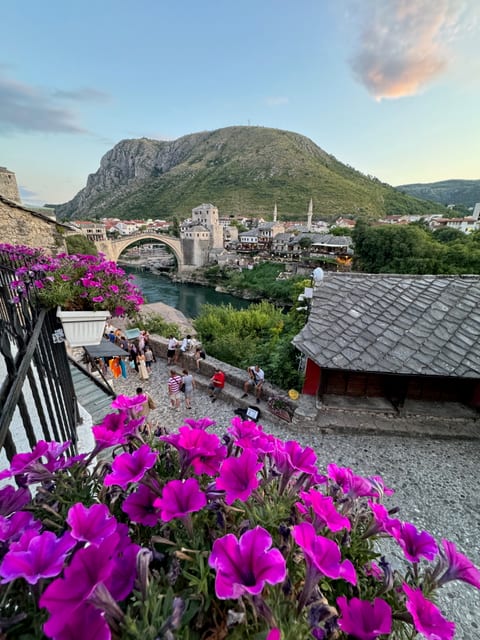
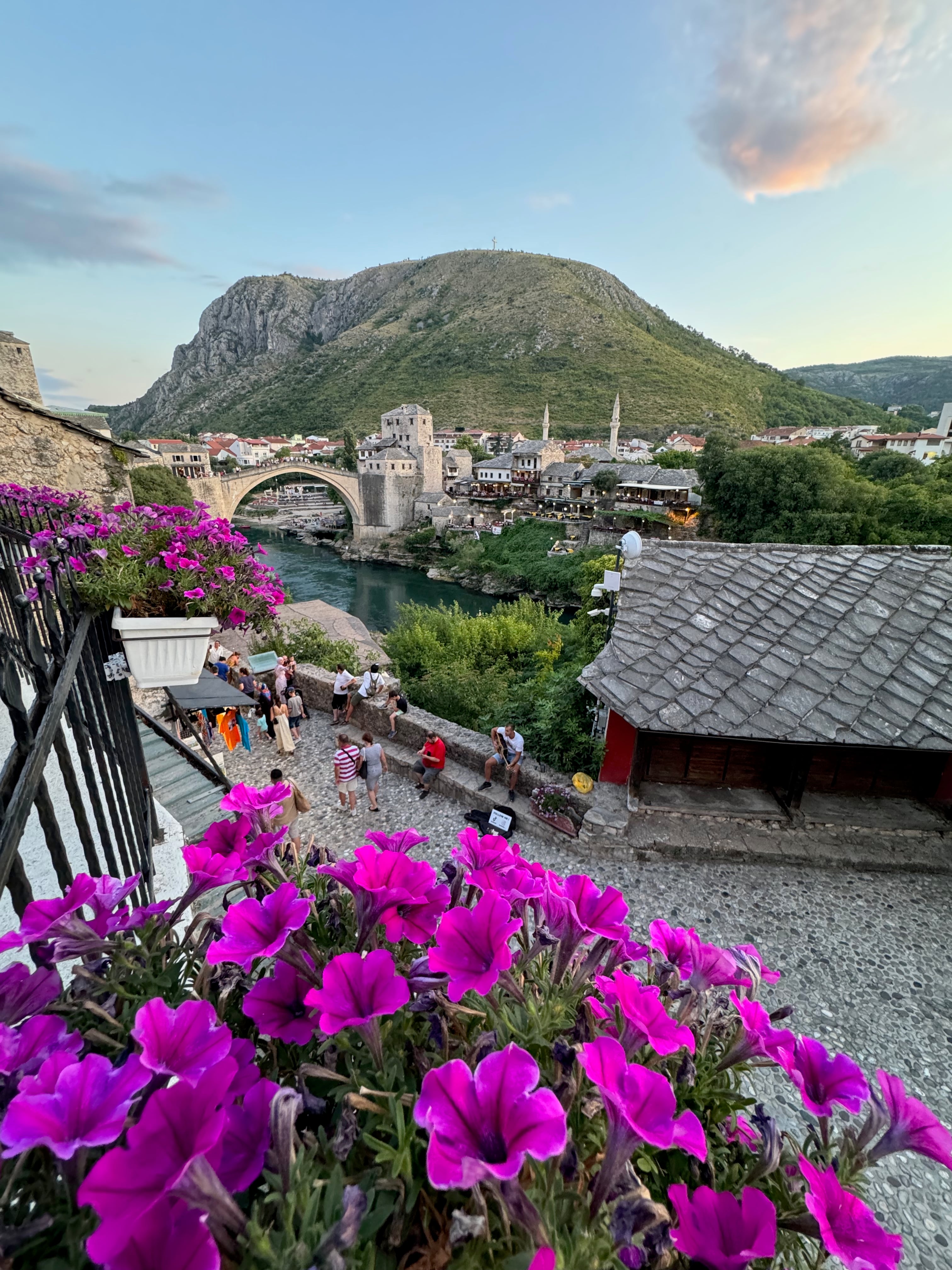
The Stari Most from the riverbank photo point. The same area is much quieter early in the morning and late in the evening.
Members of the local divers' club still leap from the bridge into the cold river through the warmer months, usually after working the crowd for tips. The drop is about 20 meters and the water is cold even in August. It is their tradition, not a visitor activity.
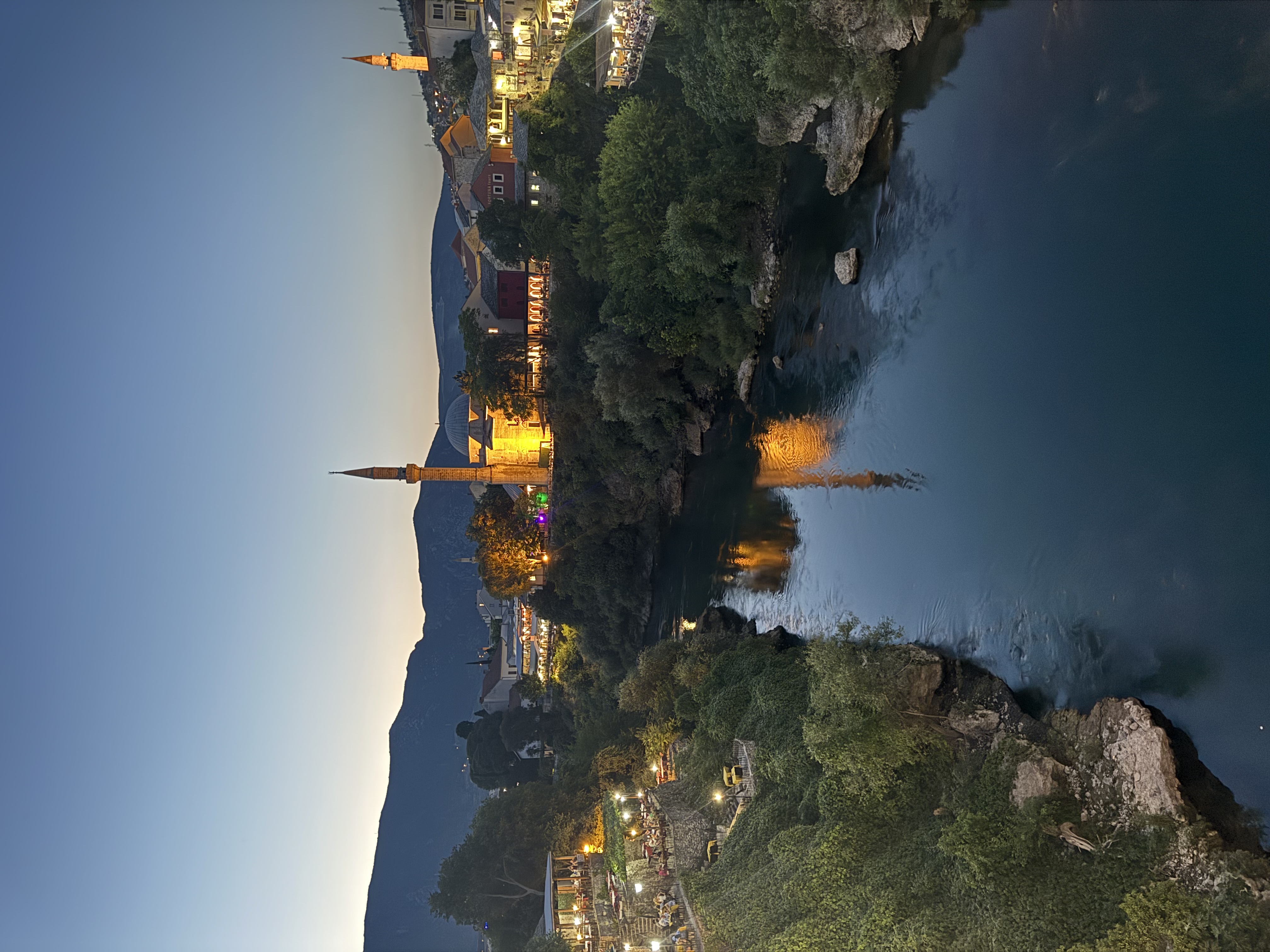
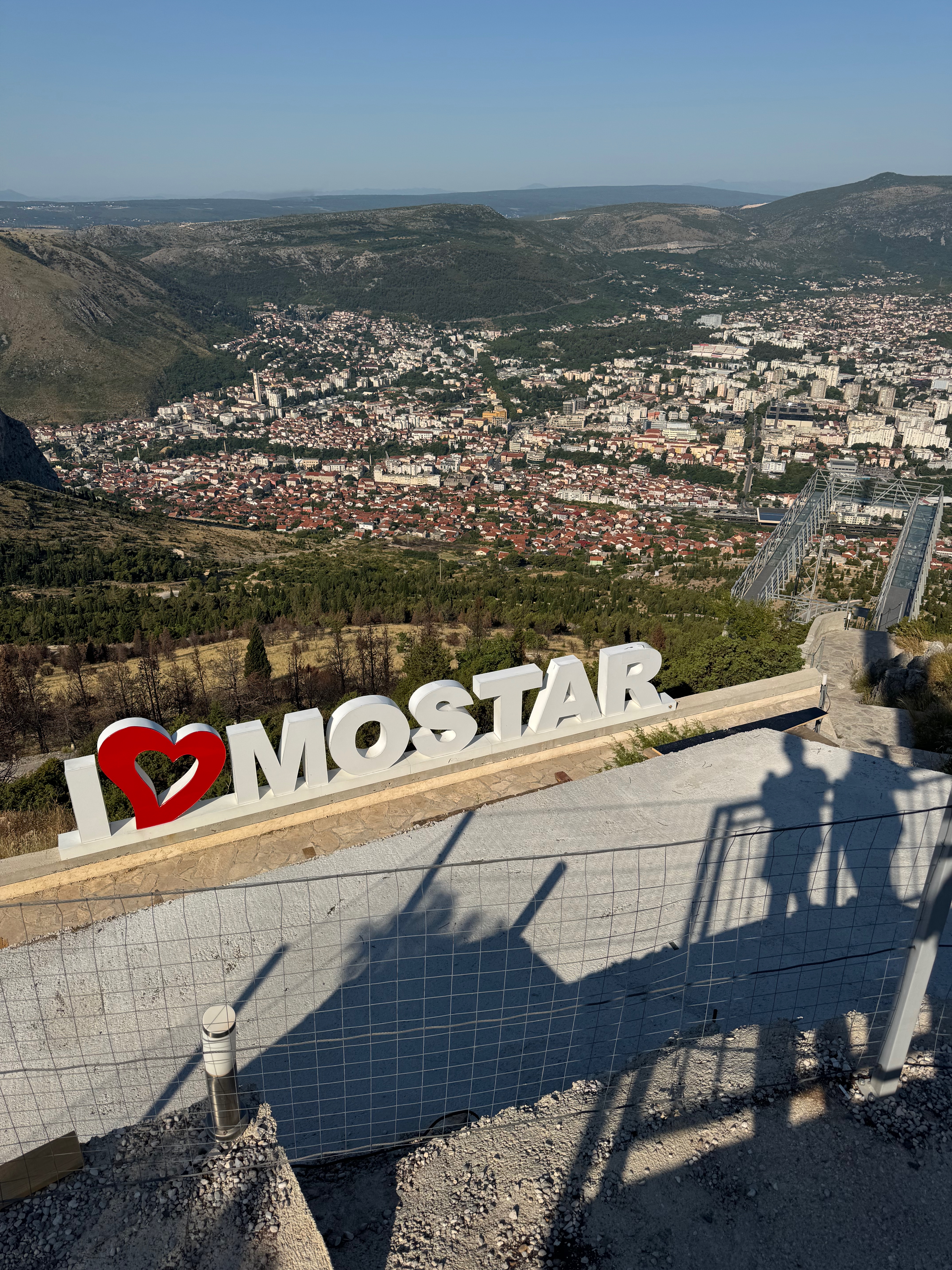
Around the bridge runs the Kujundžiluk, the old bazaar, a cobbled lane of copper workshops, rug stalls, and cafes. The Koski Mehmed-Pasha Mosque charges a small fee to climb its minaret, which gives the head-on view of the bridge. For sunset, the Mostar city viewpoint looks over the town and the river, and on a hot day the Gradski bazen is the town pool.
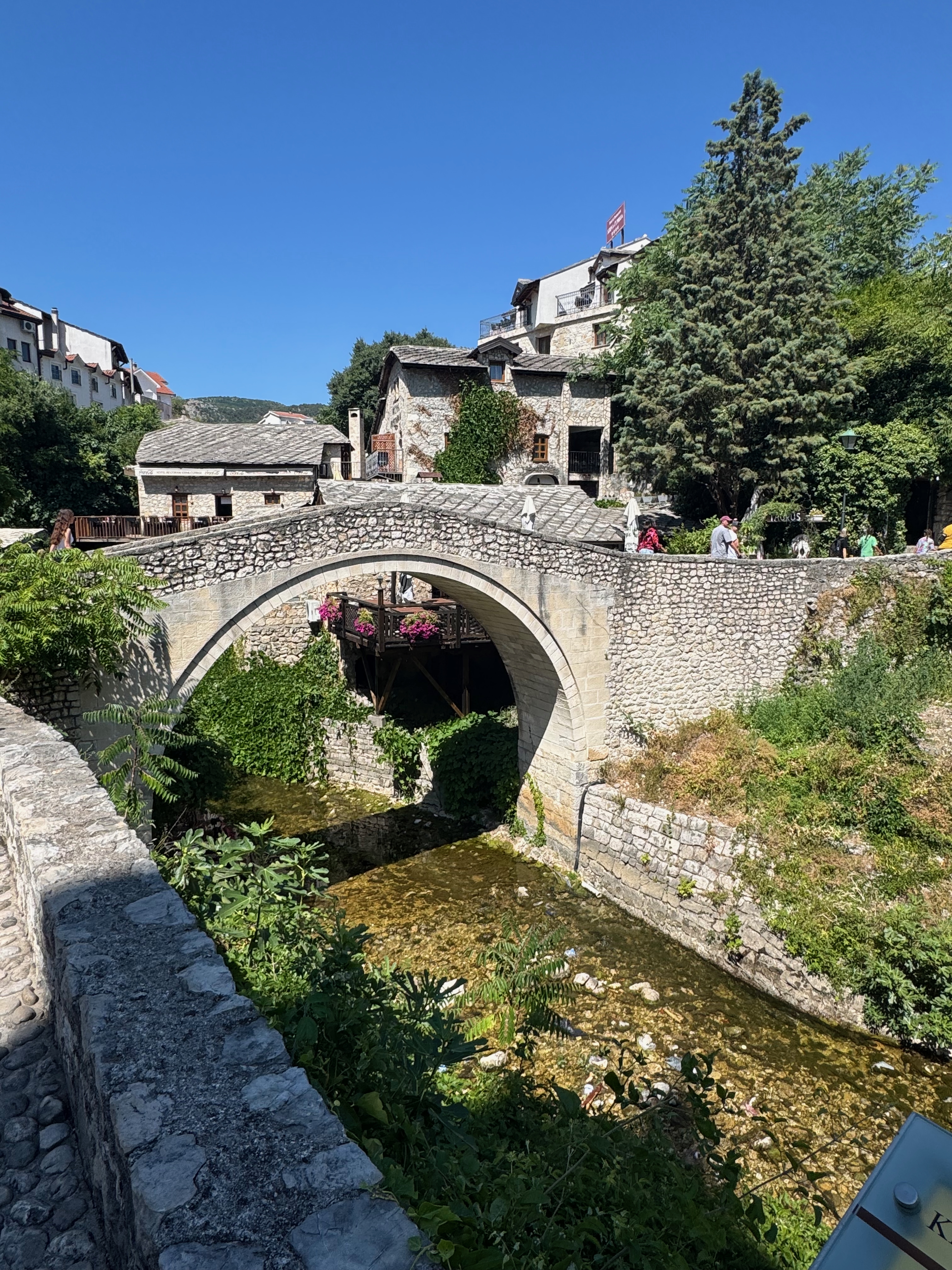
Kriva Ćuprija crosses the Radobolja stream just off the main old-town lane.
The effects of the war remain visible outside the restored center. The bridge, mosque domes, and many bazaar facades have been rebuilt, but shell damage and abandoned buildings remain elsewhere in the city. The reconstruction is still incomplete more than 30 years later.
The day trips: Blagaj, Kravice, and Počitelj
A second day in Mostar is for Blagaj, Kravice, and Počitelj:
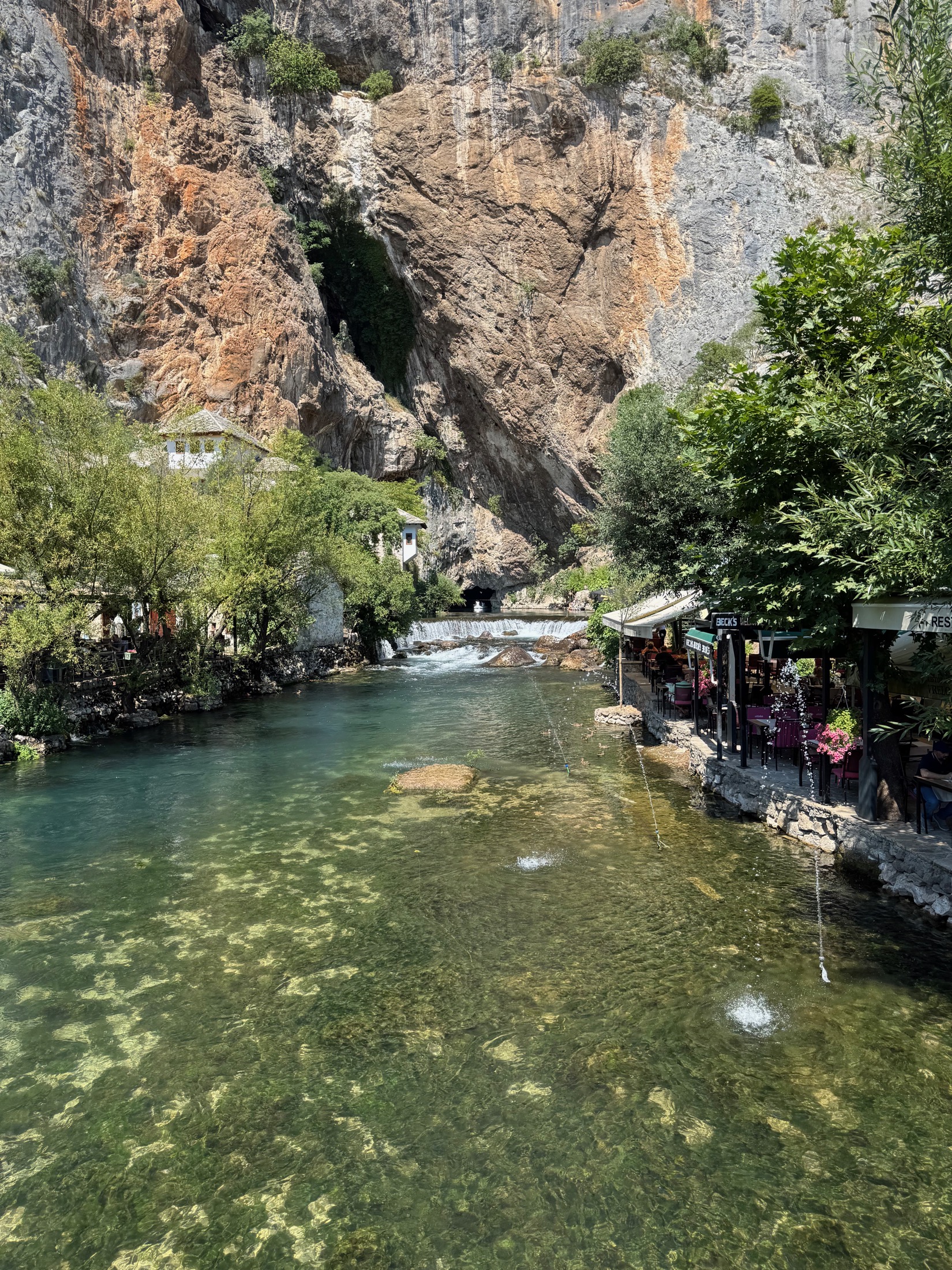
Blagaj is 12 km southeast of Mostar. The Blagaj Tekija, an Ottoman dervish house dating to the 16th century, sits below a limestone cliff at the source of the Buna River. The tekija remains an active religious site. Allow at least an hour and a half, especially if you eat beside the river.
The Buna River below the cliff in Blagaj. Several restaurants have terraces along the water.
Kravice Falls is 40 km south of Mostar on the Trebižat River. A wide curtain of 25-meter cascades over a natural amphitheater of travertine. You can swim in the pools below in summer. It is at its busiest midday with the same buses that pour into Mostar's old town. Go early or in the late afternoon.
Počitelj is a fortified village about 30 km south of Mostar, built into the hillside above the Neretva. It is on Bosnia and Herzegovina's UNESCO tentative list, not the World Heritage List. The fortress, Sahat-Kula clock tower, and Hadži Alija Mosque are spread across the slope. A quick visit takes about half an hour, but the climb is steep and takes longer in the heat.
I hired a driver for all three stops. Guesthouses and tour agents in the old town can arrange the same loop. Prices depend on the number of passengers and how long you stay, so confirm the total and whether entrance fees are included before leaving.
Fortica overlooks Mostar and the surrounding valley. It is a short additional stop when traveling by car.
Where to eat
Mostar eats Bosnian: grilled ćevapi, slow-cooked meat-and-vegetable dishes, burek and other phyllo pastries, and strong Bosnian coffee served Ottoman-style in a copper džezva with a small cup, sugar, and a piece of lokum. Ćevapi are small charcoaled minced-meat fingers, usually served with a halved fluffy somun bread and raw chopped onion. The bazaar restaurants over the river are scenic but tourist-priced. The places a street back are usually better value.
My routine was a bakery in the morning, ćevapi at lunch, several hours inside during the heat, and coffee or tea near the bridge in the evening.
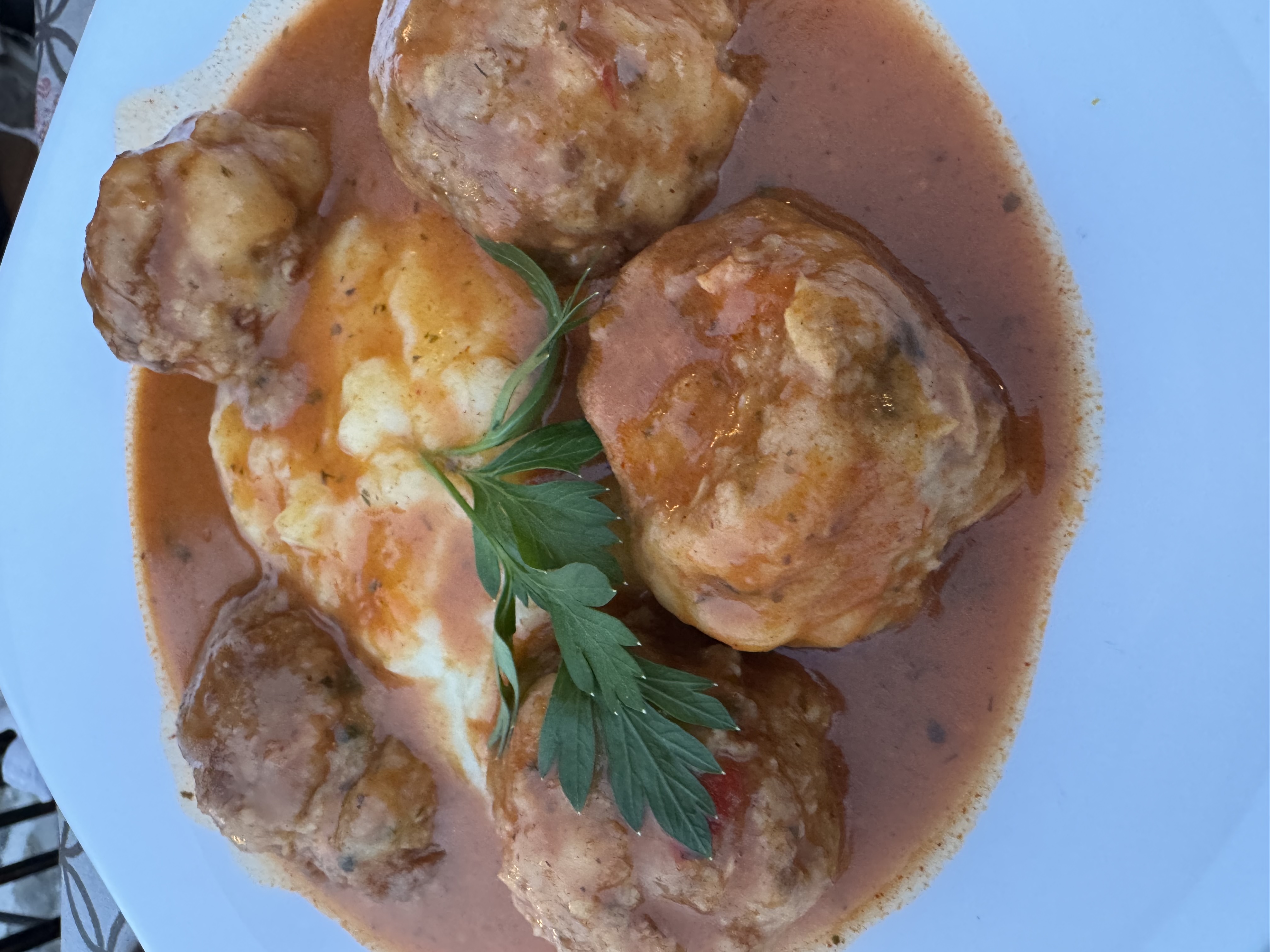
Stuffed vegetables at Restaurant Bella Vista near the Stari Most.
The restaurants beside the Buna in Blagaj are a good place to stop for lunch during the driver loop.
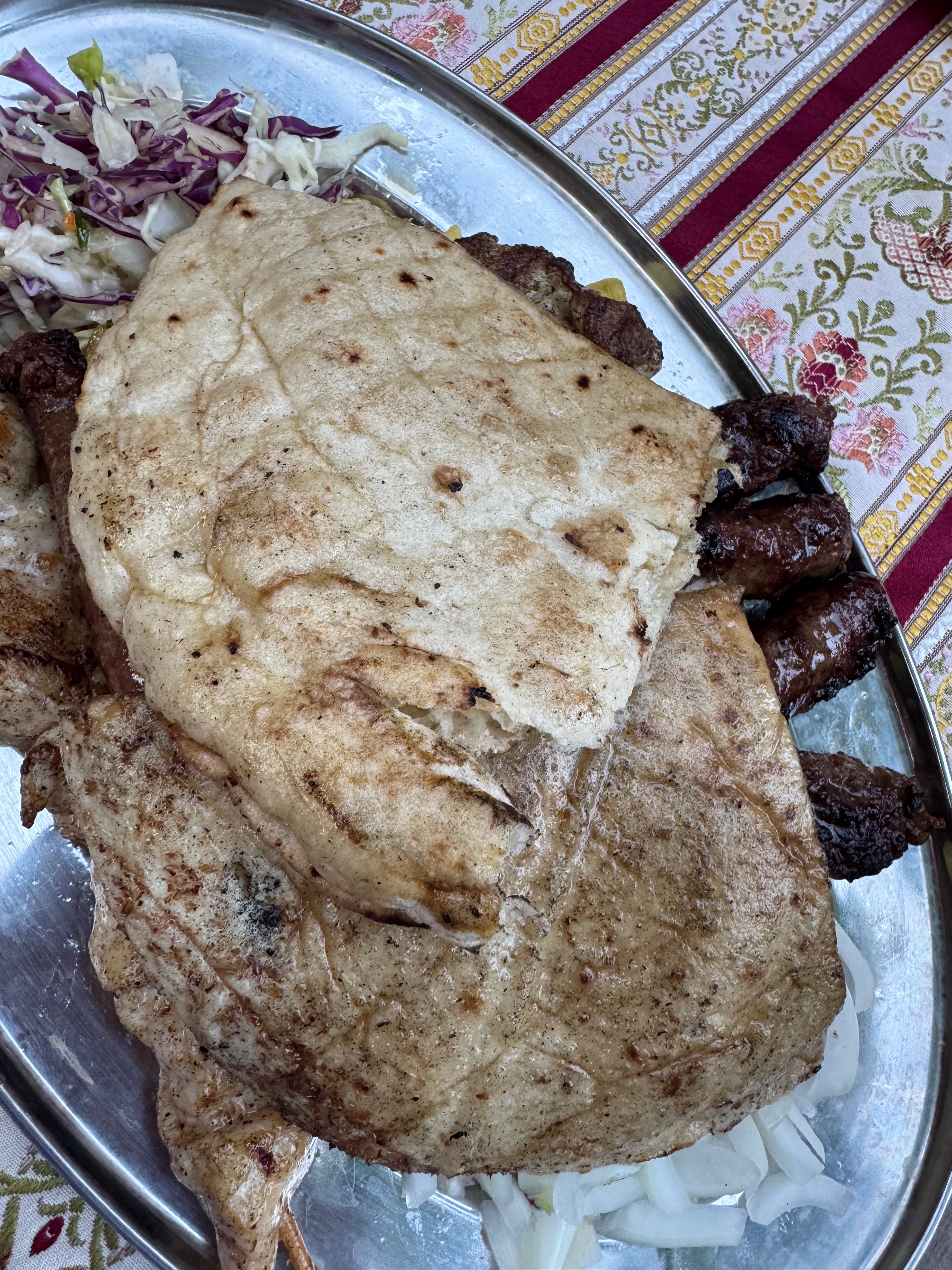
Grilled meat, flatbread, and onion at Tima - Irma in Mostar.
One day covers the old core, the Stari Most, the bazaar, and a mosque or two. The old town is busiest around midday when the coastal tour buses arrive. I would stay overnight for an early walk and dinner after the day-trippers leave. A second day is enough for Kravice Falls, Blagaj, and Počitelj.
When should I go to Mostar?
April through June and September through October are the comfortable months. July and August are very hot. Mostar sits in a valley that traps heat, and afternoon highs can break 40°C (104°F). The local pattern is indoors from noon to 6 pm, evening stroll afterward. December through February is mild but rainy, and most of the bazaar is shuttered.
How do I get to Mostar?
The Sarajevo to Mostar train takes about two hours and follows the Neretva canyon. Check the operator's current timetable because the number and timing of departures change. Buses connect Mostar with Sarajevo, Dubrovnik, and Split. Driving gives you more control over the day trips, but some mountain roads are narrow and fuel stops can be farther apart than expected.
Is Mostar safe to visit?
Yes. Mostar is a safe, welcoming town for visitors. The 1990s war is still visible in shell-scarred walls and ruined buildings across the city, including a few in the old core, and the rebuild is in obvious progress 30 years later. It is part of understanding the place, but it is history rather than current risk. Normal travel sense is all that is needed.
Can you still see the bridge divers in Mostar?
Yes. Diving from the Stari Most into the Neretva is a long-standing Mostar tradition, and members of the local divers club still jump through the day in the warmer months, usually after collecting tips from the crowd. There is also an annual Red Bull-sponsored diving competition each summer. The river is cold and the drop is 20 meters, so it is strictly their business, not a visitor activity.
 +2
+2 +3
+3 +1
+1
 +1
+1
 +1
+1
 +2
+2