Photos from Split
 +2
+2Bene Beachpark
 +2
+2Dvor Restaurantrestaurant

Tortuga Grill & Pubrestaurant

Beach Bar Nautilius Supetarrestaurant

Toto's Burger Barrestaurant
 +12
+12Split Rivapark

Jadran Beach Barrestaurant

Charlie's Bar Splitrestaurant
+2+2+12Current conditions and the practical reference material that helps turn the saved places into a trip.
7-day forecast from Open-Meteo. UV badges flag days when sun protection matters (3 and above is moderate; 8 and above is risk territory for unprotected fair skin within 30 minutes).
About 74% of the year's rain falls in these months. Typical highs around 14°C, lows around 9°C.
Typical highs around 24°C, lows around 17°C. About 49mm of rain a month.
Public holidays from Nager.Date.
Public-transit operators within 8 km of the city center. Click through to each operator’s site for routes, fares, and tickets.
Operators and modes are aggregated from individual transit-agency GTFS feeds. Route classifications come from each feed’s route type codes.
Split is the second-largest city in Croatia and the principal urban center of Dalmatia, situated on the eastern shore of the Adriatic Sea. As the administrative seat of Split-Dalmatia County and the largest city on the Croatian coast, it serves as a key economic, cultural, and transportation hub for the region. Developed around the historic core of Diocletian's Palace and extending across a central peninsula toward its surrounding suburbs and hinterland, Split combines a continuous urban tradition spanning more than seventeen centuries with a contemporary role as one of Croatia's leading tourist destinations. The city itself has a population of over 160,000, while the metropolitan area encompasses approximately 310,000 inhabitants.
The links below support the changing or licensed reference material on this page. Personal notes and ordinary geographic facts are not footnoted individually.
Monthly highs, lows, rainfall — long-term averages, NASA POWER.
Maps, image licenses, and the full dataset registry are listed in site credits.
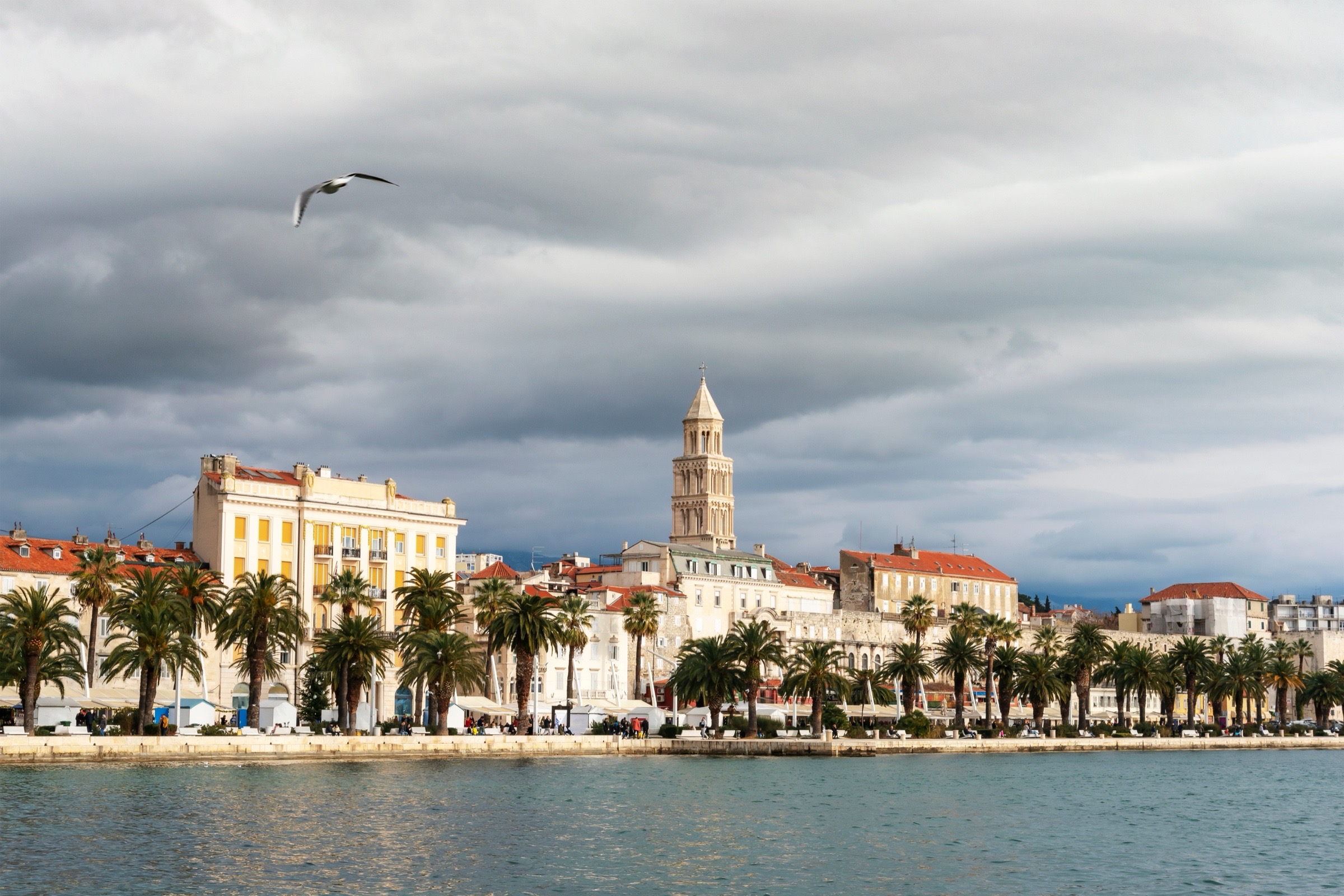
My Split travel guide. Diocletian's Palace on foot, Marjan Forest Park, ferries to Hvar and Brač, where I stay, and the restaurants I liked.
Split grew inside the walls of a Roman emperor's palace. The palace cellars, gates, temples, and apartments became part of the street plan rather than a separate archaeological site. I would allow two days for Split and Marjan Forest Park, then add time for any island trips.
Planning brief
Split grew inside and around Diocletian's Palace. Roman walls and rooms now contain homes, restaurants, shops, and churches. Two days cover the city and Marjan Forest Park. Add another day for Hvar, Brač, Šolta, or Trogir.
The historic core inside the palace walls is loud at night and the rentals overcharge. Stay in Veli Varoš, Bačvice, or just outside the Silver Gate. You walk into the palace in 5 minutes and sleep without club bass.
Peristyle, Cathedral of St. Domnius, Temple of Jupiter, Vestibule, the basement halls. Two hours if you skip the climb up the bell tower, three with it. Do it before 11 a.m. to beat the cruise-ship arrivals.
The forested peninsula west of town. 178 m to the viewpoint at Telegrin, a 90-minute round-trip walk with a stop at the small medieval churches along the way. Free.
The beach-and-forest line starts at Sv. Frane at the west edge of the Riva and normally runs toward Kašjuni and Bene. It is currently turning around at Kašjuni because of road work. Check Promet Split before relying on it for Bene.
Hvar is the party island with the better food scene. Brač has Zlatni Rat (the famous shifting-tip beach) and a quieter rhythm. Jadrolinija ferries to both leave several times a day from the Split harbor.

Split Airport (SPU) is about 20 km west of the city, near Trogir. These are the main options into town.
| Option | Time | Notes |
|---|---|---|
| Airport shuttle | About 30 to 40 min | Runs between the airport and Split Bus Station beside the harbor. Check the airport's current departure list |
| Bus 37 | Longer and dependent on traffic | Local bus between Trogir, the airport, and Sukoišanska bus terminal in Split. It does not end at the harbor |
| Uber / Bolt | About 25 to 45 min | Door-to-door and easier with luggage. The app shows the current fare |
| Official taxi | About 25 to 45 min | Use the airport rank and confirm the fare before leaving |
Intercity buses connect Split with Zagreb and other Croatian cities. The train from Zagreb is slower and runs less often. Jadrolinija also operates an overnight ferry from Ancona in Italy on a seasonal schedule. Split's cruise traffic contributes to the largest midday crowds in the palace.

Promet Split runs the local buses, but most short visits are centered on places that are easy to reach on foot. The old town, Riva, Veli Varoš, Bačvice, and the first Marjan viewpoints are close together.
The two routes I would actually remember are Bus 37 and Bus 12. Bus 37 is the Trogir and airport-corridor local from Sukoišanska. Bus 12 is the Marjan line, signed Sv. Frane - Bene, and it starts at the west edge of the Riva by St. Francis.
Bus 12 is useful after a long walk through Marjan or for reaching Kašjuni without a taxi. Some stops remain a walk from the coves, and service is not frequent enough to ignore the timetable. As of July 2026, road work has shortened the line to a temporary turnaround at Kašjuni instead of Bene.
Split's summer calendar is busy, with Ultra Europe as the main hotel-price spike and the Split Summer Festival as the cultural anchor.
| Event | When | What it changes |
|---|---|---|
| Ultra Europe | Mid-July | Major electronic festival at Poljud Stadium. Hotels can triple for the week |
| Split Summer Festival | Mid-July to mid-August | Classical music, theater, opera, and dance inside Diocletian's Palace |
| Days of Diocletian | Late August | Roman re-enactments, costumes, food, and performances in the squares |
| St Domnius | May 7 | Patron-saint procession, Riva fireworks, and food stalls |
| Mediterranean Film Festival | Early June | Film festival across central venues |
| Sudamerica Festival | Early July | Latin and reggaeton music at Žnjan |
| Advent in Split | Late November to early January | Small market on the Riva and inside the palace |
| Carnival | Before Lent | Local masked carnival on the Riva |
I prefer to stay outside the palace walls but within a 10-minute walk. The lanes inside the complex are beautiful, but bars, restaurants, and late foot traffic can make some rooms noisy.
| Area | What it is like | Notes |
|---|---|---|
| Veli Varoš | Historic neighborhood west of the palace, close to Marjan | My preference for a walkable base outside the old-town crowds |
| Bačvice | Near the city beach. Slightly further from the palace | Best for swimmers and joggers along the seafront |
| Manuš | Just north of the palace | Good middle ground. Walking distance to bus station and palace |
| Zone | Why I would not stay there |
|---|---|
| Inside the palace walls | Beautiful during the day. Loud after 10 p.m., especially on weekends |
| Mall of Split / suburbs | Cheaper and parking is available, but it only makes sense with a car. Otherwise you taxi to every dinner |

Historical Complex of Split with the Palace of Diocletian is the parent site for the palace, cathedral, temple, gates, and surrounding old city. It is an unusual cross section of history. Diocletian's government persecuted Christians, but his mausoleum later became a cathedral dedicated to St. Domnius, a bishop executed during Diocletian's rule. Other Roman spaces were also converted to Christian use, while homes and businesses filled the rest of the complex.
Allow two to three hours for the main sites, then return later without an itinerary. The palace works best when you see both the monuments and the ordinary streets built through them.
| Stop | What it is |
|---|---|
| Bronze Gate (Riva-side entrance) | The south wall opens onto the harbor. Used to face the sea directly |
| Substructures (basement halls) | Vaulted Roman rooms that supported the imperial apartments above. Part is free to cross and the museum section is ticketed |
| Peristyle | The central courtyard. Look up at the cathedral bell tower |
| Cathedral of St. Domnius | Diocletian's mausoleum converted into a cathedral dedicated to one of the Christians martyred during his rule. The bell tower requires a separate climb |
| Temple of Jupiter | A small Roman temple later converted into a baptistery. One of the Egyptian sphinxes brought to the palace stands outside |
| Vestibule | The domed entry rotunda. A cappella singers often perform here for tips |
| Gold, Silver, Iron gates | The four cardinal-direction palace gates. Walk through each |
| Gregory of Nin's Big Toe | The bronze bishop statue outside the Golden Gate. Tradition says rubbing the toe brings good luck |
| Crkva Sv. Martina (St. Martin's Church) | The early-medieval church (5th-6th century origins) squeezed into the palace's north-wall guardhouse above the Golden Gate |

The Diocletian Aqueduct carried water to the palace from the Jadro River. Surviving and restored sections stand east of the center and receive far fewer visitors than the palace.

Marjan Forest Park is my favorite place to walk in Split. The forested peninsula functions as the city's main large green space, with roads and trails for walking, running, and cycling, plus several places to swim. Start at the Riva, walk through Veli Varoš, and continue into the park. You can turn back at the first viewpoint or continue across the peninsula.
| Stop | Notes |
|---|---|
| First viewpoint (Telegrin path) | 5-min walk from the city, harbor view |
| Sv. Nikola church | Small Romanesque church tucked into the slope |
| Vidilica viewpoint | The main city view |
| Vrh Telegrin | The summit at 178 m. 45-min walk total |
| Klisko polje | The plateau between summits. Quiet picnic spot |
Bus 12 normally follows the edge of Marjan from Sv. Frane toward Kašjuni and Bene. It is useful for returning after a long walk or reaching the western beaches. Stops are not directly beside every cove, and the service is not frequent. As of July 2026, road work has shortened the route to Kašjuni, so it does not currently complete the usual run to Bene.

| Beach | Why go | Transit note |
|---|---|---|
| Bačvice | The famous city beach. Shallow water, with picigin, the local shallow-water paddle game played barefoot in calf-deep water | Walk from the palace or harbor side |
| Kašjuni | The prettier Marjan-side swim, farther out and quieter than Bačvice | Bus 12 helps, but expect a walk from stop to water |
| Bene | Forest-park beach at the far Marjan end | Normally Bus 12 terminates here. Check current service because the line may turn at Kašjuni |
| Trstenik | East-side city beach, easier if you are staying that way | Not a Marjan stop. Use it when your base is east of the old town |
The island beaches are more dramatic, but Split's beaches are easy to combine with an ordinary day in the city. I use the Marjan side for a walk and swim rather than treating it as a separate beach resort.
| Spot | What I order or remember | Notes |
|---|---|---|
| Konoba Fetivi | This might be the best restaurant in Split. Michelin-recognized at reasonable prices for the calibre | Reserve the night before, space is limited. Around $50 covered a bottle of wine, a steak, and the cuttlefish risotto when I went. Cash |
| Konoba Marjan | Hearty Dalmatian fare in Veli Varoš | Cooked fast, and not as crowded as the more obvious neighbors. Reservations help, no English menu |
| Konoba Oliva | Smaller and quieter than Fetivi | Family-run |
| Zlatna ribica | Quick fresh-fish counter in the fish market | Cash only. Stand-up or three benches. Cheapest fresh seafood in town, cooked fast |
| Fife | Local-priced classics. A regular working lunch | A bit pricey for the room, the location carries it. No bookings, queue at 12:30 |
| Villa Spiza | Small open kitchen, daily blackboard menu | Reservations essential |
| Portofino | Sit-down risotto and very professional service | Outdoor tables come with blankets, which matters because Split evenings get chilly. The gold-leaf on the shrimp is a bit much, the flavors are on point |
| Biberon Sushi Bar | My sushi choice in Split | Pleasant terrace and less crowded than the old-town restaurants. Prices are typical for sushi in Croatia |
| Mirakul dostava pizza | Late-night pizza | Delivery and walk-in |
| Chops Grill - Steak & Seafood | A non-konoba option for a steak night | Premium pricing |


Use Fife for a basic working lunch, not a special-night dinner. It is the Split version of a place that makes sense because you are nearby, hungry, and want grilled fish or a simple plate without turning lunch into a project.
One to skip if you have other options: TIN Food & Wine. The atmosphere and the view are great. The sushi was mediocre on my visit. Order a glass and a small plate, then eat elsewhere.
| Destination | Transport | Time | Notes |
|---|---|---|---|
| Trogir | Bus 37 from Sukoišanska | 50 to 60 min | UNESCO-listed historic center. Allow half a day |
| Klis Fortress | Local bus or car | About 30 min | Fortress on a ridge above Split, also used as a filming location for Meereen in Game of Thrones |
| Salona / Gradina Solin | Local bus or car | About 30 min | Archaeological remains of the Roman provincial capital outside Split |
| Brač (Bol and Zlatni Rat) | Seasonal direct catamaran to Bol, or car ferry to Supetar plus a bus | About 1 hr direct, longer through Supetar | Check the return sailing before buying because the direct Bol schedule is seasonal |
| Hvar Town | Krilo or Jadrolinija catamaran | About 1 hr | Direct passenger boats use Hvar Town. The car ferry uses Stari Grad, 110 to 120 minutes from Split |
| Šolta | Jadrolinija ferry to Rogač | About 1 hr | Quieter than Hvar or the area around Zlatni Rat |
| Krka National Park | Intercity bus toward Skradin or an organized tour | About 90 min | There is no Promet Split city bus to the park. Check the park's timed entry and current bus schedule |
| Spot | Why |
|---|---|
| Craft Pub, Brewpub, Prostor | Local craft beer in the old town. Croatian and regional taps |
| O'hara's Irish Pub | The sports pub. Football (both kinds), baseball, and the rest if Hajduk or the national team are not on |
| Harats Irish Pub Split | The other reliable late-night |
| Beach Bar Lungomare | A daytime beach bar walk from Bačvice |

Skip Joe's Beach Lounge & Bar unless it is the only game at the cove. €35 for a beach lounge, €18.50 for a bottle of water, a cider, and an ice cream, and the glasses were not as clean as the prices suggest.
For wine, almost every konoba has a local list. Pošip is the structured Croatian white from Korčula. Plavac Mali is the local red, the heavy ancestor of Zinfandel grown on the Pelješac peninsula. Babić is a lighter red from around Šibenik. Ask the kitchen what they would drink with what you ordered. It usually beats the menu pick.


