Current conditions and the practical reference material that helps turn the saved places into a trip.
The next week in Tbilisi
7-day forecast from Open-Meteo. UV badges flag days when sun protection matters (3 and above is moderate; 8 and above is risk territory for unprotected fair skin within 30 minutes).
Today
Overcast
32° / 22°
UV High
Wed
Overcast
33° / 23°
UV High
Thu
Overcast
32° / 24°
UV High
Fri
Partly cloudy
33° / 21°
UV High
Sat
Overcast
34° / 22°
UV High
Sun
Overcast
35° / 21°
UV High
Mon
Showers
33° / 22°
3.1 mm
UV High
Climate
Hot and wet season (Apr-Jun)
About 41% of the year's rain falls in these months. Typical highs around 24°C, lows around 11°C.
Cooler dry season (Nov-Mar)
Typical highs around 9°C, lows around -1°C. About 21mm of rain a month.
In August 4
Drag to scrub across the year.
JFMAMJJASOND
Weather
32° / 19°
Typical high / low
1 mm rainfall this month
Daylight
13.9h
06:08 – 20:02local
Festivals around this date
Holidays coming up
Public holidays from Nager.Date.
Airports
closest TBS · 13 km
About Tbilisi
Tbilisi is the capital and largest city of Georgia, located on the banks of the Kura River. With more than 1.3 million inhabitants, it contains almost one third of the country's population. Tbilisi was founded in the fifth century AD by Vakhtang I of Iberia and has since served as the capital of various Georgian kingdoms and republics. Between 1801 and 1917, then part of the Russian Empire, it was the seat of the Caucasus Viceroyalty, governing both the northern and southern sides of the Caucasus.
The links below support the changing or licensed reference material on this page. Personal notes and ordinary geographic facts are not footnoted individually.
City background. Wikipedia summary may be clipped or paraphrased. Structured fields are cross-checked against the related references. Related: Wikidata.
highlowrainfallcomfortable months
Monthly highs, lows, rainfall — long-term averages, NASA POWER.
Getting around. Transit operators from agency GTFS feeds and nearby commercial-airport reference data.
Public holidays. Upcoming public-holiday dates used in the annual planning scrubber.
City flag source. Public domain, Tbilisi City Seal.svg: *Tbilisi City Seal.PNG: Tbilisi City Hall derivative work: Nesnad Flag of Georgian Orthodox Church.svg: Gaeser derivative work: George M..
Maps, image licenses, and the full dataset registry are listed in site credits.
The food and wine are the main reasons I keep returning to Tbilisi. The center is compact, prices are still low, and the old town sits beside nineteenth-century avenues, Soviet concrete, and newer glass buildings. Georgia's qvevri wine tradition is thousands of years old, but it is the ordinary house pour here rather than a museum subject.
Planning brief
Planning Tbilisi
Tbilisi is easier to navigate than its position in the Caucasus suggests. Georgia left the Soviet Union in 1991, but the language, Mkhedruli script, food, and qvevri wine tradition are Georgian rather than Russian. This guide stays mostly in the city. Kakheti wine country and the mountain roads north belong to separate trips.
Uber from the airport, even at 3 a.m.
I landed at 3 a.m. on a Lufthansa flight from Munich and used Uber into the center. The airport is small, so finding the pickup area was easy. Matching the car took more attention because the driver name appeared in Mkhedruli, Georgia's own script. The license plate was the simpler check.
The architecture flips block by block
Rustaveli Avenue has nineteenth-century facades, iron balconies, and mansard roofs. The old town narrows into timber balconies and the brick domes of the sulfur baths. Soviet concrete appears between them, with the stacked Bank of Georgia headquarters as the clearest example. All three are visible within a short ride or walk through the center.
Cable car for the views, theme park for the day
The Rike-Narikala cable car climbs from the river to Narikala Fortress and the Mother of Georgia statue in about a minute. The Mtatsminda funicular climbs the other hill to the theme park, its Soviet-era observation building, and the restaurant terrace. I use the first for the old town view and the second for lunch above the city.
Khinkali, eggplant rolls, and the local wine
Georgian meals usually begin with several dishes rather than one main. Khinkali are soup dumplings held by the twisted top. Khachapuri is cheese bread, with the Adjarian version shaped like a boat and finished with egg. Badrijani nigvzit is fried eggplant wrapped around walnut paste. Qvevri amber wine is tart and oxidative, and most restaurants have a local bottle or house pour.
Tbilisi International (TBS) is a small airport about 17 kilometers east of the center. I arrived at 3 a.m. on a Lufthansa flight from Munich. The hour did not make the transfer difficult.
I used Uber into town. The pickup area was easy to find and the car arrived within a few minutes. Ride-hailing operators change, so I check which apps are active before each arrival rather than treating an old trip as a current guarantee.
The harder part was matching the driver name. Georgian uses the Mkhedruli alphabet, which is unrelated to Latin or Cyrillic, and the name appeared in Georgian script. License plates use Latin characters, so the plate was the easier check. The same issue comes up again on storefronts and menus, which is why mobile data and camera translation help.
The curb taxi rank quotes more than the ride-hailing apps. If you use one, agree the fare before getting in. Bus 337 runs between the airport and the center and takes roughly 40 minutes.
Festivals and big annual events
Tbilisi's main visitor-relevant date is Tbilisoba in early October. The other dates mostly matter for closures, hotel prices, or a Kakheti wine-country extension.
Event
When
What it changes
Tbilisoba
First weekend of October
Free music, wine, dance, and food events around the old town and Rike Park. Central hotels fill
Rtveli grape harvest
September and October
Not in Tbilisi, but the best timing for Kakheti wineries
Tbilisi Open Air
Late June
Lisi Lake music festival. Hotels rise for the weekend
New Year
December 31 to January 2
Fireworks, peak hotel prices, and closures on January 1
Georgian Orthodox Easter
April or May
Locals leave town, restaurants close, and the center gets quieter
Independence Day
May 26
Civic events and parades along Rustaveli Avenue
Where to stay
The old town puts the baths, Narikala, and the steep lanes outside the door. Rustaveli Avenue and the streets north of Freedom Square have easier metro access and flatter walks. Saarbrucken Square sits between the old town and the Dry Bridge market.
Walking distance to the old town and Dry Bridge, 24-hour Marriott check-in, fair solo rate
The in-room workspace is a counter with a bar stool rather than a desk
Old town apartments and small hotels
Various
The baths and Narikala are close, and rates are often below the international brands
Many buildings are walk-ups. Check recent reviews for stairs and access
I use the Moxy when I want a predictable late check-in and an easy walk into the old town. The room is fine for sleeping, but the counter and stool are uncomfortable for a full workday. That matters more to me than the compact room size.
The architecture, one block at a time
The center changes quickly on foot. Rustaveli Avenue has nineteenth-century stone facades and iron balconies. The old town below it narrows into timber balconies, brick bath roofs, and lanes climbing toward Narikala. Soviet offices and housing sit around both, followed by newer glass buildings along the river.
Four places make the sequence easy to see:
Rustaveli Avenue runs north from Freedom Square past the Opera, National Museum, and Marriott. Its stone fronts, mansard roofs, and iron balconies come from the nineteenth-century expansion of the city.
The old town south of Freedom Square keeps narrow lanes, timber balconies, and the sulfur bath district below Narikala Fortress.
The Bank of Georgia headquarters is a 1975 Soviet office assembled from stacked concrete bars. It remains a working bank rather than an architecture exhibit.
Sololaki and Vera have nineteenth-century houses beside later Soviet apartment blocks. I walk them rather than treating the architecture as a list of isolated monuments.
Much of this is still ordinary infrastructure. The Soviet bus stops remain in service, bakeries still use the old-town shopfronts, and the Bank of Georgia building still holds offices.
Getting around: the metro and the cable car
The Tbilisi Metro has two lines and deep Soviet-era stations. Rustaveli has a long escalator shaft and Avlabari has the marble and bronze associated with Soviet metro design. Those are the two central stations I would look at beyond using the trains for transport.
The fare is a flat 1 GEL per ride, with a 90-minute transfer window between the metro and city buses.
Contactless bank cards and phone wallets work at the turnstiles. A Metro Money card is the fallback when a foreign bank card fails. The card costs 2 GEL at station machines and can be shared, with one tap for each passenger.
The trains are loud and usually arrive within a few minutes. Platform signs show station names in Georgian and Latin script. Announcements are in Georgian.
The Rike-Narikala cable car climbs from Rike Park to Narikala Fortress and the Mother of Georgia statue in about a minute. From the upper station, the old town, river, and newer buildings along Rike Park are all visible at once. I ride up, follow the ridge, and walk down through the bath district.
The Mtatsminda funicular is a separate 1905 line. It climbs Mount Mtatsminda to the park and restaurant complex on the hill west of the center.
Mtatsminda Park, on the hill
Mtatsminda Park sits above the city on Mount Mtatsminda, and I keep going back. The 1905 funicular takes about ten minutes. At the top are a small theme park, gardens, and a Soviet-era observation building that now contains a restaurant with a terrace around it. Cats move between the paths and outdoor tables.
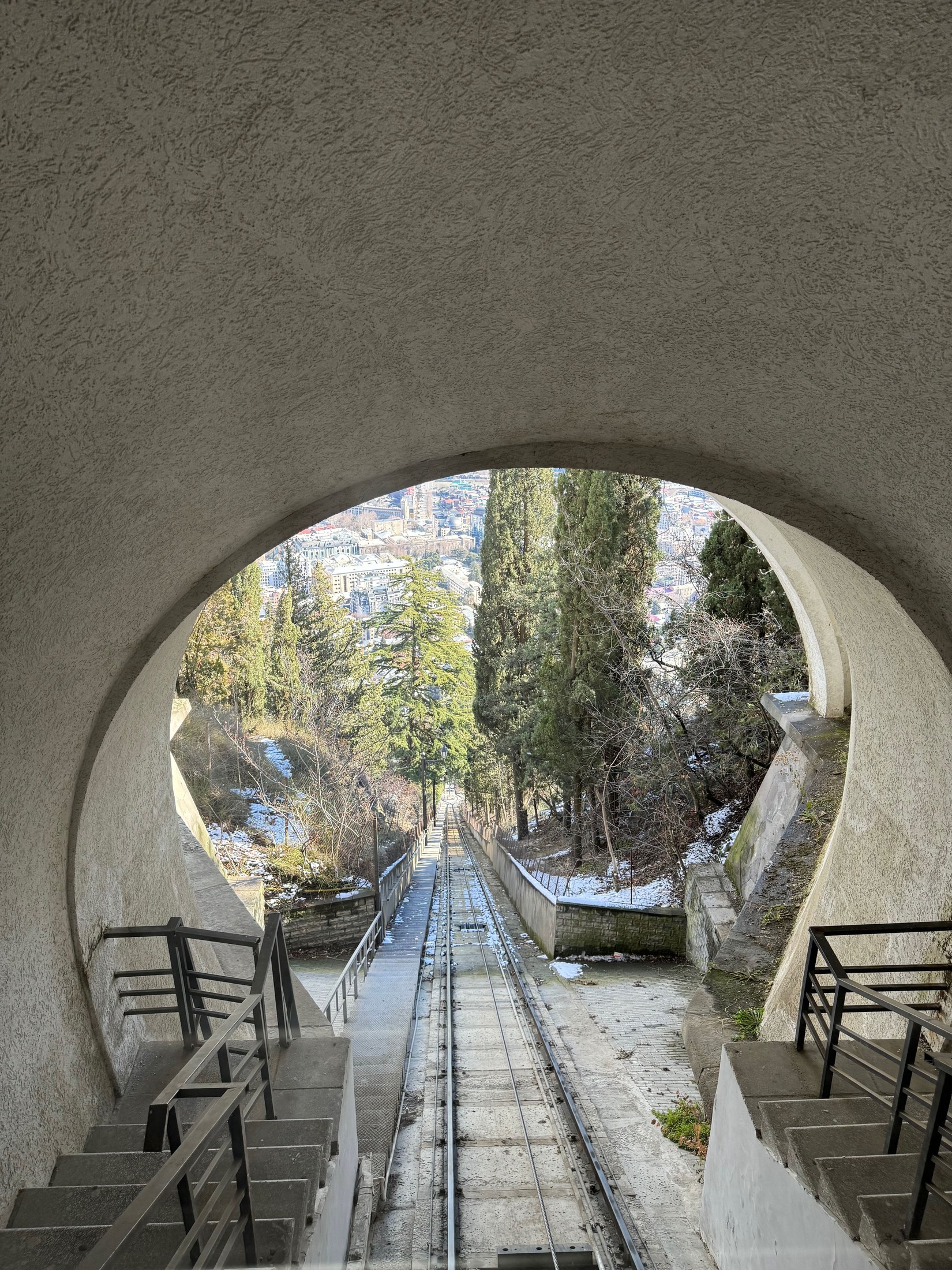
The funicular climbs through the hillside before reaching the park above central Tbilisi.
In summer, the hill is cooler than the streets below. Some rides close in winter, but the funicular, paths, and restaurant make the hill usable without them. I go for lunch on the terrace and the walk around the park rather than for the rides.
The sulfur baths
The sulfur baths sit below the old town along Abano Street. Rounded brick roofs cover the bath rooms, while Orbeliani Baths has the blue tiled facade visible from the street. The hot springs predate the Russian period and are tied to the name Tbilisi, from the Georgian word for warm.
Orbeliani Baths has the blue tiled facade at the end of the brick-domed bath row.
The Sulfur Baths cluster is the navigation point for the row. Bathhouses rent a private room, or kabini, by the hour. The room has its own sulfur pool. A kisi adds a vigorous mitt scrub and soap massage.
Flip-flops help on the wet floors. I also bring my own toiletries.
The rooms are private rather than one large communal hall. Orbeliani Baths is the tiled building most visible in photographs, but several bathhouses along the row offer the same private-room arrangement. A room plus a kisi takes about 90 minutes.
Where to eat and what to drink
Georgian food is regional, filling, and inexpensive compared with Western Europe. I can eat a two-course dinner with wine for two for less than one main in central Paris. Tbilisi is also where the differences between central Georgian, Megrelian, and Adjarian cooking become easier to see.
The dishes to know before you sit down:
Khinkali are large soup dumplings, traditionally filled with spiced beef and pork. Hold the top knot, bite the side, drink the broth, and eat the rest. The knot stays on the plate.
Khachapuri is cheese bread. The imeruli version is round and filled. Adjaruli khachapuri is boat-shaped and finished with egg.
Badrijani nigvzit is fried eggplant wrapped around walnut and garlic paste, usually served cold.
Mtsvadi is skewered grilled meat, often pork shoulder, served with raw onion and sometimes pomegranate.
Pkhali combines spinach, beet, or other vegetables with walnuts and herbs and is served cold.
Qvevri are clay vessels buried underground for fermentation and aging. Amber wine made this way is tart, oxidative, and more textured than a conventional European white wine. Most Georgian restaurants have a local bottle or house pour, often for only a few lari.
I rotate between craft beer bars and natural-wine shops in the center. Prices remain low, and most places sell smaller pours, so it is easy to try more than one Georgian brewery.
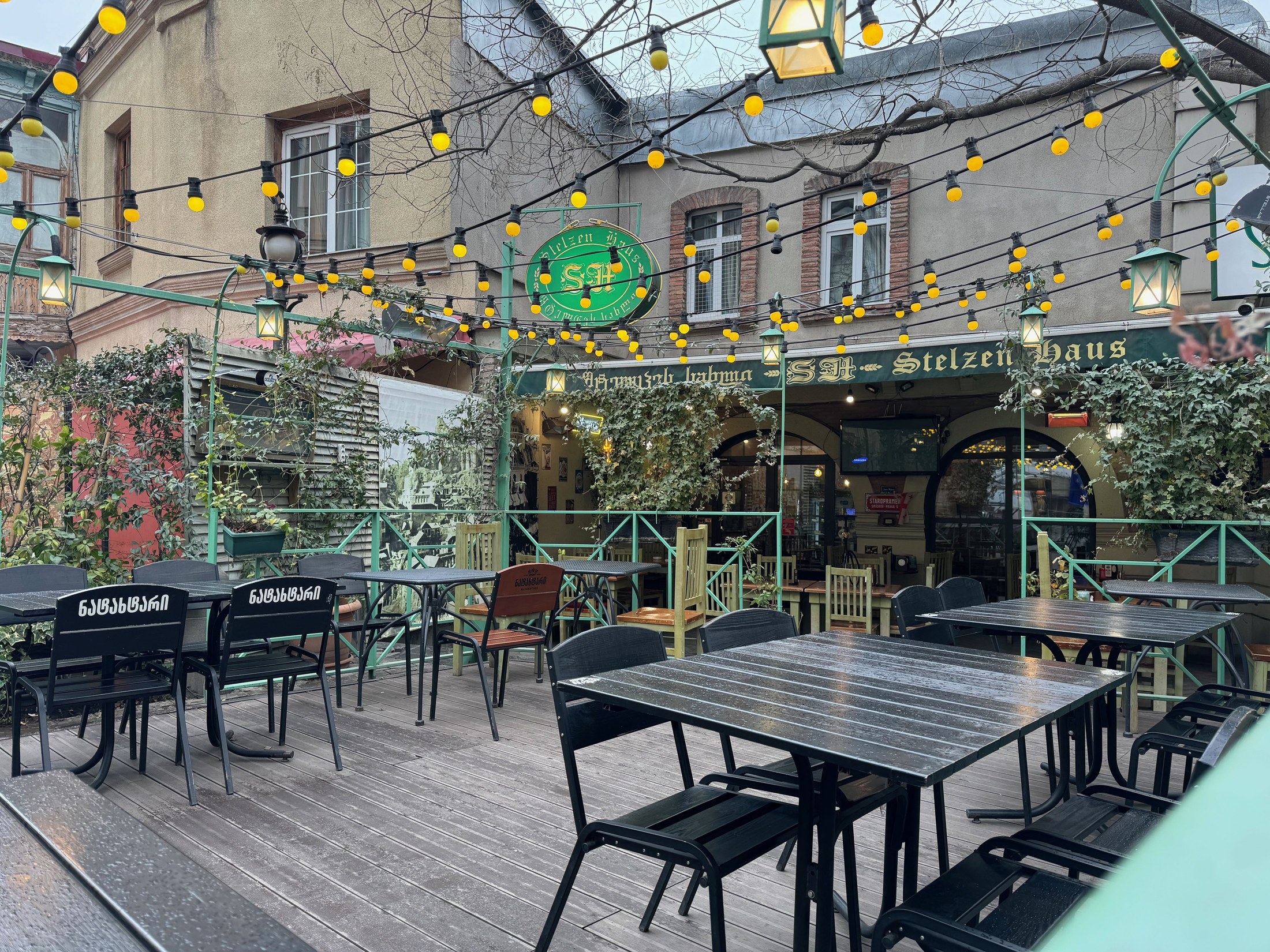
Seven Roads has a quiet patio, a long tap list, and fridges of Georgian cans.
Tourist pricing, including €6 hot wine. I go for the tram rather than the drinks
Markets to walk through
The three central markets serve different purposes:
Dezerter Bazaar is the food market north of Station Square. It has produce, cheese, dried fruit, churchkhela, spices, meat, and a wholesale flower section. Mornings have the fullest selection.
Dry Bridge Market is the open-air flea market near Saarbrucken Square. Sellers lay out Soviet cameras, watches, badges, silverware, and books in Russian and Georgian. More sellers appear on weekend mornings.
Meidan Bazar is a souvenir market inside a brick tunnel near the baths. The stalls sell carpets, ceramics, wine, and tea sets. The tunnel is more interesting than much of the merchandise.
I use Dezerter for food, Dry Bridge for browsing, and Meidan when I need a gift near the old town.
CINNAMON is the bakery counter inside Bazari Orbeliani, with pastries baked behind the counter. Kona Tea sells Georgian tea and spices nearby, and the staff will assemble a mixed bag for a gift.
The leaning clock tower, and what to do with the half hour
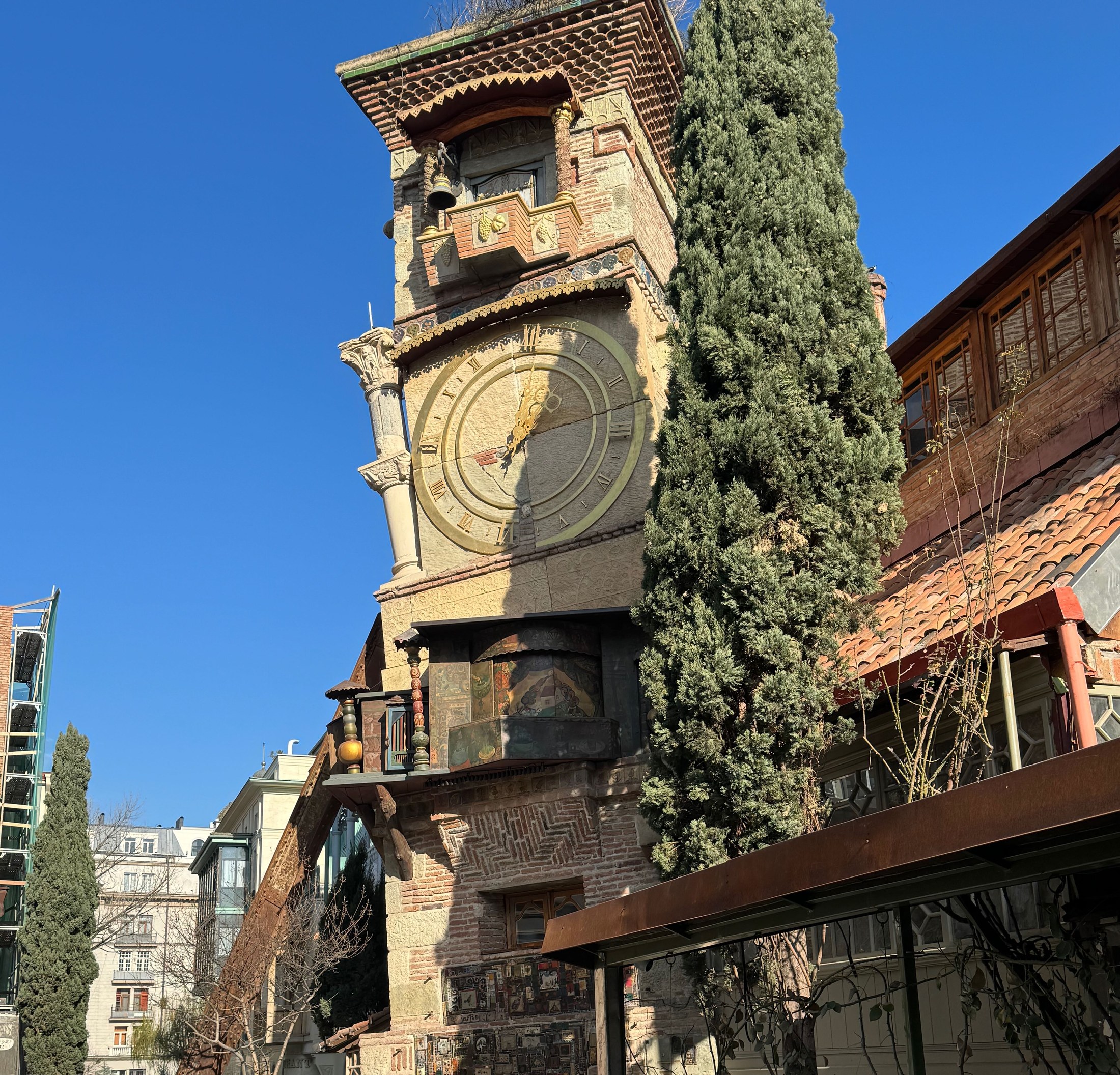
Rezo Gabriadze built the leaning clock tower beside his puppet theater in 2010. The tile-clad structure looks assembled from mismatched pieces, with a small wooden angel that rings the bell on the hour. A few minutes outside is enough unless you are waiting for the bell. The Rezo Gabriadze Puppet Theater next door is a separate ticketed visit. Performances are in Georgian, but the puppetry carries much of the story.
The leaning clock tower stands beside the Gabriadze Puppet Theater on Ioane Shavteli Street.
Tsangala's sits two minutes away on the same street and pours qvevri amber wine by the glass. I stop there after the tower, then continue downhill toward the river and the baths.
Quick answers
How do I get from Tbilisi International (TBS) to the city center?
I used Uber after landing at 3 a.m. and had no trouble getting into the center. Check the ride-hailing apps when you land because operators change. Bus 337 is the public-transport option and takes roughly 40 minutes. Curb taxis cost more, so agree the fare before getting in.
Is the Georgian language a real barrier?
The Mkhedruli script takes more adjustment than the spoken language. It is unrelated to Latin or Cyrillic, so driver names, storefronts, and Georgian-only menus are difficult to sound out at first. Hotels and many central restaurants have English available. I keep camera translation and mobile data ready for everything else.
Where should I stay in Tbilisi?
I use the Moxy Tbilisi at Saarbrucken Square for its 24-hour desk and the walk to the old town and Dry Bridge. The rooms work for a short solo stay, but the counter and bar stool are poor substitutes for a desk. Old-town apartments and small hotels put the baths closer, though recent reviews matter because many buildings are walk-ups.
Are the Tbilisi sulfur baths the same as Turkish hammams?
Tbilisi's baths use the naturally hot sulfur springs below the old town. Most bathhouses rent private rooms, called kabini, by the hour. A kisi adds a vigorous mitt scrub and soap massage. The blue-tiled Orbeliani Baths have the best-known facade, while the other bathhouses along Abano Street use the same private-room format.
Do I need to go inside the leaning clock tower?
No. A few minutes outside the Rezo Gabriadze clock tower is enough unless you are waiting for the angel to ring the bell on the hour. The puppet theater next door is a separate ticketed visit. Tsangala's wine bar is two minutes away if you want to sit nearby afterward.

 +1
+1 +1
+1 +1
+1 +4
+4 +3
+3 +6
+6 +3
+3 +1
+1 +3
+3 +2
+2 +3
+3 +1
+1 +2
+2 +1
+1 +8
+8 +5
+5

 +1
+1