One Friday night last year, AIA opened the call for presentations and I had a crazy idea. I knew I would already be in San Diego for the conference. I texted Daniel first. His family lives nearby and we have worked together since university. His reaction was "why not." I texted Agustina next, because neither Daniel nor I are architects and the tour needed someone who could talk about the design side. She said she was in. We did not expect to get picked. We definitely did not expect to lead both of them when each sold out instantly. But here we are.
Thanks again to everyone who joined our tours during the 2026 AIA conference. We ran the architecture walking tour Wednesday afternoon as ET133: Sustainability on Tap, and a beer tasting Thursday afternoon as ET176. This post is a writeup of the historical research I pulled together in preparation.
A bit of background on the three of us. I spend most of my time on the road between customer visits, making it back for the things that matter: family events, weddings, and watching the world cup with friends in Argentina. I work in AEC software, so the buildings tend to carry the weight on every trip and most of the cities I land in are places I have never been. Daniel and I went to university together. Agustina and I met at Autodesk University, realized we knew basically all the same people and hung out in the same spots, and now catch up at every AEC conference.
The tour is built around how I plan before I travel. I look up the buildings, the neighborhoods, the things I want to see, and I figure out the order before I get on the plane. The three of us share the lens. We care about the built environment, we all think hard about conservation and sustainability, and as someone in this industry I have mixed feelings about new versus old. So we picked the breweries. Daniel had been many times. Agustina and I walked the three sites for the first time on the Monday before the tour, and we spent the rest of the week pulling archival research on each one: building history, neighborhood history, the beer programs.
The driving question is why these three buildings exist at all. San Diego is a young city, and the answer for each is a different decade of how the place got built. The railroad. The fishing. The Navy. The drink is the prop.
Why San Diego grew on this exact curve
The Spanish have been on this coast for almost 500 years, but very little of the original survives beyond the place names. Cabrillo sailed into San Diego Bay in 1542 and stepped onto Point Loma at the spit that has been called Ballast Point ever since. The Mission San Diego de Alcalá followed in 1769. Between the mission and statehood the area changed hands twice but stayed small. As late as 1880, the city's population was around 2,600.
The change agent was the railroad. The California Southern reached San Diego in 1885 and tied the harbor into the Atchison, Topeka and Santa Fe network. Before that connection existed, anything industrial reaching the West Coast from the East had to sail around the tip of South America through the Strait of Magellan. The Panama Canal would not open until 1914. San Diego's natural deepwater port made it valuable the moment the railroad connected it. The 1890 census recorded 16,159 residents, more than six times the 1880 count.
The Navy noticed. On April 14, 1908, Theodore Roosevelt's Great White Fleet anchored off Coronado on the Pacific leg of its round-the-world voyage. Sixteen battleships, all painted white, all in port for four days. They had reached the Pacific by sailing around Cape Horn. The visit moved the Navy's attention west, and from then on San Diego's identity is built around three things: the harbor, the Navy, and the boom population needed to feed and shelter that combination.
| Census year | Population | Note |
|---|---|---|
| 1870 | 2,300 | Pre-rail. |
| 1880 | 2,637 | Pre-rail. |
| 1890 | 16,159 | First census after the railroad arrives in 1885. |
| 1900 | 17,700 | Great White Fleet anchors off Coronado in 1908. |
| 1910 | 39,578 | Pacific Tuna Canning opens in Logan Heights, 1911. |
| 1920 | 74,361 | |
| 1930 | 147,995 | Wonder Bread bakery (1924). 6,000+ Italian families in Little Italy by 1925. |
| 1940 | 203,341 | Naval Training Center (1923) is a major employer. |
| 1950 | 334,387 | Ballast Point's warehouse (1946) goes up the year after the war. |
The three buildings on this post sit at three points on that climb.
The railroad: Mission Brewery in the Wonder Bread Building
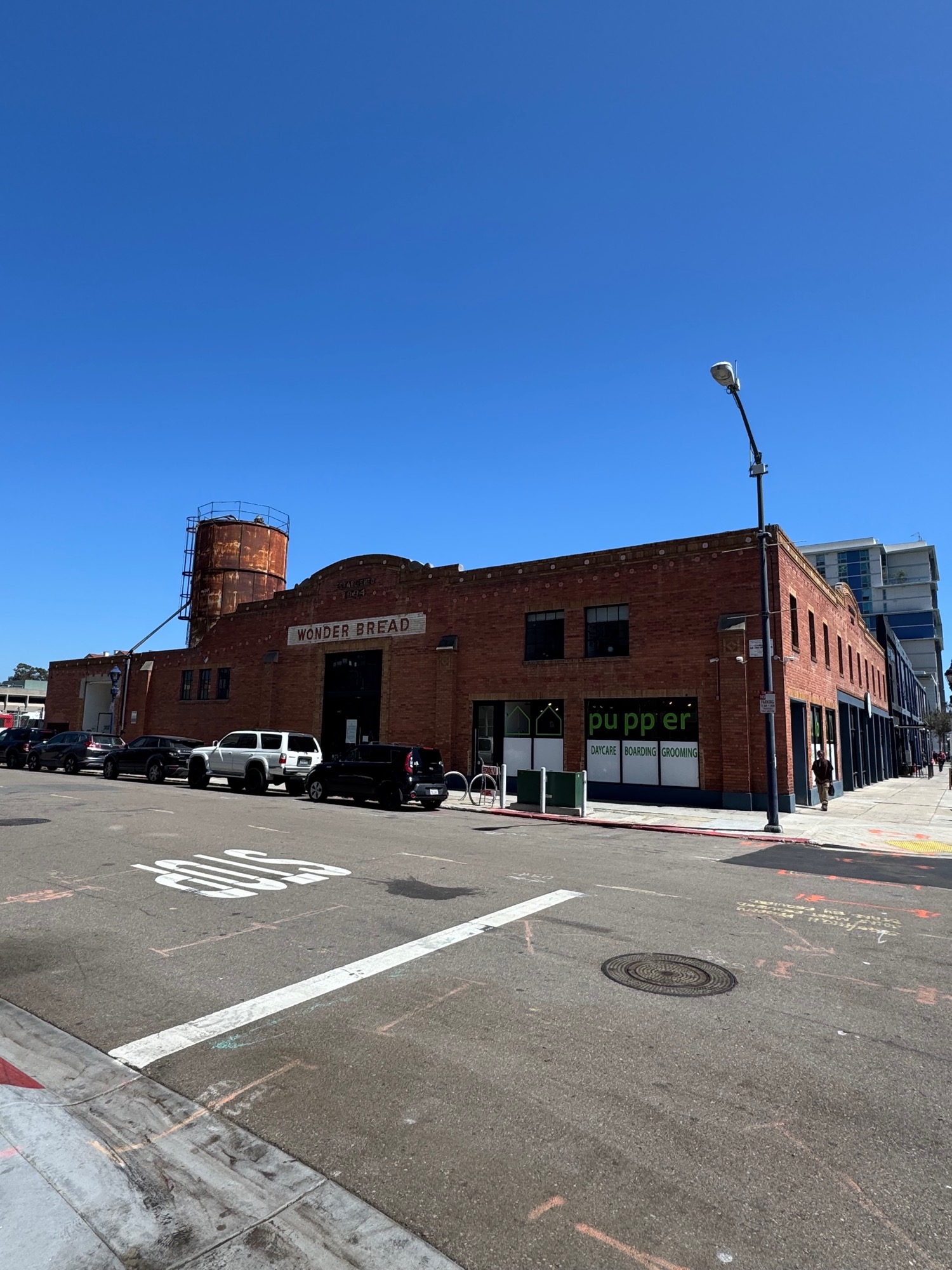
A booming city needed bread. Continental Baking Company, the largest commercial baker in the United States by the late 1920s, opened a Wonder Bread plant at 171 14th Street in the East Village warehouse district. The brick and reinforced-concrete building dates to 1924. The architect was Eugene Hoffman, who the City of San Diego later named a Master Architect when it designated the building HRB Site #458 in 2001. The builder was A.L. Dennstedt. Wonder Bread operated here for 83 years, until 2007.
The building nearly came down twice. The first threat was a 2007 proposal to clear the East Village warehouse blocks for a new Chargers stadium. Save Our Heritage Organisation's Warehouse District settlement agreement that year preserved ten buildings across nine blocks, the Wonder Bread plant among them. The second was the 2016 Measure C stadium proposal, which floated a facade-only retention that was contested at the Historical Resources Board. Measure C failed in November 2016. The Chargers left San Diego in 2017.
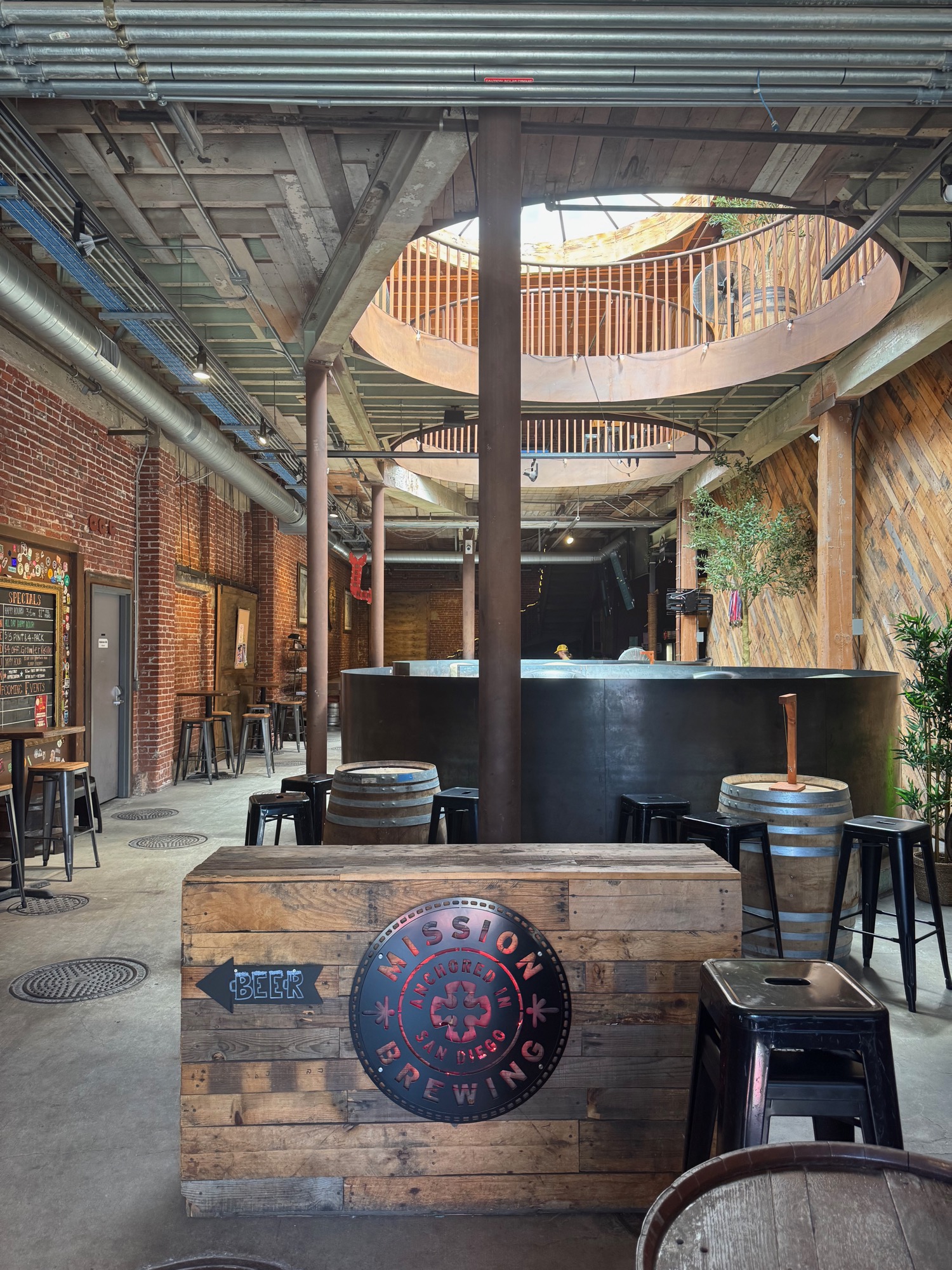
Mission Brewery moved into the building in 2011. The brand had been revived in 2007 by Dan Selis (the original San Diego operation went back to 1913 and died under Prohibition) and operated out of several locations before landing at 14th Street. HGW Architecture led the adaptive reuse of the 25,000 square foot bakery into the brewery and tasting room. HGW kept the brick exterior, the wood bow trusses, and the rooftop monitors (the raised clerestory windows that pour daylight onto the floor). A seismic retrofit went in along the way.
The floor is a small museum. Set into the concrete are pieces of the Sinclair Collection: salvaged manhole covers, granite paving blocks, and industrial fittings from the East Village's making-things era. Bob Sinclair (1942 to 2011) was an East Village sculptor, the founder of Pannikin Coffee & Tea, and at one point the largest single property owner in the neighborhood. He and his wife Gay acquired the Wonder Bread Building in 2002 and held it through the Chargers fight. Sinclair died in August 2011 and his memorial was held in this room. His manhole covers sit face-up in the brewhouse floor.
The interior layout is the part to flag. The taproom is an infill, a smaller structure built inside the larger former-bakery volume. When Mission first opened in this building, brewing happened at the far end near the painted "Wonder Bread" facade. Brewing has since shifted to the volume directly next to the taproom, and the taproom now sits on a discrete 3,000 square foot floor plate inside the original 25,000 square foot shell. The original flour silos were cut down and now anchor the round seating area on the lower floor. The tops of the silos are open and you can look up through them all the way to the roof. The upstairs mezzanine, used today as event space, wraps the production volume. You can see all of this standing on the floor.
Fishing: Ballast Point in a 1946 warehouse
By the late 1920s, San Diego was the tuna capital of the West Coast, and Little Italy was the working neighborhood that fed it. Genovese, Sicilian, and Azorean fishermen had been arriving since the 1880s. The 1906 San Francisco earthquake pushed many more south. By 1925 more than 6,000 Italian families lived along India, Columbia, and State Streets and Kettner Boulevard. The first tuna cannery, the Pacific Tuna Canning Company, opened in Logan Heights in 1911. By the 1920s, more than a dozen canneries lined the bay shore between Little Italy and the south end of downtown. The fishermen lived a few blocks uphill from the boats and the canners.
Three boat changes turned San Diego into the headquarters of the Pacific tuna fleet. The first was the live-bait clipper, a method pioneered locally where boats carried tanks of live sardines and anchovies in the stern. Crews chummed the bait into the water to bring tuna to the surface, then hooked them one at a time on poles. Brine kept the bait alive through long runs. The second was diesel power. The nineteen new boats added in 1927 and 1928 had cruising ranges of 2,500 to 6,000 miles, far enough to reach tuna grounds off the Pacific coasts of Mexico and Central America. The third was cork-lined refrigerated holds, which kept the catch fresh on the way back. Together they extended the fleet's reach from coastal to open ocean. At the industry's 1978 peak, more than 40,000 people in San Diego worked the boats, the canneries, and the supply chain.
The warehouse that now holds Ballast Point went up in 1946 at 2215 India Street, on the corner of India and Ivy. About 9,216 square feet under a roof, no famous architect, no historic designation. When Ballast Point opened the site on October 14, 2013, they added an R&D brewery, a tasting room, a kitchen, and a 4,000 square foot beer garden inside the existing shell. The 1946 warehouse gave them the core and shell, and they fit out the interior inside it. Constellation Brands bought the company for about a billion dollars in 2015 and sold it to Kings & Convicts in 2019. The Little Italy site keeps brewing.
That is the point of putting Ballast Point on this tour. The building carries no regulatory protection. Mission Brewery is preserved under the SOHO settlement and the HRB designation. Stone Brewing sits inside a federal historic district. Ballast Point is a core-and-shell fit-out with no protection. The architect at each was free to do different amounts.
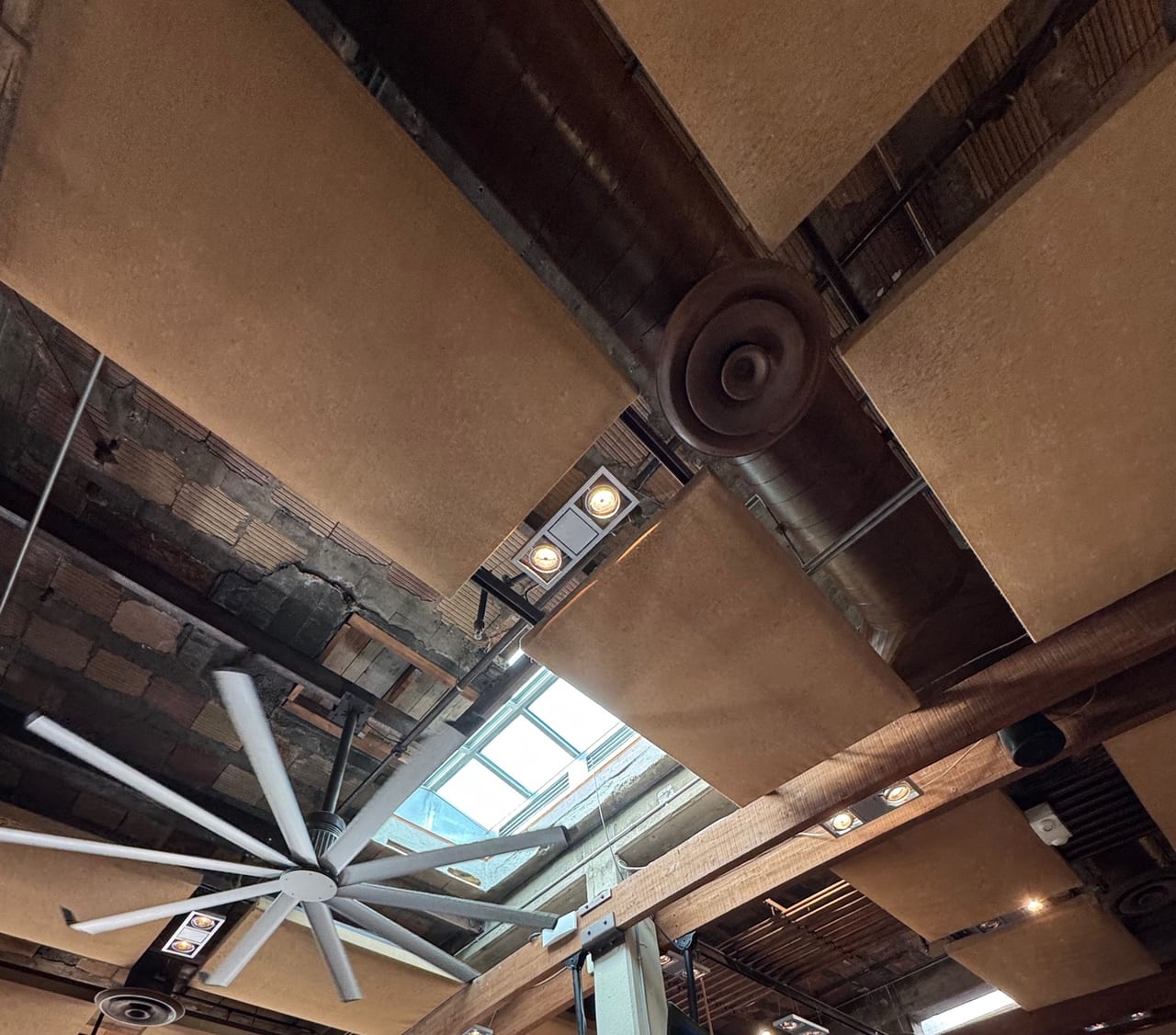
That freedom shows up in the ceiling. The patched roof deck, added acoustic panels, exposed ductwork, and old wood trusses all share the same room without pretending to be a restoration project. It is adaptive reuse by usefulness first.
The neighborhood thinned twice. The last major tuna cannery closed in 1983 as the industry moved overseas. Interstate 5 was cut through Little Italy in the early 1960s and erased about 35 percent of the grid, separating the community from its waterfront. The Little Italy Association was founded in 1996 to lead the rebuild. Today you walk through that rebuild, on the thinned grid. A block away, a faded painted Ben-Hur mural on the side of the Adams-Henry building marks what the neighborhood was before. The Adams-Henry went up in 1913 to a design by G.A. Hanssen. San Diego Coffee Company bought it in 1928 and made it the local Ben-Hur coffee distributor. The mural was sandblasted off during a building restoration in 1979 and repainted on the same east wall in 1982.
The Navy: Stone Brewing in a Naval Training Center mess hall
The Navy presence here loops back to the railroad and the Great White Fleet. After the 1908 fleet visit, San Diego lobbied successfully for permanent Navy facilities. The Naval Training Center was authorized by Congress in 1919, broke ground in 1921, and was dedicated October 27, 1923. The campus is Spanish Colonial Revival, the style codified locally by Bertram Goodhue's pavilions for the 1915 Panama-California Exposition and adopted as the regional vernacular through the 1920s. The Navy's actual designers were Lincoln Rogers and Frank W. Stevenson, working through the Bureau of Yards & Docks.
For 74 years NTC fed and trained Pacific Navy recruits at the western edge of the bay. The building Stone Brewing now occupies was Building 26, the mess hall, later the base library. During the Second World War the campus ran around the clock. Camp Nimitz, added in 1955, brought sixteen more barracks for 3,248 sailors and a galley with eight mess wings feeding 5,000 at a sitting. The landlocked USS Recruit (TDE-1), known as the "Neversail," trained more than 50,000 recruits a year through 1989 and is California Historical Landmark #1042.
The base closed in 1997 under the Base Realignment and Closure round that followed the end of the cold war. The City of San Diego adopted a Reuse Plan in 1998. The Navy's Record of Decision came in 1999. The land was transferred to the city on May 3, 2000, and redeveloped as Liberty Station, a mixed-use district of arts, retail, residential, education, and food.
The protection here is federal, and it is heavy. The historic core of NTC was listed on the National Register of Historic Places as the Naval Training Center Historic District on July 5, 2001, with 66 contributing resources across 550 acres. Many individual structures also carry City of San Diego historic designation. In practice, the protection covers more than the walls and roofs. Windows, fittings, and fixtures are part of the listing because they are original. Heritage Architecture & Planning is the district's preservation architect.
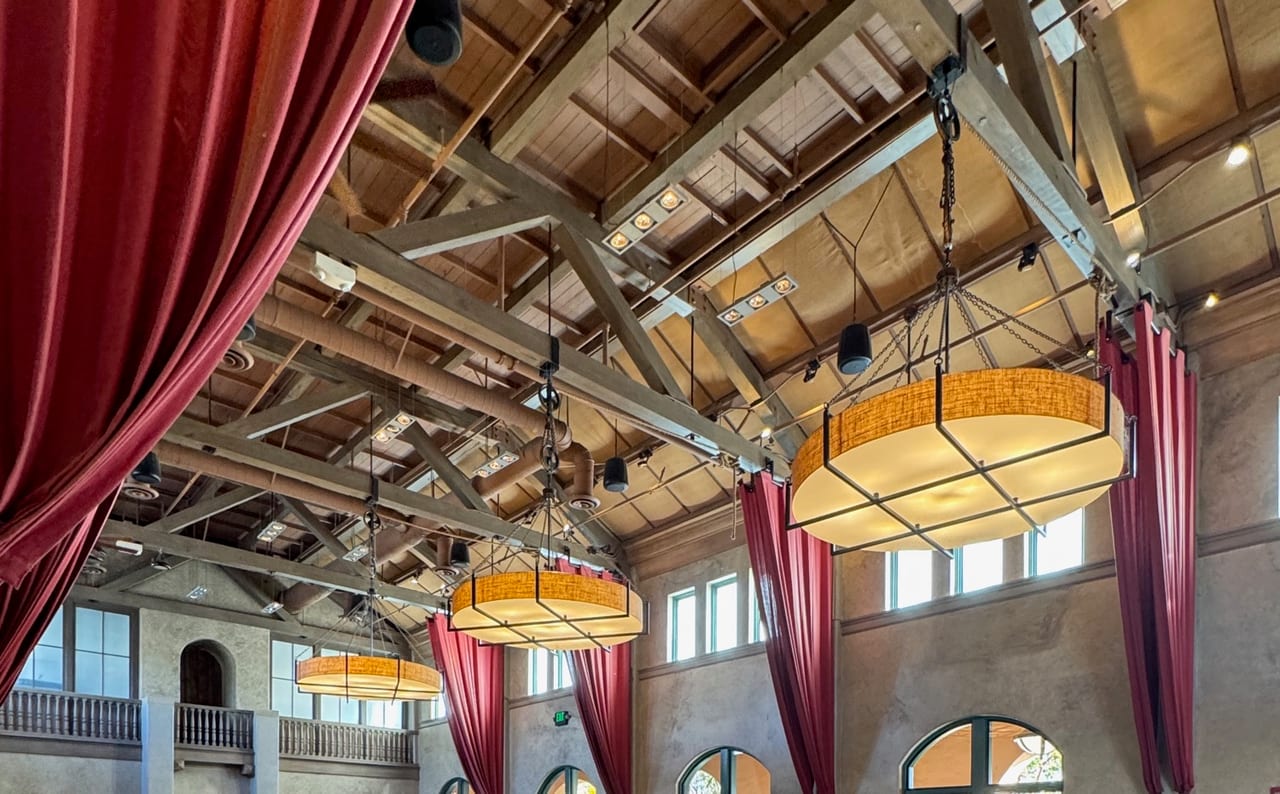
Stone Brewing opened in Building 26 on May 15, 2013. The brewery itself was founded in 1996 in San Marcos by Greg Koch and Steve Wagner. The Liberty Station site is the World Bistro & Gardens, with a brewing operation, a full kitchen, and an outdoor garden the company completed later that year. They could not tear down a wall if they wanted to. They could not replace the original windows. They could move tanks in, hang a sign, and run the kitchen. Sapporo bought Stone for $165 million in 2022. Firestone Walker and Duvel Moortgat USA bought the brand together in 2026.
The Spanish era set the names. The railroad built the population. The Navy built the rooms. The breweries are using all three.
Reading the three together
The three buildings map a spectrum of architectural protection. Ballast Point has none, a core and shell the brewery fit out from the inside. Mission Brewery has a local SOHO settlement and an HRB designation that saved the brick shell and the original structural fabric, but the interior is the architect's to rework. Stone Brewing sits inside a federal historic district that protects the building down to its windows. Walk all three in a single day and you read the trade between what the regulation preserves and what the architect is free to change.
Each building is also the city remembering a different decade of how it got built. The bakery is the rail era and the population boom. The warehouse is the fishing era and the working immigrant grid that built Little Italy. The mess hall is the Navy era and the long economic anchor that came with it. The drink in your hand is the prop.
Notes and credits
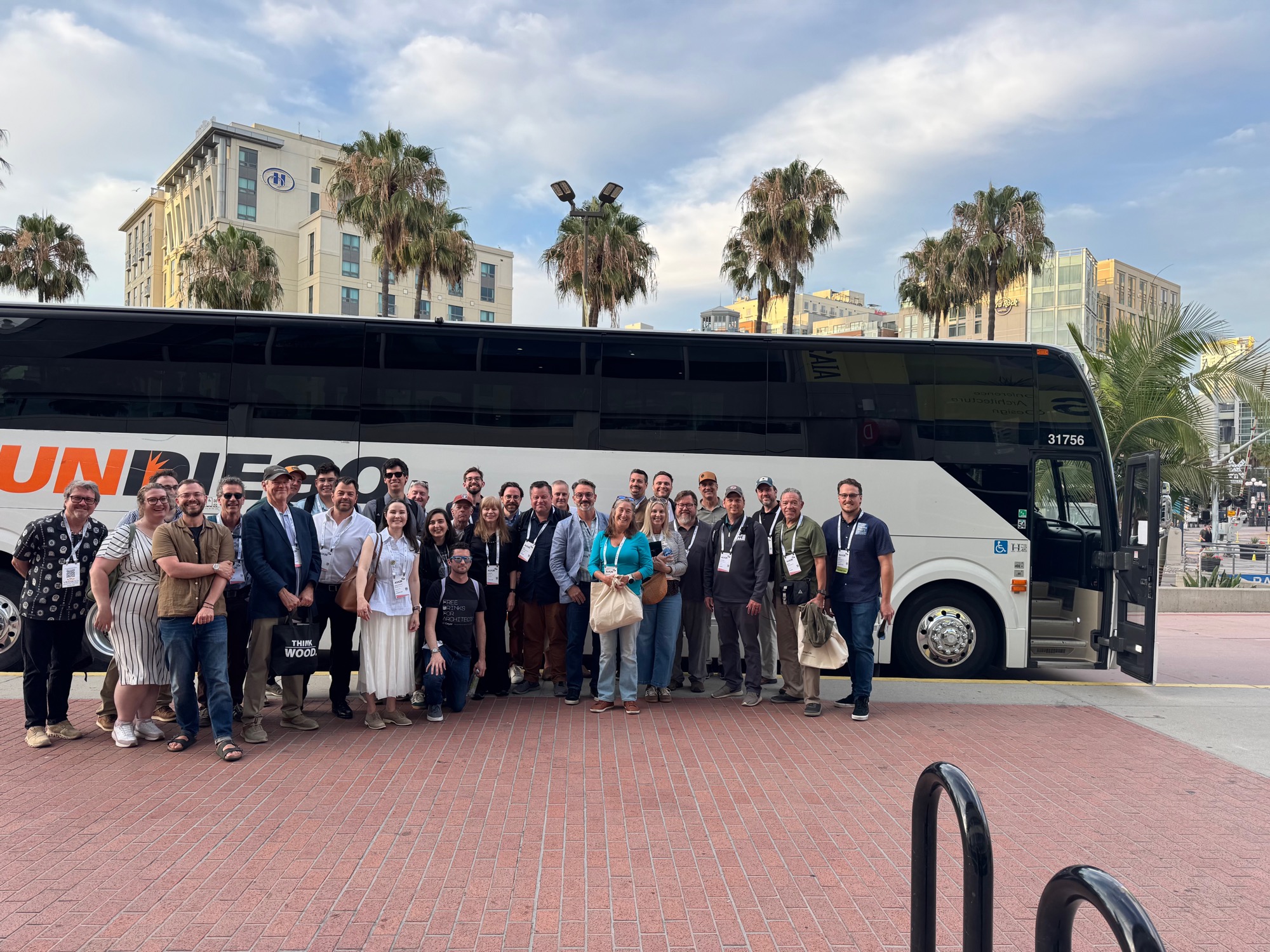
Thanks again to Agustina Aboy and Daniel McDermott for co-organizing the AIA San Diego conference tours with me: ET133 Sustainability on Tap (the Wednesday architecture walking tour) and ET176 (the Thursday beer tasting). Agustina led the architectural narration. Daniel handled the carbon and greenhouse-gas accounting.
Sources. Population figures are from US decennial census counts for the City of San Diego. The Wonder Bread Building dates, the HRB Site #458 designation, and the SOHO 2007 settlement follow SOHO's Warehouse District record and the City of San Diego HRB record. The Sinclair Collection details follow Bob Sinclair's profile in the San Diego News. The Great White Fleet's San Diego visit follows the City of San Diego digital archives. The tuna fleet boat changes follow the San Diego Reader's anatomy of a tuna clipper and the San Diego History Center's origins of California's high-seas tuna fleet. The Little Italy Association founding follows their own site. The Naval Training Center Historic District details follow the National Register listing record.