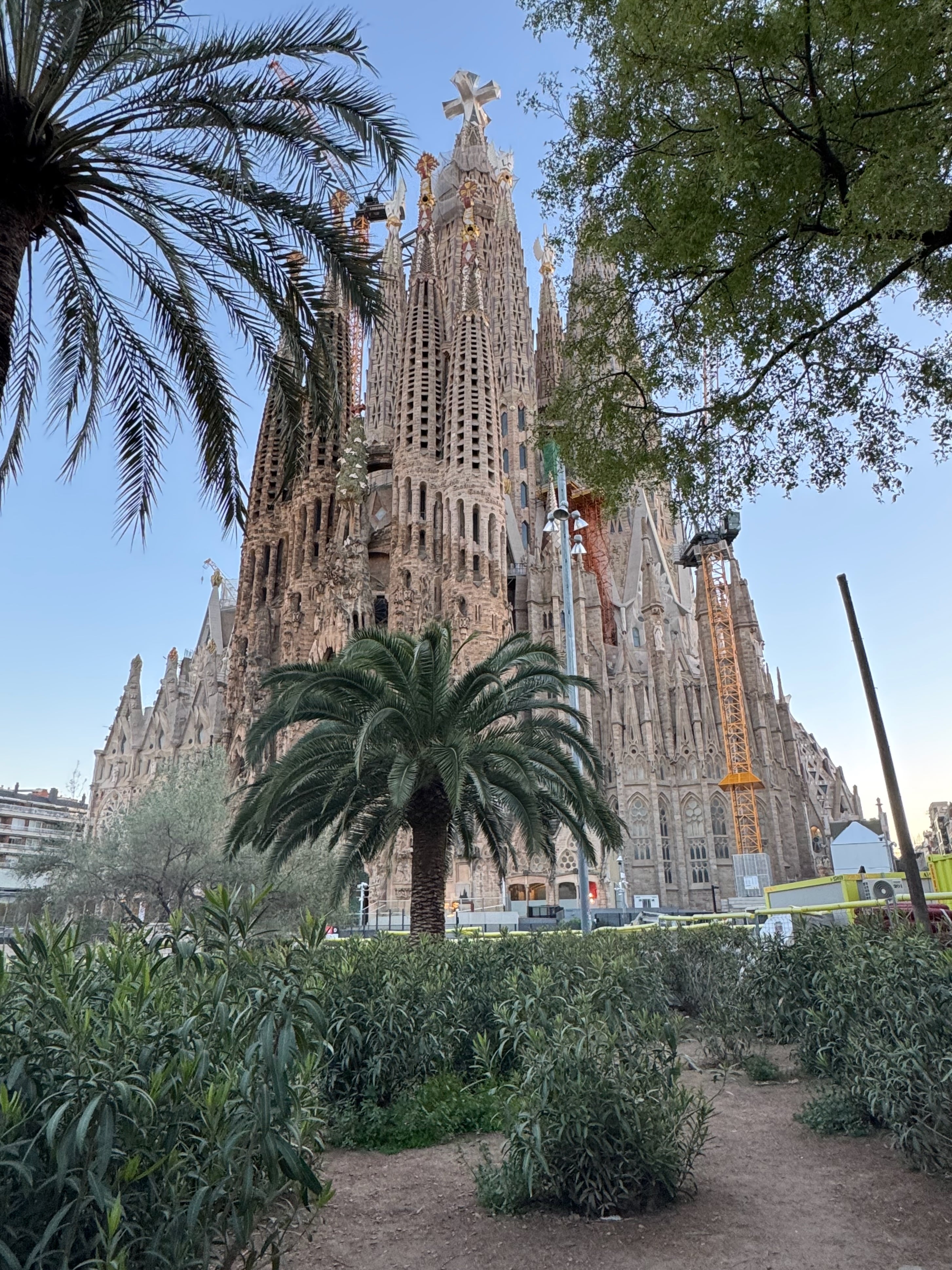
Antoni Gaudí
My guide to Antoni Gaudí's architecture in Barcelona. The Sagrada Família, Park Güell, Casa Batlló, La Pedrera, and how to book the ones that sell out.
- Updated
- Jul 24, 2026
- Saved places
- 9
On this page
Antoni Gaudí shaped the look of Barcelona more than anyone, and seven of his buildings now share a single UNESCO listing. This is my Gaudí trail: which works to see, how to book the ones that sell out, and the two that sit outside the city. For the rest of Barcelona, see that guide.
Planning brief
Planning a Gaudí trip
Antoni Gaudí, the Catalan architect who died in 1926, shaped the look of Barcelona more than any other single figure. Seven of his works are inscribed together as a UNESCO World Heritage Site, and most cluster within the city. This guide is the Gaudí trail, covering what to see, how to book it, and the two sites that sit outside Barcelona.
Group sites by area
Casa Batlló and La Pedrera sit on Passeig de Gràcia. Park Güell and the Sagrada Família need separate journeys.
Book everything in advance
The Sagrada Família, Park Güell, Casa Batlló, and La Pedrera all sell timed tickets that sell out in peak season. Buying ahead is essential.
The Sagrada Família is the centerpiece
Gaudí's unfinished basilica is the one site to give real time. Book a timed entry, and add the tower lift if you want the height.
Two sites sit outside the city
The Colònia Güell crypt is a short train ride from Barcelona. El Capricho is far north in Comillas, a separate trip entirely.
Places in Barcelona
Planning the route
The sites sit in different parts of Barcelona. Put Casa Batlló and La Pedrera together on Passeig de Gràcia. Casa Vicens is farther north in Gràcia. Park Güell and the Sagrada Família each need a separate timed entry and journey. Palau Güell is just off La Rambla.
The Colònia Güell crypt is outside Barcelona. El Capricho is in Cantabria and belongs to a separate northern Spain route.
Booking the Gaudí sites
This is the part that decides the trip. The Sagrada Família, Park Güell, Casa Batlló, and La Pedrera all sell timed-entry tickets through their official websites, and in peak season they sell out days in advance.


Book as early as you can, and buy only through the official sites, not the resale listings that pad the price. Walking up and hoping for a same-day ticket is how people miss the Sagrada Família. Park Güell in particular limits how many visitors enter the monumental core each half-hour, so the slot matters.
The Sagrada Família
La Sagrada Família is the centerpiece and the site I prioritize. Gaudí's basilica has been under construction since 1882 and is still unfinished. Inside, branching stone columns rise into a canopy while colored glass changes the light across the church.
The basic ticket covers the basilica and the museum. A separate add-on is the lift up one of the towers, for a close look at the spires and a view over the city. Tower slots are limited, so book the add-on with the entry if you want the height. If you see only one Gaudí site, see this one.
The Gaudí houses
Gaudí built a series of private houses across the city, and three of them anchor a Gaudí walk through the Eixample and Gràcia.
Casa Batlló, on Passeig de Gràcia, is the most theatrical, a remodeled house with a rippling, bone-and-mask facade and a scaled, dragon-backed roof. A short walk up the same street, La Pedrera, or Casa Milà, is the wave-fronted stone apartment block whose rooftop of sculpted chimneys is the highlight. Casa Vicens, in Gràcia, is Gaudí's first major house, an early tile-clad work that shows the style before it loosened.
A lesser-seen work is the Col·legi de les Teresianes, a convent school Gaudí designed with long parabolic-arched corridors. It is a working school, so public access is very limited. Check ahead before counting on a visit.
Park Güell and Palau Güell
Park Güell is Gaudí's hillside park, planned as a housing estate that was never completed, and now a public park whose monumental zone holds the mosaic-tiled terrace, the serpentine bench, and the famous tiled lizard. The monumental core is the ticketed, timed-entry part, and the wider park around it is free.

Palau Güell, just off La Rambla, is an earlier work, a dark, richly built mansion Gaudí designed for his patron Eusebi Güell, with a notable parabolic-arched hall and another roof of colorful chimneys. It is the most central of the Gaudí sites and the least crowded of the major ones.
Beyond Barcelona
Two sites sit outside the city. The Cripta de la Colònia Güell, the crypt of an unfinished church in the industrial village of Colònia Güell at Santa Coloma de Cervelló, is a short FGC train ride from central Barcelona. Gaudí used it as a structural testing ground for the Sagrada Família.
El Capricho is the outlier. It is an early, brightly tiled Gaudí villa in Comillas, on the northern coast of Cantabria. It is nowhere near Barcelona.
Quick answers
- How should I group the Gaudí sites?
- Put Casa Batlló and La Pedrera together on Passeig de Gràcia. Casa Vicens is farther north in Gràcia. Park Güell and the Sagrada Família each need their own timed entry and journey. Palau Güell is just off La Rambla. The Colònia Güell crypt is outside Barcelona.
- Do I need to book Gaudí sites in advance?
- Yes, for the major ones. The Sagrada Família, Park Güell, Casa Batlló, and La Pedrera all sell timed-entry tickets through their official websites, and in peak season they sell out days ahead. Book as early as you can, and buy only through the official sites to avoid resale markups. Walking up and hoping for a same-day ticket is how people miss the Sagrada Família entirely.
- Which Gaudí site should I prioritize?
- The Sagrada Família, without much competition. Gaudí's unfinished basilica is unlike any other building, and the interior, a forest of branching columns under colored light, is the reason to give it real time. If you see only one Gaudí site, see that one. Park Güell and Casa Batlló are the next tier.
- Are all of Gaudí's works in Barcelona?
- Most are, but not all. Seven Gaudí works hold UNESCO World Heritage status together, and the bulk are in or near Barcelona. The Colònia Güell crypt is in Santa Coloma de Cervelló, a short train ride outside the city. El Capricho, an early Gaudí villa, is far away in Comillas on the northern Cantabrian coast, and belongs to a separate northern Spain trip.