Wat Phra Chetuphon Wimon Mangkhalaram Rajwaramahawihanattraction
Wat Arun Ratchawararam Ratchawaramahawihanattraction
Khao San Roadattraction
Hyatt Place Bangkok Sukhumvit 24hotel
+2
Benchasiri Parkpark
InterContinental Bangkokhotel
Joan Mum Tuek Cafe Koh Kretrestaurant
Wat Sala Kunattraction
Plan Bangkok
Current conditions and the practical reference material that helps turn the saved places into a trip.
The next week in Bangkok
7-day forecast from Open-Meteo. UV badges flag days when sun protection matters (3 and above is moderate; 8 and above is risk territory for unprotected fair skin within 30 minutes).
Today
Thunderstorm
32° / 26°
4.5 mm
UV Very high
Wed
Thunderstorm
32° / 26°
14.0 mm
UV Very high
Thu
Showers
31° / 26°
7.3 mm
UV Moderate
Fri
Thunderstorm
32° / 27°
9.0 mm
UV Very high
Sat
Thunderstorm
30° / 27°
11.7 mm
UV High
Sun
Thunderstorm
31° / 27°
7.8 mm
UV Moderate
Mon
Drizzle
30° / 27°
1.6 mm
UV Moderate
Climate
Wet season (May-Oct)
About 85% of the year's rain falls in these months. Typical highs around 31°C, lows around 24°C.
Dry season (Nov-Apr)
About 34mm of rain a month, against 193mm in the wet season.
In August 4
Drag to scrub across the year.
JFMAMJJASOND
Weather
31° / 24°
Typical high / low
6 mm rainfall this month
Daylight
12.6h
06:05 – 18:40local
Festivals around this date
Airports
closest DMK · 21 km
Getting around Bangkok
Public-transit operators within 8 km of the city center. Click through to each operator’s site for routes, fares, and tickets.
Local transit operators
บริษัท ทางด่วนและรถไฟฟ้ากรุงเทพ จำกัด;Bangkok Expressway and Metro Public Company Limitedกรุงเทพมหานคร;Bangkok Metropolitan Administrationองค์การขนส่งมวลชนกรุงเทพ (ขสมก.);Bangkok Mass Transit Authorityบ.กรุงเทพธนาคม;The Krungthep Thanakom Co.,Ltdบริษัท ระบบขนส่งมวลชนกรุงเทพ จำกัด;Bangkok Mass Transit System Public Company Limitedกรมการขนส่งทางบก;Department of Land Transportบ.ครอบครัวขนส่ง;Family transport company
About Bangkok
Bangkok, officially known in Thai as Krung Thep Maha Nakhon and colloquially as Krung Thep, is the capital and most populous city of Thailand. The city occupies 1,568.7 square kilometres (605.7 sq mi) in the Chao Phraya River delta in central Thailand and has an estimated population of 11.4 million people as of 2024, 15.9% of the country's population. Over 17.4 million people live within the surrounding Bangkok Metropolitan Region as of the 2021 estimate, making Bangkok a megacity and an extreme primate city, dwarfing Thailand's other urban centres in both size and importance to the national economy.
The links below support the changing or licensed reference material on this page. Personal notes and ordinary geographic facts are not footnoted individually.
City background. Wikipedia summary may be clipped or paraphrased. Structured fields are cross-checked against the related references.
highlowrainfallcomfortable months
Monthly highs, lows, rainfall — long-term averages, NASA POWER.
สำนักงานจัดการทรัพย์สิน จุฬาลงกรณ์ มหาวิทยาลัย;Property Management of Chulalongkorn University
การรถไฟแห่งประเทศไทย (รฟท.);State Railway of Thailand
บริษัท รถไฟฟ้า ร.ฟ.ท. จำกัด;S.R.T. Electrified Train Company Limited
บ.สุภัทรา;Supattra Travel Co.,Ltd
บริษัท ขนส่ง จำกัด (บขส.);The Transport Company Limited
การรถไฟฟ้าขนส่งมวลชนแห่งประเทศไทย;Mass Rapid Transit Authority of Thailand
Bangkok is huge. Pick a base that matches the part of the city you want, then move by river and BTS instead of fighting the traffic. Here's how I'd plan the city itself. The country-level version is in my Thailand notes.
Planning brief
Planning Bangkok
Bangkok gets easier when you pick a base for the kind of day you want, use transit instead of fighting traffic, and group the old-city temples near the river. The first day after a long-haul flight, walk the BTS mall spine instead of forcing temples.
Pick a base that matches the trip
Sukhumvit is the convenient international option (Phrom Phong puts the Em District at your doorstep). Silom is the business-and-park compromise. Riverside is calmer and ferry-friendly for the old-city temples. Khao San is backpacker territory. Stay there only if that is the trip you actually want.
Stop fighting the traffic
Use the BTS Skytrain, the MRT subway, the Chao Phraya river ferries, and Grab. Bangkok is still cash-driven, so keep some baht on hand. Grab drivers will sometimes cancel card-payment rides. If you take a metered taxi, make sure the meter starts.
Walk the malls on travel-hangover days
MBK at National Stadium, Siam Center and Siam Paragon at Siam, CentralWorld at Chit Lom, then the Em District (Emporium, EmQuartier, Emsphere) at Phrom Phong. Air-conditioned the whole way, plenty of food, low impact for a jet-lagged first day.
Group the river temples
Wat Phra Kaew and the Grand Palace, Wat Pho, and Wat Arun all sit close to the river. Walk the first two, take the cross-river ferry to the third, and you have a clean half-day without taxis.
The easiest time to be outside. Mornings are pleasant, afternoons in the high 20s°C, low humidity. Peak season, so book hotels early.
Hot and dry
February to early April
Daily highs 30–35°C, afternoons feel heavier than the number suggests. April is the hottest month and Songkran (the water-throwing new year) takes over the city in mid-April.
Hot and wet
May to October
Afternoon thunderstorms most days, but rarely all-day rain. The city is much less crowded and hotels drop in price. Pack an umbrella and plan around the storm window.
Festivals and big annual events
Bangkok has two festival checks for most visitors: Songkran in April and Loy Krathong in November.
Event
When
What it changes
Songkran
April 13 to 15
Three-day water fight centered on Khao San Road and Silom. Book early and waterproof everything
Loy Krathong
Early to mid-November
Floating offerings on the Chao Phraya and temple ponds at dusk
Yi Peng
Same date as Loy Krathong
Bangkok has a smaller version, but the sky-lantern trip belongs in Chiang Mai
Chinese New Year
Late January or February
Yaowarat gets dragon dances, food specials, and heavy crowds
Royal holidays
July 28 and August 12
Some official sites close and the city decorates in royal colors
Vegetarian Festival
Late September or early October
Chinatown food stalls switch to vegetarian dishes marked with yellow flags
Getting to and from the airport
Most central Bangkok hotels sit about an hour by road from either airport, traffic depending. Plan that into your arrival day rather than assuming you will check in twenty minutes after wheels-down.
Suvarnabhumi (BKK) is the larger airport and the more likely first arrival. Don Mueang (DMK) is the older airport and serves most of the low-cost regional carriers.
For a late-evening arrival, DMK is usually the friendlier of the two. It is closer to most central hotels, and the traffic thins out enough after 10 p.m. that one hour door-to-door is realistic. BKK is bigger, immigration takes longer, and ground transport also takes longer, even at midnight.
Solves the long leg only. You still need a Grab from Phaya Thai
Official metered taxi
BKK / DMK
~60 min
Late arrivals, large parties
The kiosk-and-stall ritual. Drivers may try a flat fare or skip the meter
Grab
BKK / DMK
~60 min
Easiest with luggage
Some drivers quietly cancel card-payment rides. Keep cash
SRT Red Line
DMK
Slow with luggage
Cheap and you are already at Don Mueang
Skip unless pricing matters more than time
The official taxi rank ritual. At BKK, take a number from the kiosk at the curb, walk to the assigned numbered stall, and confirm the meter is on before you pull away. Ignore anyone offering a ride inside the terminal.
What it should cost you, May 2026. The realistic range to a central Sukhumvit, Silom, or Riverside hotel via metered taxi is around 400 to 500 ฿ all-in (the meter runs 250–400 ฿, plus a 50 ฿ airport surcharge, plus 25–75 ฿ in expressway tolls that you pay in cash from the back seat). Grab runs roughly the same with mild surge during peak hours. The catch is that even official drivers will sometimes refuse to start the meter and try to agree on a flat fare instead. Flat quotes at the rank typically come in at 500 to 800 ฿ for the same trip. If a flat fare is the only thing on offer, "500 baht" is a fair price to a central hotel and a clean confident number to push back with. Drivers will often agree to that rather than re-queue. Above 600 you are overpaying. Prices change, fuel and tolls drift, so check a current source on arrival day if you want a tighter number.
Cash matters more than most travelers expect. Bangkok is still a cash-friendly city. Pull a few thousand baht from an airport ATM on the way out so tolls, taxis, and street food don't slow you down.
For an early flight. If you have a 6 a.m. departure out of BKK, the easy answer is the Hyatt Regency Bangkok Suvarnabhumi. Older property, large pools, an outdoor bar, a couple of restaurants, FoodPanda delivery if those are closed by the time you check in, and a walk-over to the terminal in the morning. The walk has a few curbs to negotiate with luggage, but it beats fighting the airport at 4 a.m. with a Grab.
Moving around the city
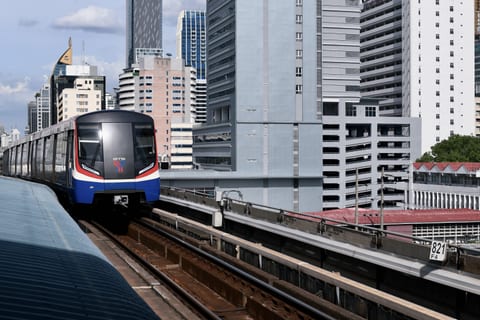
Use the BTS Skytrain, the MRT, the Chao Phraya river ferries, and Grab. Between those four you can reach almost anything you want to see without negotiating a tuk-tuk or guessing whether your driver took the long way. The BTS sells single-journey cards at every station, plus a reusable Rabbit card and a one-day pass. The MRT Blue and Purple lines now use EMV contactless bank-card tap. The Airport Rail Link handles Suvarnabhumi to Phaya Thai, and the SRT Red Lines matter mainly for Don Mueang Airport or northern rail trips. Tuk-tuks are fine for the experience once. Agree on the price first and then go back to better transport.
The Chao Phraya makes the old-city temples easier to understand than another cross-town car ride.
The river is the part most first-time visitors miss. The Chao Phraya Express Boat runs north–south on a regular schedule from Sathorn Pier (the BTS interchange at Saphan Taksin), the cross-river ferries are a few baht, and the older ceremonial city sits close to the water for a reason. Use the river when Wat Pho, Wat Arun, or the Grand Palace is on the plan. You will save an hour and learn the city's geography in the process.
The payment headache is mostly that Bangkok has several good systems rather than one unified one. BTS is Rabbit/single-journey/one-day pass territory. MRT Blue/Purple is contactless bank-card territory. Airport Rail Link is a cheap airport train with separate ticketing. If the route is clean, use rail. If it turns into two transfers and a hot walk, call Grab.
Where to stay
Three trip shapes set the base differently.
Quick answers
How do I get from BKK or DMK to the city center?
Most central hotels are about an hour by road from either airport. From Suvarnabhumi (BKK), the three reasonable options are the Airport Rail Link to Phaya Thai BTS (cheapest, about 30 minutes, plus a final-mile taxi or Grab), Grab (easiest with luggage. Keep some cash because some drivers cancel card-payment rides), or the official taxi rank (take a number from the kiosk, go to the assigned stall, confirm the meter is on before you pull away). From Don Mueang (DMK), Grab or the official taxi rank are the cleanest options. Skip anyone offering you a ride inside the terminal.
Where should I stay in Bangkok for a first visit?
Sukhumvit is the easiest base for a first trip, with BTS at the door, restaurants, malls, and hotels at every budget. Silom works if you want a more business-district rhythm and proximity to Lumpini Park. Riverside is calmer and better for the old-city temples but more expensive. Avoid Khao San unless you specifically want backpacker Bangkok.
How much time should I give Bangkok?
Two to four days covers the old-city temples, one or two markets, the river, and a Chinatown food night without burning out. Add a day if you want a real museum afternoon (the Jim Thompson House and the Bangkok National Museum both reward a slow visit) or a day trip out of the city.
When is the best time to visit Bangkok?
November through February is the cooler-and-drier window. February and March are warm and mostly dry, with afternoons that feel heavier than the temperature suggests. April is the hottest month. May through October is the wet season. Afternoon storms are common but rarely all-day.
Should I make time for the floating markets?
They are a half-day trip west of the city, popular for the boat ride and the photos. Damnoen Saduak and Amphawa are the two main ones, and both draw crowds, so go early. If your days are short, Chinatown and Chatuchak are closer and need no van transfer.
If you arrived on a long-haul flight and outdoor temples are too much for the first morning, Bangkok has an easy answer. You can spend a day walking from one mall to the next without ever leaving the BTS spine and without being outside in the heat for very long. I have done this loop more times than I can count, often with friends or visiting siblings, and the appeal does not wear off because there is always a new food stall to try in one of the food halls. The malls are connected to the train, the train is air-conditioned, and the sequence runs roughly older-and-weirder to newer-and-slicker as you move east.
The Bangkok scams that affect first-time visitors cluster around the Grand Palace area. They are not subtle once you know the shape.
"The Grand Palace is closed today." No one standing outside is going to tell you the truth about whether it's open. The palace runs daily 8:30 to 15:30 and is essentially never closed for a "Buddhist holiday" or a "VIP visit." The person telling you it's closed has a tuk-tuk waiting to take you to a gem shop or a tailor where they earn commission. Walk past, enter the gate yourself, see for yourself.
The "special tour" tuk-tuk for 20 baht. No tuk-tuk driver is going to give you an hour of their time for 20 baht out of love for the city. The route is: temple, gem shop, tailor, temple, gem shop, tailor. You buy a "ruby" that is glass. Take a metered taxi or a Grab to the temple and ignore the tuk-tuks parked outside.
The gem export "investment." Anyone explaining how you can buy gems in Bangkok and resell them at home for profit is running a fraud. Thai jewelry from a normal shop at a normal price is fine. Thai jewelry from someone who approached you on the street is not.
Bargirl drinks and bill switching. This is the Patpong / Soi Cowboy version. A bar will hand you a "menu" with one price and the bill at the end with another. If you sit down anywhere where a woman invited you in, read the bill carefully and expect to negotiate. The cleaner answer is to drink at a normal bar.
The closed-currency-shop / wallet-snatch combo near MBK. Less common than it used to be but still happens. Use the bank ATMs inside MBK, not a money changer that flagged you down on the sidewalk.
The temples themselves are safe. The walk between them is the part to mind.
Khao San at night
I would not stay on Khao San Road, but I will go for an evening. The street is what it advertises: cheap beer, neon, fried scorpions for the photo, hair-braiding stalls, live cover bands, very loud, very international. If the version of Bangkok you want is "out late, walking, eating bad-for-you things," Khao San is that street and you do not have to wake up there.
Khao San is best treated as a contained evening hit: loud, walkable, and useful for one dose of backpacker Bangkok before you head back to a better base.
The version that works: take a Grab in around 8 or 9 p.m., walk Khao San and the parallel Soi Rambuttri (which is the calmer adult cousin of the same street), eat one or two stalls, have a drink, Grab back to your hotel. A couple of hours is the right dose. It pairs well with a temple morning, since the old city is right there.
Cultural deep cuts
Two non-temple stops to slot into a longer Bangkok trip if you have time for one or both.
Jim Thompson House is the museum I would put on a first Bangkok trip if you only have room for one. It is six traditional Thai houses combined into a single compound by an American silk-business expat in the 1950s, and the collection inside is mostly Southeast Asian art he assembled. The compound itself is the reason to go: shaded teak rooms, garden, a working canal-side setting in the middle of the city. Closest BTS is National Stadium.
The Bangkok National Museum is the deeper-context complement to the Grand Palace. About a 10-minute walk across Sanam Luang from the royal precinct and far less crowded, with the same era covered in more detail. Open Wednesday through Sunday. Closed Mondays and Tuesdays. Skip if museums are not the trip. Pair with the old-city temples if they are.
What can I actually do on the first day after a long-haul flight?
Walk the BTS mall spine. Start at MBK at National Stadium (older, independent stalls, Thai food court), take the skybridge to Siam Center and Siam Paragon at Siam, ride one stop east to CentralWorld at Chit Lom, then ride out to Phrom Phong for the Em District (Emporium, EmQuartier, Emsphere). Air-conditioned the whole way, low impact, plenty of food. Save the temples and Chinatown for day two when you actually want to be outside.

 +2
+2 +2
+2 +2
+2 +12
+12
 +2
+2