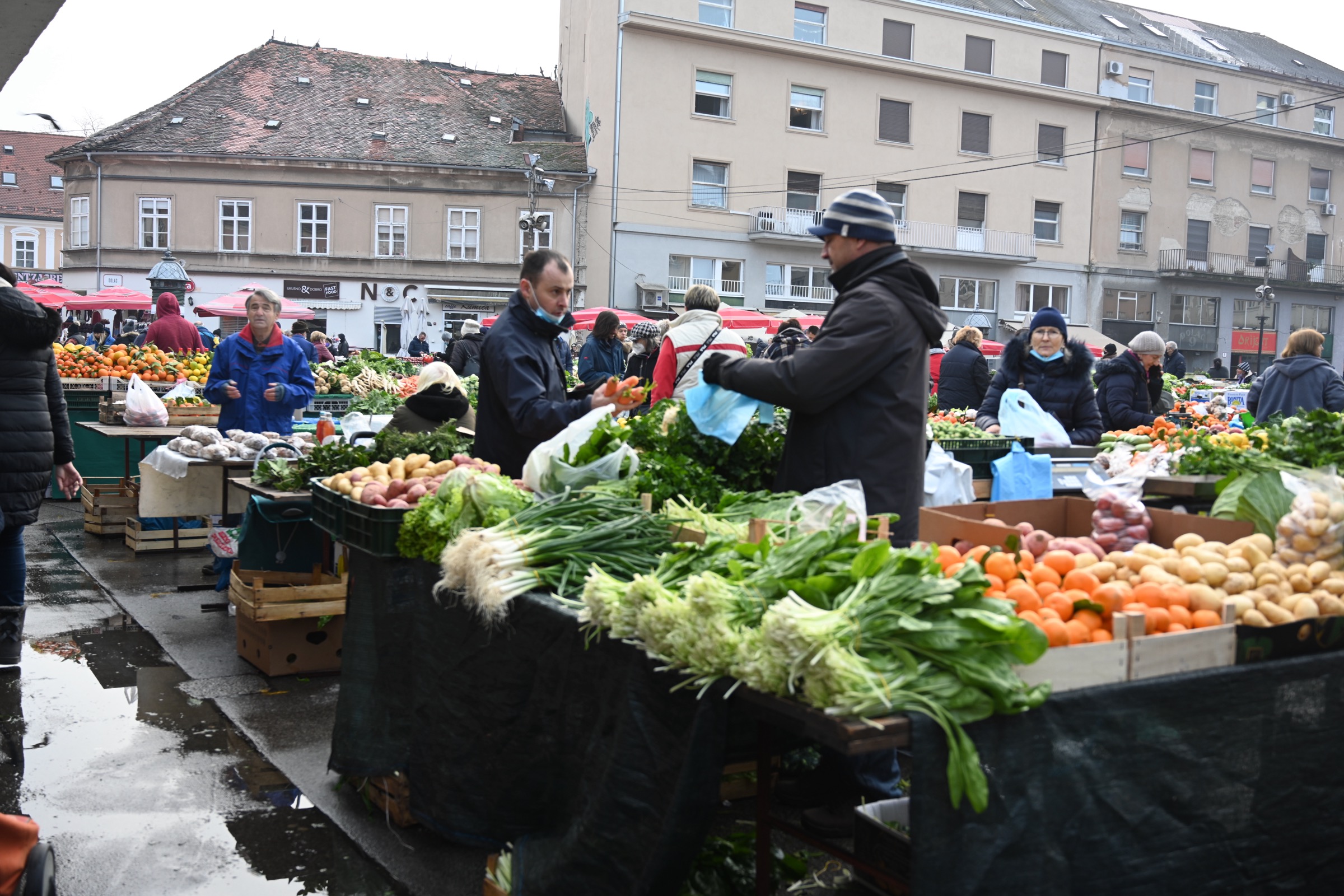
When I stay somewhere for four to eight weeks, I usually end up cooking more than I eat out. Green markets become part of the routine: morning fruit, tomatoes that actually taste like tomatoes, greens for dinner, honey to bring home, and sometimes a bottle of local olive oil or rakija from someone who makes it themselves.
That is different from visiting a market once as a sight. The same place can be both useful and performative, and the balance changes by city. Split Green Market, also called Pazar, beside Diocletian's Palace, is still worth walking through, but it has become partly a visitor attraction. If you were living in Split for several weeks and bought everything there, you would probably overpay. Many local people do more of their ordinary shopping elsewhere.
The cleaner version is somewhere like Zelena Pijaca Bar in Bar, Montenegro: less English, fewer posted prices, smaller tables, and more produce that looks as if it came from someone's plot that morning. The advice below works best in places like that, but it still helps you read the more touristed markets without treating them as fake.
Markets Linked From This Guide
The list is not meant to be complete. It is a working set of markets that help explain the range: old-town visitor circuit, everyday neighborhood shopping, and larger city markets where a longer stay starts to feel practical.
- Dolac Market, Zagreb
- Split Green Market (Pazar), Split
- Zelena Pijaca Bar, Bar
- Kalenić Green Market, Belgrade
- Zeleni Venac, Belgrade
- Pijaca Markale food market, Sarajevo
- Kotor Food Market, Kotor
- Obor Market, Bucharest
First, Decide What Kind of Market You Are In
Some markets are still primarily neighborhood food markets. Some are mixed. Some, especially in old-town cores or cruise-heavy cities, now function partly as a stage for visitors. That does not make them useless. It changes how I use them.
In a tourist-heavy market, I might buy figs, honey, dried herbs, or a small bottle of local alcohol, then do regular groceries somewhere else. In a working local market, I am more likely to buy the week's vegetables, eggs, cheese, and whatever fruit is in season.
The quick test is the tables. If every stall has the same polished produce stacked high, you are probably looking at resellers. If a table has six cucumbers, ten tomatoes, a bunch of swiss chard, a few potatoes, and not much else, there is a better chance the seller grew it or brought it from a small plot.
Buy From Small Tables
The best table is often not the prettiest one. It is mixed, uneven, and limited. The seller has what was ready that morning, not every vegetable a shopper could imagine.
That usually means:
- A few bunches of greens
- Tomatoes in mixed sizes
- Cucumbers that are not identical
- Potatoes with dirt still on them
- Figs, grapes, or stone fruit only when the season is right
If the table looks like more than one household could grow, it may be wholesale produce being resold as local. That is not a moral failure. It is just not the reason I go to these markets.
Ask Before Handling Produce
There is a small etiquette to getting the good produce without being annoying. Do not walk up and start pawing through the table in silence. Say what you want, ask for a bag or hand over your own, and then choose the pieces if that seems welcome. In some places the seller will expect to pick for you. In others, choosing your own is normal once you have asked.
If someone fills the bag for you and slips in a bruised tomato or two, that is not unusual. I would rather pick my own when the situation allows it, but the first rule is still to be polite. Markets are working spaces, not photo sets.
Go Early if You Are Actually Shopping
Most markets open early. By mid-morning, the best small tables are picked over, and by noon you are often looking at whatever did not move. If I am buying food for an apartment, I try to go before nine.
Longer stays make this easier. If you return to the same stall every few days, the seller starts to recognize you. That is when shopping gets better: prices feel less performative, small extras appear, and the whole exchange becomes less like a transaction with a visitor.
Things Visitors Get Wrong
Do not haggle over produce. This is not the setting for it. Prices are already low by most visitor standards, and the money matters more to the seller than the tiny saving matters to you.
Do not pose with fruit, take photos of someone's table for a minute, and then walk away as if the market exists for your camera. If you want a photo, buy something.
Bring cash in small local denominations. Some stalls have digital scales, some still use older spring scales, and many sellers do not want to break a large note for a small purchase. If the total comes out awkwardly, a seller may round it by adding a few extra pieces. Sometimes that is a bargain. Sometimes it is produce that needs to move. Decide based on the produce, not the convenience.
Look Beyond the Formal Stalls
Outside the formal market, you will often see older people selling small piles of produce from a blanket, crate, or tarp. These are usually retired farmers, villagers, or people with garden surplus rather than full-time vendors.
I buy from them when the produce looks good. The quantities are small because the source is small: a few onions, some greens, a bag of potatoes, figs in season, herbs tied with string. It is often the freshest thing on offer, and it also matters because pensions for retired farmers in this part of the world can be thin.
This is not where you go with a shopping list. It is where you buy what ripened.
What Is Worth Bringing Home
Green markets are good for apartment cooking, but they are also good for small gifts. Honey is the easiest one for me. A sealed jar travels better than fresh produce or cheese, and it is often easier to bring through customs than many other food products, though you should still check the rules for your destination.
Olive oil, rakija, and local liqueurs can also be good gifts if they are sealed properly and you can pack them safely. I would be more cautious with soft cheese, prosciutto, open pickled vegetables, or anything that depends on refrigeration or has import restrictions.
For eating during the stay, I look for:
- Figs, grapes, cherries, or stone fruit in season
- Fresh honey
- Greens and tomatoes for simple apartment dinners
- Olive oil if I trust the source
- Rakija or local liqueur from someone recommended by a host
- Pickled vegetables when they look clean and busy enough to turn over quickly
If you are renting an apartment and your host offers to introduce you to someone who makes olive oil, honey, or liqueur, take the introduction. Pricing is informal, quality is often better than the supermarket, and the exchange is more memorable than buying another packaged souvenir.
The Useful Way to Think About These Markets
Green markets in the Balkans are not all the same anymore. Some are still local food infrastructure. Some are half-shopping, half-theater. Some change character by season, cruise schedule, and neighborhood.
That is fine. I still go. I just do not use every market the same way. In Split, I might walk through Pazar, buy something seasonal, and do practical shopping somewhere else. In Bar, I would build the morning around the market. The point is to read what is in front of you, buy from the people who are actually selling something good, and remember that a market is most interesting when it is still part of daily life.