Buenos Aires Subte
Metro · Buenos Aires · Emova Movilidad S.A. / Subterráneos de Buenos Aires (SBASE)
6 lines · 89 stations · 2 interchanges
Every line drawn through its stations. Tap a line in the legend to hide or show it.
Lines
- Buenos Aires Subte Line APlaza de Mayo <-> San Pedrito18
- Buenos Aires Subte Line BLeandro N. Alem <-> Juan Manuel de Rosas17
- Buenos Aires Subte Line CRetiro <-> Constitucion9
- Buenos Aires Subte Line DCatedral <-> Congreso de Tucumán16
- Buenos Aires Subte Line EPlaza de los Virreyes - Eva Perón <-> Retiro18
- Buenos Aires Subte Line HFacultad de Derecho - Julieta Lanteri <-> Hospitales12
Stations from my trips
Photographs from stations connected to this network.
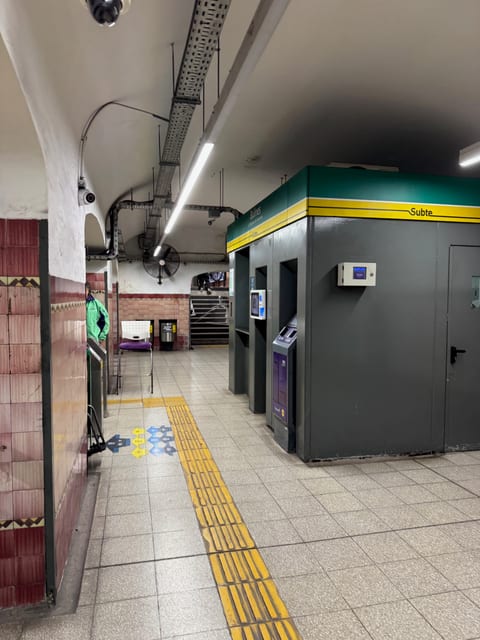 +1
+1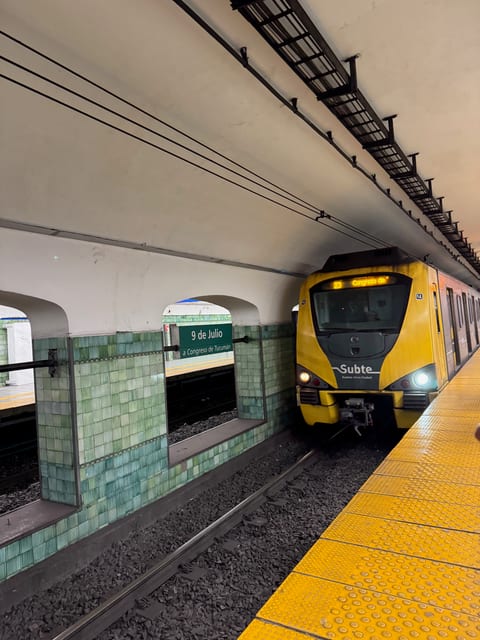 +4
+4Service information checked . Check the operator before travel because schedules can change at short notice.
Quick facts
- Operator
- Emova operates the Subte for the Buenos Aires city subway authority, SBASE.
- Payment
- SUBE works across the Subte, buses, and suburban trains. Subte turnstiles also accept contactless cards, NFC devices, and QR payments.
- I still carry SUBE because it covers the wider Buenos Aires transit network.
- SUBEContactless
- Lines to know
- Line D reaches Palermo and Belgrano. Line C connects Retiro and Constitución. Line A follows Avenida de Mayo.
- Photographed stations
- 9 de Julio is the Line D part of the Obelisco interchange. Bulnes is the Line D stop beside Alto Palermo.
- 9 de Julio Subte StationBulnes Subte Station
- Premetro
- Premetro is a separate surface line from Intendente Saguier to Centro Cívico Lugano and General Savio.
- Change between Line E and Premetro at Plaza de los Virreyes and Intendente Saguier.
- Buenos Aires Premetro
Mike’s notes
The Subte has six underground lines. It covers the center well and reaches north through Palermo and Belgrano, west through Caballito, Flores, and Villa Urquiza, and south toward Parque Patricios. Buenos Aires extends far beyond those corridors, so buses and taxis or rideshare fill many of the gaps.
Line D is the practical line for Palermo and Belgrano. Line C runs between Retiro and Constitución, which makes it useful for rail connections. Line A follows Avenida de Mayo and continues west to San Pedrito. Line B links the center with Villa Crespo and Villa Urquiza.
At the Obelisco, three station names form one transfer complex: 9 de Julio on Line D, Carlos Pellegrini on Line B, and Diagonal Norte on Line C. Underground passages connect them, but the walk between platforms takes a few minutes. Bulnes is farther north on Line D, directly beside Alto Palermo. Neither 9 de Julio nor Bulnes has an elevator in the city's current accessibility dataset.
Line A opened in 1913 as the first underground railway in Latin America. Its wooden La Brugeoise cars were removed from regular service in 2013. The stations and route remain part of the everyday network rather than a preserved tourist line.
The current fleet is a mix of newer air-conditioned trains and much older cars. Lines A, C, D, and H have more air-conditioned equipment, while Line B still uses some of the oldest cars in the system. All lines get crowded during the morning and evening commute, and the older cars can feel hot even outside summer.
I keep a SUBE card available because it also works on buses and suburban trains. Contactless bank cards, NFC devices, and QR payments now work at Subte stations, but those payment options do not replace SUBE across every part of the wider transit network.